
Loading...
Explore our articles and research on global geopolitical issues.

The multidimensional dispute between Iran and the Washington-Tel Aviv axis, transmuted into a kinetic confrontation since February 2026, does not constitute a simple regional crisis, but a catalyst for fragmentation of the world system. The intensity of this crisis corroborates the theses of strategic stagnation, where Israel's preventive posture and the American doctrine of containment aim, through forced decoupling, to neutralize Eurasian influence in the Middle East. The geoeconomic repercussions are structured around four pillars: energy security, global logistics, industrial resilience and macrofinancial balances. Energy Crisis and Flow DisruptionThe partial asphyxiation of the Strait of Hormuz – a strategic lock through which 30% of the world's oil and 17% of the world's gas transit – has generated major exogenous volatility, propelling prices beyond 50% of their pre-conflict value. The profitability differential: The selective blockage (reduction to 5 million barrels/day) highlights a critical asymmetry: while extraction costs in the Middle East remain marginal ($3-10), American shale hydrocarbons require a much higher profitability threshold ($40-60), accentuating global energy inflation. Alternatives and reorientation: If the increase in flow rates via the Abqaiq-Yanbu pipeline (targeting 7 million b/d according to Saudi Aramco) and the Habshan-Fujairah pipeline offers a palliative, the shutdown of the northern routes (Kurdistan, BTC) limits the compensation. In the medium term, we are witnessing a pivot towards the West: the development of Mediterranean infrastructure secured by American-Israeli influence foreshadows a diversion of resources to the detriment of Asian economies (China, India, Japan). Reconfiguration of Logistics and TradeInsecurity in chokepoints (Bab el-Mandeb, Suez) requires a redefinition of maritime geography. The diversion via the Cape of Good Hope, while it guarantees the continuity of flows for the Atlantic powers, induces a structural increase in costs (20-30%) and an extension of delivery times. The decline of East-West routes: The model of horizontal flows, pillar of liberal globalization, is obsolete. The architecture of the “New Silk Roads” is compromised, apart from its Russian and Central Asian continental segments, themselves burdened by diplomatic ostracism towards Moscow. The emergence of the North-South model: We are observing a transition towards a regionalized model based on nearshoring and friendshoring. This shift favors a reindustrialization of the West and propels Africa and Latin America as new productive lungs, articulated around the energy-water-material nexus. Disruptions and Industrial SovereigntyThe conflict reveals the dependence of processing industries on Middle Eastern inputs (chemistry, metals, helium). The food peril: The tension over fertilizers is symptomatic. Despite the capabilities of leaders like OCP in Morocco, dependence on regional inputs (ammonia) creates a risk of supply disruption. The security strategies of India and the USA illustrate a return to strategic protectionism. Defense economy: The arms sector is emerging as the main beneficiary of this instability, with an acceleration in global military budgets (exceeding $1,781 billion by 2024). War of commodities: China's use of its levers on sensitive technologies (rare earths, PCBs) in response to Western pressure confirms the transition from a market economy to an shortage management economy. Macroeconomic Imbalances and Systemic RiskThe conflict serves as a vector for a struggle for monetary supremacy. Anchoring the dollar to “strategic nexus” trade is a direct response to the desire for dedollarization of the BRICS. Recessionary spiral: Imported inflation forces central banks to tighten monetary policy. The rise in interest rates and the widening of bond spreads (notably between the Bund and the OAT) revive the specter of a fragmentation of the euro zone. Atrophy of growth: The correlation between the rise in oil prices and the fall in GDP (0.5 points of growth lost for 10% increase in price) suggests a lasting global recession, an increase in structural unemployment and an unsustainable deterioration in debt service for the most exposed States. The current confrontation seals the end of the illusion of infinite and deregulated growth. The world is falling into an era of systemic fragmentation where the Middle East remains the pivot of the balance of power between East and West. The viability of the international financial system, still indexed to the petrodollar, is now being tested by a geopolitical reality where supply radically takes precedence over demand. References Clausewitz, C. von: Of War – For the analysis of the continuity of politics through financial means. Mackinder, H.: The Geographic Pivot of History – Relevance of the Middle East/Eurasia zone. Friendshoring Theory (J. Yellen): Analysis of new resilient zones of influence. Reports from the IEA and the World Bank (2025-2026): Data on transport capacities and growth forecasts. Energy-Water-Food Nexus Concept: Sustainable global security analysis framework.

The American-Israeli crisis against Iran from February-March 2026 revealed the vulnerability of the major global energy and logistics balances. The tensions around the Strait of Hormuz have been interpreted by the markets as a risk of blockage (traffic disruptions, additional insurance costs, re-routing, etc.), resilience no longer depends only on power, but also on the capacity to diversify its routes, its partners and its support bases. In this new configuration, Morocco appears as an increasingly credible space of stability, interconnection and strategic projection. A regional crisis with systemic effectsThe American-Israeli war against Iran from February-March 2026 constitutes much more than a military episode confined to the Middle East. It acted as a brutal revealer of the fragilities of the regional security and energy architecture, while accelerating the erosion of a strategic model long associated with Pax Americana. The de facto closure of the Strait of Hormuz has caused a global economic shock. The barrel of Brent exceeded 114 dollars [1], maritime freight costs rose sharply and global financial markets suffered a sharp decline. Among the most notable indicators, the South Korean KOSPI stock index lost up to 12%, while the Japanese Nikkei fell by around 2% and the Dow Jones lost almost 400 points [2]. At the same time, rising tensions have caused gas prices to soar in Europe, which have increased by 50% since March 2 [4]. The economic consequences have also affected other sectors, notably tourism in the Gulf countries, where projections suggest a potential loss of 56 billion dollars and up to 38 million fewer visitors for the year 2026 [5]. Finally, the direct costs of the conflict illustrate the extent of the economic pressures generated by the war. According to some estimates, the Israeli economy would bear a cost of approximately $2.9 billion per week linked to military operations and economic disruption [6]. The shock of 2026 or the end of certainties The sequence of Israel-Iran escalation (with American involvement) has gone beyond the regional framework to establish itself as a real geopolitical shock with systemic effects. It highlighted the limits of a system based both on the centrality of a single energy corridor – the Strait of Hormuz – and on a security architecture largely backed by the United States. This reading is debated: some see that the $2,000 billion in investments promised to the United States may appear less as the price of lasting protection than as the cost of a strategic dependence that has become more uncertain [3]. This shock is not simply cyclical. It reveals a structural transformation. It requires us to rethink the very concept of economic security. For economies whose prosperity relies on the fluid circulation of hydrocarbons and the stability of trade routes, the diversification of logistical and strategic anchorages now becomes an imperative. Morocco, a pole of stability in an uncertain environmentIn this changing landscape, Morocco stands out through a set of attributes that reinforce its credibility as a space of continuity and strategic projection. Its geopolitical value is not only due to its geographical position. It is based on a model combining institutional stability, efficient infrastructure, multidimensional diplomacy and transnational human capital. Consolidated political stability The dynastic continuity and the long-term strategic vision carried by the Monarchy give Morocco continuity in public policies in the region. This stability constitutes a determining factor for long-cycle strategic investments. World-class logistics infrastructureThis port architecture is expected to be strengthened with the rise in power of the port of Nador West Med, located in the bay of Betoya, approximately 30 km west of the city of Nador. Designed as a new generation deep-water port, it is destined to become one of the main logistics and energy hubs in the Western Mediterranean. Its container component provides for an initial capacity of around 3 million TEUs, expandable to 5 million TEUs over time. Taken together, Tanger Med, Nador West Med and Dakhla Atlantique gradually shape a true strategic Moroccan port arc, connecting the Mediterranean, the Strait of Gibraltar and the Atlantic. This increases the value of Morocco as a workaround and continuity solution in the event of stress on the Hormuz–Red Sea–Suez corridors. A multidimensional diplomacy Morocco also stands out for its ability to dialogue with several power centers. It has been a major non-NATO ally of the United States since 2004, a privileged partner of the European Union and a growing player in African integration through the Atlantic Initiative. At the same time, it maintains close relations with China and Russia [9]. Transnational human capitalFinancial transfers from Moroccans living abroad reached $12.9 billion in 2024, or more than 8% of the national GDP [10]. Beyond their economic dimension, these flows demonstrate the depth of the links between the diaspora and the national economy. Three scenarios for the next 6 to 18 months In such an uncertain environment, the scenario method makes it possible to structure the analysis. The first scenario is that of a contained conflict. In this hypothesis, military tensions remain mainly limited to the confrontation between Iran and Israel, without major extension to other regional actors. Disruptions in the Strait of Hormuz remain intermittent, causing regular tensions on energy markets and maritime insurance costs. Oil flows are not permanently interrupted but remain exposed to high security risks. In this context, energy prices remain high and volatile, oscillating around 100 to 120 dollars per barrel, without lastingly crossing critical thresholds for the global economy. The second scenario is that of regional escalation.In this more critical configuration, the conflict is gradually widening by more directly involving certain Gulf actors and their strategic infrastructures. Attacks on energy installations, ports or maritime routes are increasing, leading to a prolonged or partial blockage of the Strait of Hormuz, through which nearly a third of global maritime oil trade passes. Such a situation would cause a major energy shock and could propel oil prices well beyond $130 or $150 per barrel, generating high global energy inflation, financial market tensions and a real risk of a global economic slowdown. The third scenario is that of precarious stabilization.In this hypothesis, international mediation – potentially supported by several powers or international organizations – manages to establish a fragile ceasefire between the parties. Maritime traffic in the Strait of Hormuz is gradually resuming, allowing for relative relaxation in energy markets. Oil prices could then stabilize in a range between $90 and $110 per barrel. However, this stabilization remains structurally fragile: distrust between regional actors persists and states and companies are continuing their strategies of diversifying trade and logistics routes in order to reduce their exposure to future geopolitical shocks. What strategic implications?Faced with these uncertainties, several directions appear possible. Mapping of strategic orientations Horizon 0 – 3 months: security and operational continuity In the immediate phase, the priority is to reduce exposure to logistical and energy disruptions caused by regional instability. Economic and institutional actors must focus on securing trade flows and diversifying operational bases. Several actions can be considered: Building security logistics capacities at Tanger Med, making it possible to secure trade flows to Europe and Africa and to anticipate possible disruptions in supply chains. Strategic audit of logistics and energy chains, to identify critical dependencies linked to the Gulf and Red Sea shipping routes. Partial relocation of strategic functions (logistics management, finance, regional supervision) to stable hubs like Casablanca Finance City. Reinforcement of strategic stocks for sensitive sectors (energy, raw materials, industrial components). Horizon 3 – 6 months: diversification and operational deployment Once operational continuity is ensured, the challenge consists of transforming crisis management into a structural diversification strategy. Initiatives may include: Development of industrial and logistical partnerships around Moroccan infrastructures (Tangier Med, Nador West Med and industrial platforms). Targeted investments in Moroccan economic zones, particularly in the industrial, agri-food and pharmaceutical sectors, in order to strengthen regional production capacities. Establishment of pilot projects in the energy transition, particularly in the green hydrogen sector, an area in which Morocco aims to mobilize 1 million hectares and $35 billion in investments [11]. Structuring alternative logistics corridors linking the Atlantic, Europe and Africa. Horizon 6 – 18 months: strategic integration and African projection In the longer term, the objective becomes the consolidation of a lasting strategic partnership and the gradual integration of initiatives into a broader regional economic architecture. Several axes can be developed: Creation of joint investment vehicles intended to finance infrastructure and industrialization projects in Africa. Strengthening Atlantic economic corridors, linking Morocco to emerging African markets and transatlantic trade routes. Development of regional industrial ecosystems around strategic sectors: energy, logistics, automotive industry, agro-industry and green technologies. Institutionalization of a long-term economic and strategic dialogue between public and private partners in order to anticipate future geopolitical transformations. This gradual approach makes it possible to move from a logic of risk management to a logic of strategic projection, transforming geopolitical uncertainties into opportunities for economic restructuring. Resilience as a new strategic grammarThe crisis of 2026 constitutes an inflection point. She reminds us that security architectures based on too concentrated dependencies inevitably become fragile. In this context, resilience is no longer limited to the ability to resist crises. It is now based on the ability to organize relays of stability, to multiply anchor points and to diversify economic routes. Through its institutional stability, the quality of its infrastructure, the flexibility of its diplomacy and the depth of its human and economic networks, Morocco appears to be one of the most credible spaces to support this transition. In a world where the major maritime routes – from the Strait of Hormuz to the Red Sea, from the Suez Canal to the Strait of Gibraltar – are once again becoming spaces of strategic tension, the capacity to organize alternative logistical continuities becomes a determining factor of economic stability. Through the complementarity of its port infrastructures, from Tanger Med to Nador West Med and up to the future port of Dakhla Atlantique, Morocco is gradually positioning itself as one of the pivots of this new geography of flows. At the crossroads of the Mediterranean, the Atlantic and African dynamics, it tends to embody a true arch of strategic resilience, capable of articulating new trade routes in an increasingly fragmented international system. As Ibn Khaldoun wrote, history does not repeat itself but it teaches. The lesson of this crisis is perhaps the following: in a more fragmented world, strategic autonomy depends less on raw power than on the ability to build lasting continuities. References[1] Reuters. (2026). Oil prices surge above $110 as Middle East tensions threaten Strait of Hormuz shipping.https://www.reuters.com/markets/commodities/ [2] Financial Times. (2026). Global markets slide as Middle East conflict rattles investors.https://www.ft.com [4] The World. (2026, March 5). War in the Middle East: the mechanics of a new economic shock are in place. https://www.lemonde.fr/economie/article/2026/03/05/guerre-en-iran-la-mecanique-d-un-nouveau-choc-economique-est-en-place_6669595_3234.html [5] BFM TV. (2026, March 4). Up to 38 million fewer visitors and $56 billion in lost revenue in 2026. https://www.bfmtv.com/economie/international/until-38-millions-of-visitors-in-minus-and-56-billion-de-dollars-de-miss eu-to-win-in-2026-the-conflict-in-the-middle-east-threatens-the-lucrative-tourism-sector-in-the-gulf_AV-202603040534.html [6] Arab News. (2026, March 4). Damage to Israeli economy from Iran war could top $2.9 billion a week. https://www.arabnews.com/node/2635242 [7] Tangier Med. Port and Logistics Center. https://www.tangermed.ma/fr/pole-portuaire-et-logistique/ Gulf: the Iran–United States war puts an end to fifty years of Pax Americana
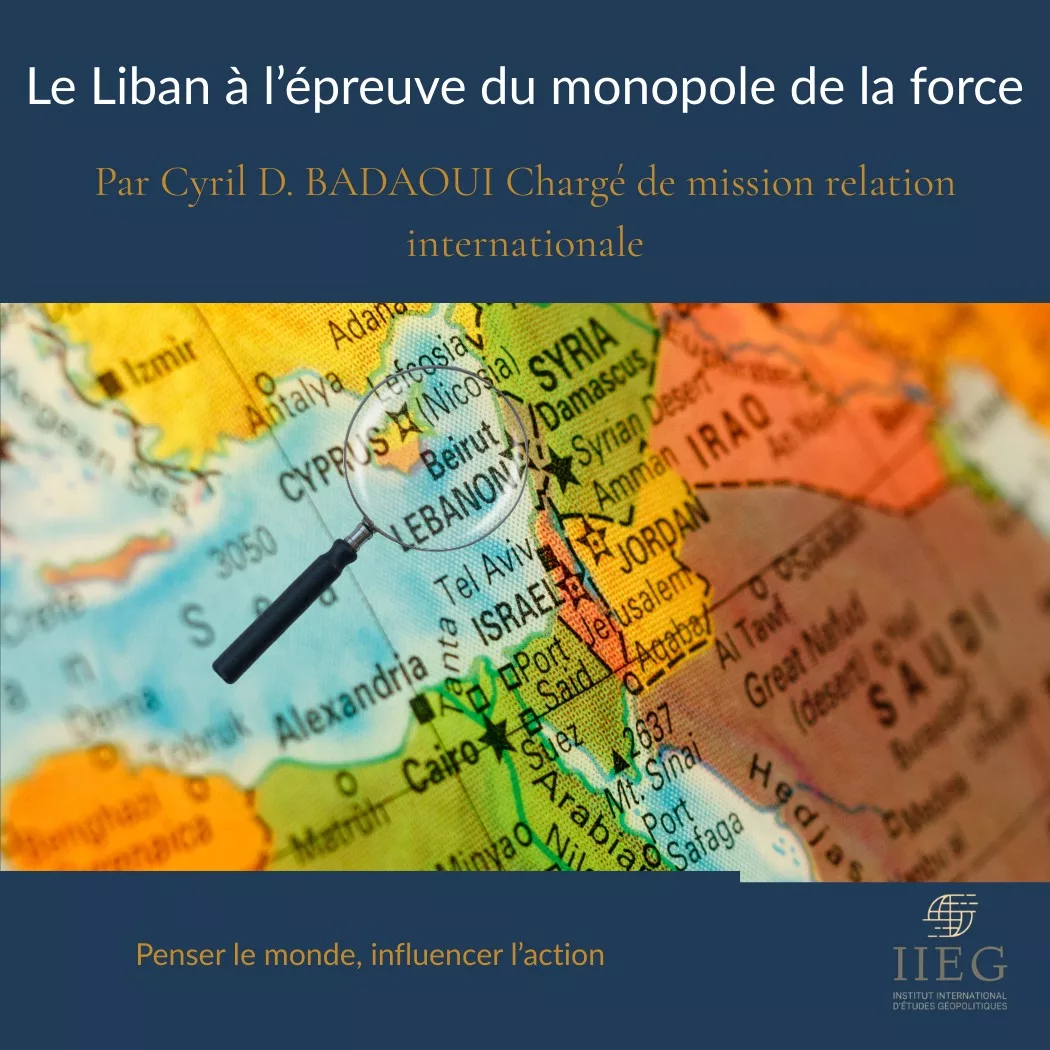
The decision of the Lebanese Council of Ministers of March 2, 2026 (Annex 1) prohibiting any security or military activity of a non-state armed actor and instructing the legitimate Lebanese armed forces to take possession of its weapons constitutes a pivotal moment for the Lebanese state. In a regional context marked by tensions involving Iran, the United States and several conflicts in the Middle East, this decision reaffirms the state monopoly on legitimate violence and national sovereignty. The article analyzes the relevant constitutional foundations, international law and international humanitarian law, assesses the geopolitical implications and highlights the strategic importance of Lebanon's active neutrality and relations with the Gulf States. IntroductionLebanon is going through a critical phase of institutional restructuring. The prolonged coexistence of non-state armed actors weakens the authority of the Council of Ministers and undermines the ability of the state to exercise its monopoly on legitimate violence. The decision of March 2, 2026 aims to prohibit any autonomous military activity of these actors and to entrust the Lebanese army and the internal security forces with the resumption of their weapons, in compliance with national law and international obligations. This decision comes in an unstable regional context, characterized by the growing influence of Iran and the proliferation of armed actors, which expose Lebanon to the risk of proxy conflicts. This study examines the institutional and legal implications of this decision, emphasizing the importance of restoring state monopoly and guaranteeing strategic neutrality. I. Monopoly of legitimate violence: doctrinal and constitutional foundations1. Doctrinal Foundations Max Weber defines the modern state as “the human community which successfully claims a monopoly on legitimate physical violence in a given territory” ¹. This conceptualization remains central in political science and public law for understanding the legitimacy of the State in the face of militias. Hans Kelsen emphasizes that the unity of coercive power is an essential element for maintaining the internal legal order². The absence of exclusive control over the armed force creates risks of anomie and fragmentation of authority. 2. Lebanese constitutional foundations The Preamble of the Lebanese Constitution enshrines national sovereignty. The Council of Ministers holds executive power and determines defense policy. The monopoly of armed force is exercised by the Lebanese armed forces, in accordance with the national defense law. Any parallel armed structure weakens decision-making cohesion and compromises the unity of the State. II. Public international law and international obligations 1. State ResponsibilityAccording to the Montevideo Convention and the jurisprudence of the International Court of Justice (Nicaragua case, 1986), a State is responsible for acts committed from its territory by non-State entities if it exercises effective control or if these acts violate international law⁴. 2. Security Council Resolutions Lebanon is bound by United Nations Security Council resolutions 1559 (2004) and 1701 (2006), which: Call for the disarmament of militias; Urge the government to fully exercise its authority throughout the territory; Underline the need to prevent any use of Lebanese territory for regional conflicts. 3. International humanitarian law (IHL)IHL applies whenever there is an armed conflict, including when it involves non-state actors. According to Additional Protocol II to the 1977 Geneva Conventions and the jurisprudence of the International Committee of the Red Cross (ICRC): Non-state armed groups must comply with IHL and cannot carry out military operations in the territory of a sovereign state without legitimate authorization. The State must protect the civilian population and ensure proportionality and distinction in all military action. The decision of March 3, 2026 is part of this legal framework: it seeks to restore the primacy of the State over armed force and to prevent potential violations of IHL. III. Regional context: Iranian tensions and conflicts in the Middle EastRivalries involving Iran and its regional allies exacerbate the risks of conflict projection onto Lebanese territory. Strategic analyzes highlight that the coexistence of autonomous armed actors increases the risk of escalation. Indeed, the allies of the Islamic Republic of Iran in Lebanon joined it in the war between Israel and the United States, after the assassination of the Iranian Supreme Leader, Ayatollah Ali Khamenei. On the night of Sunday March 1 to Monday March 2, Lebanese Hezbollah claimed its first salvos of drones and missiles towards Israel since the ceasefire agreement concluded between Lebanon and the Jewish state in November 2024, which offered a golden alibi to Israel to bomb Lebanon during the night from Sunday to Monday, causing around thirty deaths and hundreds of injured⁷. Strategic neutrality therefore appears to be a measure of national protection and stability. IV. Strategic neutrality and national interestActive neutrality, inspired by the Swiss and Austrian models, consists of not taking sides in regional conflicts while maintaining balanced diplomatic and economic relations. For Lebanon, this implies: The dissociation of regional conflict axes; The consolidation of reliable state institutions; Maintaining credibility with strategic partners, notably the Gulf States. V. Relations with the Gulf States: strategic and economic dimension The support of the Gulf States for Lebanon is based on: Direct financial aid and investments; Integration of the diaspora into economic flows; Diplomatic support in instances The restoration of state monopoly and sovereignty is a positive signal for these partners and a factor of economic and political confidence. VI. Implementation and institutional challengesThe success of this decision will depend on: Internal political cohesion; The operational capacity of the Lebanese Armed Forces; The clear legal framework, respecting constitutional law, public international law and IHL; Measured international support. Gradual implementation helps reduce the risks of internal and external escalation and strengthens the legitimacy of the State. ConclusionThe decision of March 3, 2026 represents a major institutional turning point. The restoration of the monopoly on legitimate violence constitutes a precondition for the sovereignty, strategic neutrality and economic and diplomatic stability of Lebanon. This decision is also essential to ensure respect for public international law and IHL, while consolidating Lebanon's credibility with its regional and international allies. Notes and references: Weber, The Scientist and the Politician, 1919. Kelsen, Pure Theory of Law, 1934. Rotberg, When States Fail: Causes and Consequences, Princeton University Press, 2004. ICJ, Military and Paramilitary Activities in and against Nicaragua (Nicaragua v. United States), 1986, ICJ Rep. 14. International Committee of the Red Cross (ICRC), Commentary to the Geneva Conventions, 2016. Byman, Deadly Connections: States That Sponsor Terrorism, Cambridge University Press, 2005. https://lemonde.fr/international/article/2026/03/02/en-tirant-des- missiles-sur-israel-le-hezbollah-precipite-de-nouveau-le-liban-dans-la- war_6669238_3210.html Fauchille, Neutrality and international law, Recueil des Cours de l’Académie de Droit International, 1938. Collier, The Bottom Billion, Oxford University Press, 2007. Appendix 1: The Lebanese Government Prohibits All Security or Military Activities of Hezbollah and Instructs the Army to Take Possession of Its Weapons The Council of Ministers, In application of the Constitution, the National Document of Understanding and the Ministerial Declaration of the Government, Following its rejection and condemnation of the rocket launching operation claimed yesterday by Hezbollah, an operation which goes against the principle according to which the decision of war and peace rests exclusively with the Lebanese State, and the desire of Lebanon not to be drawn into the ongoing regional war, and which constitutes a violation of the decisions of the Council of Ministers as well as a contempt for the will of the majority of the Lebanese, thus undermining the credibility of the State Lebanese, After deliberation, The Council decided:First: The Lebanese State declares its absolute rejection, without any ambiguity or possibility of misinterpretation, of any military or security act emanating from Lebanese territory outside the framework of its legitimate institutions, and affirms that the decision of war and peace rests exclusively with the State. This implies the immediate ban on all of Hezbollah's security and military activities, these being illegal, and obliges it to hand over its weapons to the Lebanese State and to confine its action to the political domain, within the framework of constitutional and legal provisions, so as to consecrate the exclusivity of the carrying of weapons for the benefit of the State and to strengthen its full and complete sovereignty over its entire territory. The Government calls on all military and security apparatuses to take immediate measures to implement the above, to prevent any military operation or any launch of rockets or drones from Lebanese territory, and to apprehend offenders in accordance with applicable laws and regulations. Second: Request the Army Command to immediately and firmly implement the plan it presented at the Council of Ministers session held on 16-2-2026, regarding the cantonment of weapons north of the Litani River, using all necessary means to ensure its execution. Third: In line with its constant commitment to prevent Lebanon from being drawn into any conflict in a context of heightened regional tensions, the Council calls on the Guarantor States of the Declaration of Cessation of Hostilities to obtain a clear and definitive commitment from the Israeli side to cease all attacks throughout Lebanese territory. The Council reaffirms Lebanon's total and definitive adherence to all the provisions of the Declaration, thus preserving peace and stability. The Council declares its full availability to resume negotiations on this subject, with civilian participation and under international auspices. Fourth: Asking the Ministry of Foreign Affairs and Emigrants to intensify diplomatic contacts with the international community as well as with brotherly and friendly countries in order to put an end to Israeli aggression and ensure the implementation of relevant international resolutions. Fifth: Request the Ministry of Social Affairs to ensure accommodation for displaced people and provide them with food and other essential supplies, in coordination with the relevant ministries, the High Relief Committee, the Development and Reconstruction Council, the Southern Council, and the Disaster Risk and Crisis Management Unit at the Presidency of the Council of Ministers.

The construction of the Safran Group's landing gear production plant in Nouaceur constitutes a major strategic turning point in the move upmarket of the Moroccan aeronautical industry. As pointed out by the president of the International Institute of Geopolitical Studies (IIEG), Khaled Hamadé, this project goes far beyond the framework of a simple industrial investment to be part of a profound reconfiguration of global geopolitical balances, today in the midst of change. Located in the Midparc industrial platform, in the heart of the Nouaceur aeronautical hub, this investment of more than 280 million euros illustrates the consolidation of Morocco's positioning as an industrial hub integrated into high-technology-intensive global value chains. It confirms the gradual transformation of the Kingdom, from an assembly territory towards a production center with high added value, better integrated and more influential.The production of landing gear systems is not a classic assembly activity. It requires a high level of engineering, extreme precision, rigorous international certification and advanced technological mastery. By welcoming one of the largest landing system manufacturing centers in the world, Morocco is strengthening its national industrial fabric in precision machining, advanced metallurgy and aeronautical maintenance, while consolidating rare and sought-after skills. With 500 highly qualified jobs at stake and a 100% carbon-free energy supply, the project is fully in line with the national industrial strategy with the requirements of sustainable competitiveness and energy transition. It is not just about producing, but about producing better, within a framework that complies with new international environmental and industrial standards, and is compatible with the most demanding standards.At the geostrategic level, the IIEG identifies in this project the concretization of the doctrine of “friendshoring”. Faced with growing geopolitical tensions and recurring disruptions in global supply chains, Western powers are now relocating their critical production to politically reliable and geographically close partners. This strategy aims to strengthen industrial resilience without breaking with globalization, but by reorganizing it according to criteria of trust. Morocco, through its institutional stability, its proximity to Europe and its strategic positioning at the crossroads of Africa and the Mediterranean basin, perfectly embodies this strategic industrial rear base. By establishing a production capacity for new generation landing gear and engines at the gates of Europe, Safran is not outsourcing: it is creating distributed resilience to serve the entire Western aeronautical industry, and therefore its operational continuity.This industrial choice reflects a logic of securing value chains in an international context marked by fragmentation and rivalry between great powers. The Kingdom thus becomes an essential link in the global aeronautical value chain, actively participating in Western industrial security and the robustness of critical sectors. In the medium term, this type of investment is likely to strengthen Morocco's attractiveness among other global equipment manufacturers and consolidate industrial sovereignty in strategic sectors. The Kingdom is thus taking a new step in its ambition to become a benchmark aeronautical platform on an international scale, capable of attracting, producing and exporting value. In the new fragmented world order, Morocco is transforming its economic geography into geopolitical capital. It no longer suffers from globalization: it now shapes it to its advantage. Through structuring projects like that of Nouaceur, the country affirms its capacity to combine industrial competitiveness, energy transition and strategic positioning, establishing itself as a key player in Western industrial restructuring and a development model for the African continent, sustainably and clearly assumed.https://snrtnews.com/fr/article/think-tank-francais-la-realisation-de-lusine-de-production-des-trains-d landing-de

As the next African Union summit approaches, the declaration relating to the situation in Palestine and the Middle East cannot be treated as a simple political or symbolic exercise because it engages the diplomatic credibility of the African continent, its capacity to be recognized as a mediator and, more broadly, its role in building lasting peace solutions in an increasingly fragmented international system. In international relations, words are never neutral, they structure positions, but above all possibilities. Depending on the language used, a declaration can open a space for dialogue or, on the contrary, close it permanently and, in a conflict as polarized as that of the Middle East, this responsibility is decisive. Africa and its tradition of mediationAfrica has a unique legitimacy in the art of mediation because for several decades, the AU has asserted itself as a facilitating actor in complex crisis contexts, whether internal or regional conflicts. This posture is based on a fundamental principle: to be heard by all parties, we must stay above divisions and preserve open channels of communication. This credibility is not based on condemnation, but on balance; a mediator therefore ceases to be useful as soon as he is perceived as a stakeholder. The language used in an official declaration is therefore not a secondary issue: it directly conditions the ability of an actor to bring together, to dialogue and to facilitate. The limits of an accusatory registerIn international conflicts, there is an essential distinction between diplomatic language and legal-criminal language. The first aims to create political conditions; the second produces effects of judgment and accusation. Using unilateral vocabulary, designating an exclusive person responsible or legally qualifying a situation upstream of any political process may respond to moral logic but on a diplomatic level, these formulations tend to rigidify positions, reduce the space for negotiation and transform a political declaration into an act of confrontation. An actor who aspires to play a mediation role must preserve his ability to speak to everyone and legal terms often close doors that diplomacy precisely tries to keep open. The primacy of humanitarian law and the protection of civiliansFaced with the seriousness of the situation, the priority must remain humanitarian because in fact, civilians, both Palestinian and Israeli, bear the main weight of the violence. The protection of populations, unhindered access to humanitarian aid, respect for international law and de-escalation constitute a minimal basis around which a broad consensus can form. This register, in accordance with multilateral practices, denies neither suffering nor responsibilities, it aims to create common ground, essential to any subsequent political dynamic. Placing human dignity at the center of the game makes it possible to overcome polarization and preserve a space for dialogue. Mutual security and lasting peaceThe lasting political solution is based on a widely recognized reality: two States living side by side, in peace and security. This perspective involves two inseparable demands: Palestinian sovereignty and self-determination, as well as Israeli security. These two dimensions do not exclude each other, they are mutually conditional because without security, no State negotiates and without dignity and self-determination, no stability is lasting. Recognizing this interdependence does not constitute a renunciation, but an act of diplomatic realism. Peace cannot be built on the permanent insecurity of one or on the denial of the rights of the other; it requires an approach capable of holding these two imperatives together. African credibility and collective responsibilityBeyond the conflict itself, the issue is also that of the African position on the international scene. The repercussions of the Middle East in terms of security, energy, migration or regional stability directly affect the continent. In this context, Africa has a strategic interest in promoting stability and dialogue rather than polarization. A balanced text promotes broader consensus between Member States, strengthens continental cohesion and gives greater weight to its voice in international forums. Conversely, a statement perceived as partisan risks weakening unity and reducing the capacity for collective influence. In this regard, the experience of Moroccan diplomacy, which continues to favor a policy of helping hands despite a regional environment sometimes marked by persistent tensions, illustrates that an approach based on dialogue and restraint can constitute a lever for lasting stability. Choose a language that brings people togetherAdapting the language of a statement to make it more measured does not mean abandoning principles, it means giving them a chance to be effective. Diplomatic credibility is born from balance, not from condemnation; a mediator must be able to speak to everyone. Peace is not born from indictments, but from dialogue, and this dialogue always begins with words capable of bringing people together. If Africa wishes to continue to play a respected role in major international crises, it must preserve this tradition of responsibility, pragmatism and openness because, ultimately, diplomacy is not the art of accusing... It’s the art of bringing people together!

In 1885 the Berlin Conference was held which decided the fate of Africa for the next sixty years. In 1943 the Anfa conference was held, in the famous Anfa district which overlooks the Atlantic and the White House of North Africa, Casablanca! In the famous Villa Dar es-Saada (House of Happiness), the leaders of the greatest world powers at war against the forces of the Germany – Japan – Italy Axis meet. MM Roosevelt for the USA, Churchill for the UK, and General De Gaulle for occupied France. They outline the contours of a future in the absence of Stalin who refused to go there. In Yalta in 1945, they met in the absence of France to finalize the design of the new bipolar world order, a transition to the immediate post-war period. Where are we today? The first year of Donald Trump's mandate comes to an end and confirms the defensive refocusing of American geopolitics - in line with the Monroe Doctrine of 1823 amended by Theodore Roosevelt's corollary and what we can today call the second Trump corollary in reference to the final update of the national security strategy published by the White House on December 5, 2025[i] - for controlling energy and resources in its immediate vicinity. They practice aggressive "neo-containment", securing their backyard while fortifying their peripheral strongholds to face the Sino-Russian bloc as demonstrated in the following sequence. In Panama, faced with the obsolescence of infrastructure and the growing control of Chinese companies (CK Hutchison) over the terminal ports[ii], Washington imposed reinforced “security co-management”. Under the pretext of fighting drug trafficking and securing flows in the face of chronic drought, the United States reinvested the canal through bilateral defense agreements, de facto marking the end of the absolute neutrality of the passage in favor of an American technological protectorate. In Venezuela, the world's largest hydrocarbon reserve, the triggering of Operation Midnight Hammer[iii]” consisting of the surgical extraction of Nicolás Maduro by special forces and contractors was technically successful, unlike its political continuation, the outcome of which is not very clear. Nevertheless, the signal is interpreted as a warning shot to the international order and to China. In Cuba, the situation is at a crossroads. The final collapse of the electricity system and the end of Russian subsidies forced Havana into a wild economic opening. Washington uses migratory leverage and investments from the Florida diaspora to influence a market transition, while closely monitoring Chinese listening bases (Bejucal[iv]) which remain the last major point of friction. Interest in Greenland is not a simple real estate fad but a permanent Arctic necessity in American foreign policy. The base at Pituffik (formerly Thule) has been massively modernized. It is now the central node of the anti-missile shield and surveillance of submarine cables, confirming the 1867 doctrine[v]: the Arctic is the northern border of American internal security and is part of American vital space. In Iran, after the escalation of 2024-2025, the USA is practicing a strategy of “remote strikes” without engagement on the ground and is continuing its attempts to destabilize with Israel as proven by the latest internal upheavals[vi]. The pivot to Asia is the ultimate decoupling point. The activation of this sword of Damocles is on the agenda, its temporality will depend on the tactical evolution of the situation and Chinese reactions. Taiwan remains the epicenter of global tension. Washington has transformed the island into a technological and military “porcupine”. This “red rag” serves to test Beijing’s resilience and to justify massive rearmament in the Indo-Pacific. In 2026, the American strategy is clear: maintain increasingly muscular strategic ambiguity to prevent any forced unification which would signify the end of American naval hegemony. A return in time allows us to put the moment into perspective. The League of Nations (League of Nations), established in 1919 after World War I, aimed to ensure international cooperation and peace. However, it proved ineffective in the face of the expansionist ambitions of totalitarian regimes in the 1930s. The arrival of Adolf Hitler to power in Germany marked a turning point. Germany's withdrawal from the League of Nations in 1933 undermined the organization's authority. The widespread rearmament of Germany, in flagrant violation of the Treaty of Versailles, and the inability of the League to prevent it led to the outbreak of World War II in 1939. As early as 1942 (United Nations Declaration), the idea of a new organization emerged to succeed the League. The Allied conferences, notably that of Anfa and Yalta in February 1945, laid the foundations of the United Nations (UN), equipped with a Security Council where the main victorious powers (United States, USSR, United Kingdom, France, China) had a right of veto, thus guaranteeing their participation and, in theory, more decisive action. The immediate post-war period saw the emergence of a world divided into two ideological and military blocs dominated by the United States and the USSR. The UN has become the theater of indirect confrontation between the two superpowers. The veto power within the Security Council has often paralyzed the organization's action on major issues, however, thanks to the balance of terror, the UN has been able to serve as a vital diplomatic forum. The fall of the Berlin Wall in 1989 and the collapse of the USSR in 1991 brought an end to bipolarity. For a time, the Security Council, freed from the systematic Soviet veto, was able to act more effectively (first Gulf War, 1990-1991). The American political scientist Francis Fukuyama theorized this moment - the definitive triumph of liberal democracy and the market economy - as being the "end of history". In this vision, a unified world order seemed possible under the aegis of the West. However, this vision quickly faced new limits due to the growing unilateralism of the United States in the 2000s: difficulties in preventing and the resurgence of conflicts (Iraq War in 2003, without a clear mandate from the UN), increasing interference, retreat of international law in the face of the interests of the superpower and the new emerging powers, direct challenges to this order. The result was a fragility of the international order and an evolution towards a more fragmented and multipolar world. The divisions within the Security Council (Syria, Ukraine, Gaza) recall the paralysis which preceded the Second World War, and question the capacity of the big five to guarantee international peace and security. The short and medium-term outlook is affected. American strategy, as mentioned above, focuses on maintaining its hegemony, and strengthening the continental sphere of influence to guarantee the nexus via a stable, resource-rich rear base, as a prelude to potential global disruptions. The United States could propose arrangements to Moscow, to avoid a consolidated anti-American alliance. The pivot and use of tensions in the Middle East aims to disrupt Chinese energy supply routes and initiatives (such as the New Silk Roads[vii]), creating points of friction to divert attention and resources from Beijing. The ultimate goal could be to force a new world order where the United States and its Western allies clearly demarcate their spheres of influence, strategically isolating China and its partners. The sustainability of this policy is questioned in light of President Trump's age and the constitutional limits of his mandate. Rising figures like J.D. Vance are potential successors or architects of a post-Trump Republican foreign policy, potentially more coherent but just as isolationist or competition-oriented. These key elements will determine the future trajectory: control of energy flows remains central to economic and political power; the Middle East – a geopolitical powder keg – whose instability could either distract the attention of the great powers or serve as a lever of pressure; a possible Trump -Putin deal could reshape the balance of power in Eastern Europe and the Middle East; the global reserve currency status of the dollar is a major tool of influence for the United States, its challenge would be a major upheaval; Europe is no longer strategic and is relegated to second place in the great Sino-American rivalry; nuclear proliferation becomes the ultimate security guarantee for any state aspiring to protect its independence and sovereignty. Three main scenarios are emerging: The path of reason (Competitive Coexistence): Great powers recognize the costs of direct confrontation and opt for intense economic and technological competition, but without major military conflict. The runaway and forced rebalancing (Major Conflict): an incident (in Taiwan, the China Sea, or the Middle East) degenerates into military conflict, leading to a brutally redesigned new world order. Chaos (Fragmentation): the international system fragments into rival blocs and multiple regional conflicts break out, without a power being able to impose its vision.These classic scenarios could be disrupted by an unforeseen event or a third party: a decisive technological advance (AI, fusion energy); a major climate or health crisis that forces cooperation; the emergence of a non-aligned power strong enough to offer an alternative to the Sino-American duopoly. The geopolitical situation is at an inflection point, with American strategy as the main variable in the face of a rising China, and multiple hot spots likely to tip the world towards a new equilibrium or chaos. The establishment, in this context, of a new global security architecture is therefore of the utmost importance and should be based on the following fundamentals. The primacy of international law and the non-interference clause would strengthen its legitimacy, restore confidence in the multilateral system where “double standards” would disappear, and guarantee respect for the sovereignty and self-determination of nations against all attempts at influence. At the same time, dispute resolution mechanisms such as the International Court of Justice (ICJ) and the International Criminal Court (ICC) should become more effective and impartial in punishing violations. Respect for human rights, as provided for in the United Nations Charter[viii], should become a pillar of international relations influencing cooperation between states. The Office of the High Commissioner for Human Rights should promote a global culture of respect for human dignity, and should be given more resources to carry out activities in this direction as well as authorities to carry out independent investigations. The environmental imperative, the reduction of inequalities, and a shift in the global economy towards a negentropic system[ix] must also be on the agenda. Promoting an economic model that addresses the root causes of instability, through reform of global financial institutions and better distribution of wealth; which creates order from energy and resources, promoting circularity, sustainability, cooperation, instead of extraction, waste, overconsumption, and competition. It would be appropriate to sit down at the table and overhaul the UN by taking into account the new balances. Reforming the Security Council through an expansion of the number of permanent and non-permanent members to include emerging powers and reflect the world of the 21st century would be a major priority. Strengthening the General Secretariat and the General Assembly by giving more weight to their decisions would be a further step towards multilateralism respectful of the collective interest. Limitation of the right of veto for issues relating to war crimes and mass atrocities could be considered and strengthened. These recommendations aim to transform the global security architecture from a system based on military power and narrow interests to a cooperative, sustainable and just security system capable of responding to the complex challenges of our time. [i] “National security strategy of the United States of America”, December 5, 2025. www.whitehouse.gov [ii] https://www.lemonde.fr/international/article/2025/08/15/le-groupe-hongkongais-ck-hutchison-ne-cedera-pas-ses-ports-de-panama-avant-2026_6629934_3210.html [iii] https://www.bakunetwork.org/fr/news/analytics/15387 [iv] https://korii.slate.fr/et-caetera/ espionage-etats-unis-chine-construit-stations-ecoute-cuba-renseignement-antenne-radar-radio-satellite [v] https://www.nationalgeographic.fr/histoire/geopolitique-strategie-negociations-pourquoi-les-etats-unis-covoitent-ils-tant-le-groenland [vi] https://fr-archive.almanar.com.lb/3474660 [vii] https://lopinion.ma/fr/international/nouvelles-routes-de-la-soie-la-chine-signe-des-accords-dune-valeur-de-213-mmusd-en-2025_a46968?articleId=d0d6007e-f34d-4bea-969d-570947be5ed5 [viii] https://www.un.org/fr/about-us/un-charter/full-text [ix] https://philitt.fr/2025/09/09/la-destruction-non-creatrice-bernard-stiegler-face-a-lentropie-capitaliste/
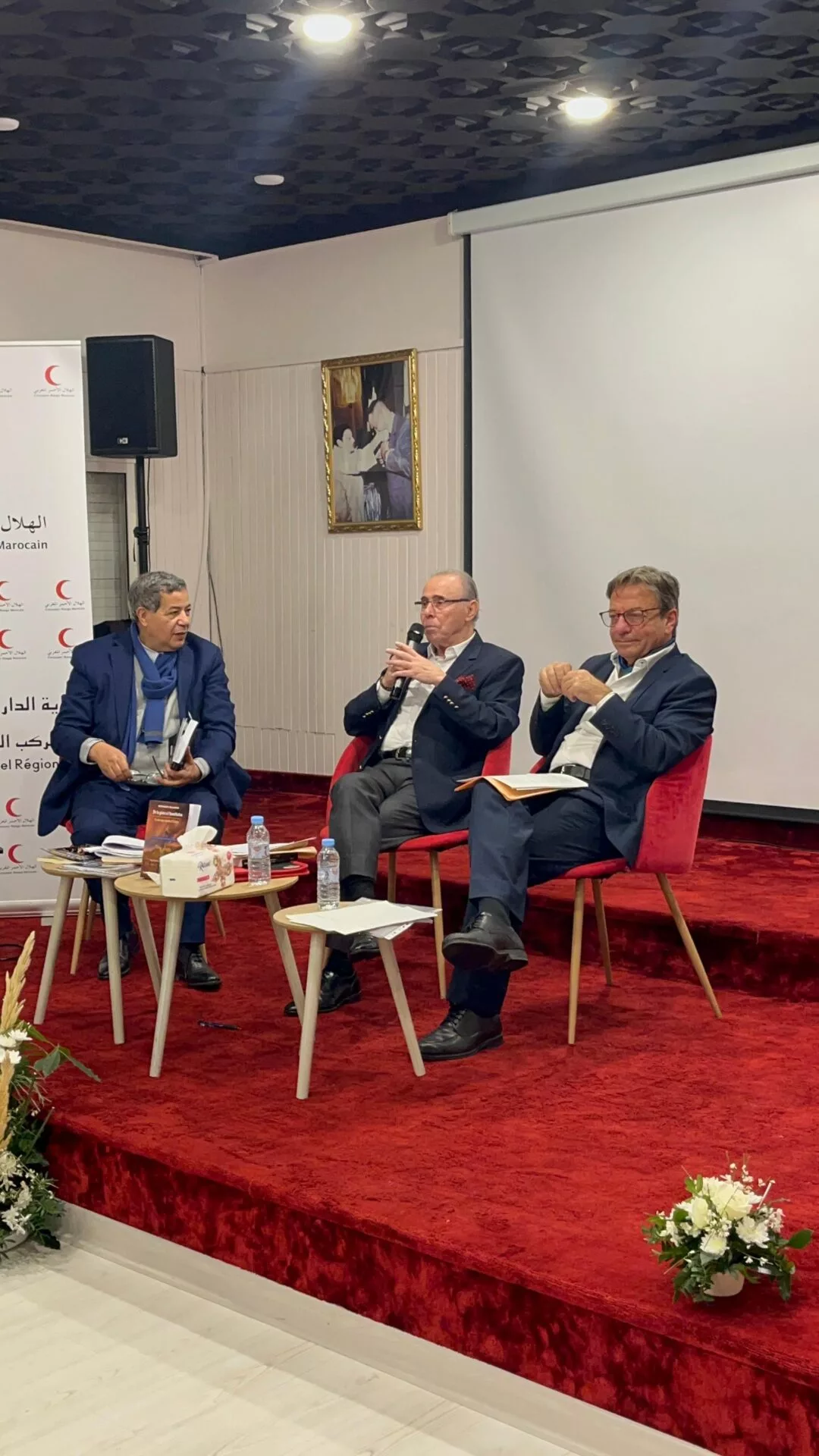
On January 27 in Casablanca, a high-level intellectual meeting brought together researchers, experts, academics and informed citizens around the same objective: better understand contemporary crises in the light of long history. This meeting was held on the occasion of the presentation of the work From Glory to Humiliation, by the historian Mohammed Belahmer, dedicated to the root causes of the fall of the Kingdom of Granada in 1492. Central moment of the event, the intervention of Khaled Hamadé, President of the International Institute of Geopolitical Studies (IIEG), left a lasting impression on people through the depth of its analysis and the strength of its geopolitical perspectives.1492: a historic rupture founding the modern geopolitical order Returning to the fall of Granada, the last Muslim stronghold in al-Andalus, Khaled Hamadé recalled that 1492 is not only a symbolic date, but a major tipping point in the structuring of the modern geopolitical order. Far from a purely memorial or emotional reading, his analysis highlighted the emergence, from this period, of a sustainable model of power, still at work in contemporary international relations. This model is based on an old matrix — comparable to a real geopolitical “source code” — articulated around three fundamental pillars: territorial conquest, its legitimization by historical, religious or ideological stories, strategic control of trade routes, economic flows and maritime spaces. According to the President of the IIEG, this triptych, more than five centuries old, never really disappeared; it has been transformed, adapted and modernized.A reading grid to decipher contemporary crises This geopolitical approach has made it possible to shed light, with rigor and education, on the dynamics at work in several current theaters: in Europe, Asia, the Middle East, but also in global economic rivalries. The analysis highlighted a worrying phenomenon: the assumed return of power relations, often to the detriment of international law and multilateral mechanisms supposed to guarantee global stability. In this context, legal norms tend to be circumvented or exploited, while international institutions appear increasingly weakened in the face of the logic of state power. Mohammed Belahmer’s book: a lucid reading of history The presentation of the book From Glory to Humiliation was another highlight of the meeting.Through rigorous and documented historical work, Mohammed Belahmer was able to expose the true causes of the fall of Granada, highlighting the internal responsibilities, political divisions and governance flaws that weakened the Nasrid State.This reading, praised by the public, breaks with fatalistic or exclusively externalized narratives of history and invites a more demanding reflection on the role of elites and political choices in the great historical collapses. A high-level debate and strong public mobilization The discussions with the public, who came in large numbers, confirmed the growing interest in this type of cross-analysis between history, geopolitics and international news. The debate was brilliantly moderated by Abid Kabadi, vice-president of IMRI, recognized jurist and geopolitical analyst, whose mastery of the issues contributed greatly to the quality and fluidity of the discussions. Thinking about the world to better understand the present Beyond the success of this meeting, the event recalled an essential conviction:👉 understand the world beyond simplistic speeches,👉 connect the past to the issues of the present,👉 give geopolitical thought back its place in citizen debate.The success of this meeting illustrates the importance of these spaces for dialogue and transmission, made possible thanks to the commitment of the organizing teams, in particular Madame Najat Lebbar, to the joint intellectual contribution of the IMRI and the IIEG, as well as to the generous welcome of Madame Chraibi within the Red Crescent space. In a world marked by instability, polarization and the questioning of common rules, long history remains an essential tool for deciphering the present.This meeting in Casablanca offered a clear and convincing demonstration, confirming the essential role of spaces for reflection and think tanks in shedding light on contemporary geopolitical issues. [caption id="attachment_9700" align="alignnone" width="768"] the presentation of the work From Glory to Humiliation[/caption]

The final of the African Cup of Nations between Morocco and Senegal left its mark. Beyond the unfortunate incidents that occurred at the end of the match, what really attracts attention is the attempt by certain actors to transform a sporting event into a weapon of division between two African brothers. This is precisely what His Majesty King Mohammed VI denounced with firmness and wisdom in his message to Moroccans. The Sovereign recalled a simple but fundamental truth: Morocco's relations with Africa, and in particular with Senegal, cannot be reduced to a football match. They are much deeper, much older, and above all much more solid than those who try to exploit them would like. Thequality, scope and historicity of these relationships, forged by decades of solidarity and concrete partnerships, cannot in any way be negatively impacted by the outcome of a football final. A story that goes beyond the passions of one day. When we look at the facts, we quickly understand that these attempts at manipulation are doomed to failure. Morocco and Senegal are not enemies today. They are lifelong partners. As early as 1960, when Senegal gained independence, Morocco was there to support it. The Kingdom was one of the sponsors of its admission to the United Nations. This is not a detail: it is the sign of real and active African solidarity, not a facade. Since then, the links have continued to strengthen. The 1964 Establishment Convention between Morocco and Senegal is unique in Africa: it grants nationals of the two countries a quasi-national status. This means that a Moroccan in Senegal or a Senegalese in Morocco are not foreigners, but almost nationals. This is what true African brotherhood is. Concrete investments, not promisesBeyond the symbols, there is also economic reality. Morocco is investing massively in Senegal. In the banking sector, telecommunications, energy, training... These are not window dressing investments, but lasting partnerships which create employment and development. Senegal, for its part, recognizes Morocco as a credible, constant and deeply supportive strategic partner. This is what the highest Senegalese authorities affirmed, particularly after the incidents in the final. This says a lot about the strength of the relationship. When reason must take precedence over emotionWhat is remarkable in the reaction of His Majesty the King is precisely this: it calls for us to go beyond the passions of the moment to face reality. The Sovereign affirmed that “the inter-African fraternity will naturally regain the upper hand”. This is not wishful thinking, it is a certainty based on decades of strong partnership. Morocco also made it clear that it will not allow itself to be “dragged into rancor and discord”. In other words: those who try to create division between Morocco and Africa are wasting their time. The Moroccan people “know how to put things into perspective”, as the King emphasized. A recognized African soft powerToday, Morocco is ranked third African power in terms of soft power. It is the result of decades of constant commitment to the continent. It is no coincidence that Morocco was able to successfully organize the 2025 Africa Cup of Nations: it is because the continent trusts the Kingdom. The Moroccan national team reached 8th place in the world, an exceptional result which also reflects a proactive and high-level sporting and infrastructure policy. But more importantly, it is a symbol of Moroccan ambition for Africa. The manipulators are losing the lead Those who are trying to sow discord between Morocco and its African brothers are banking on the emotion of the moment. They hope the passion of a football match will be enough to eclipse decades of partnership. It's a strategy doomed to failure, and for one simple reason: facts are stubborn. Moroccan investments in Africa are real. The thousands of Moroccans who work and live in Africa, and the hundreds of thousands of Africans in Morocco, are real. Institutional partnerships within the African Union, the Organization of Islamic Cooperation and La Francophonie are real. None of this can be erased by football incidents. Africa needs Morocco, Morocco needs Africa His Majesty the King recalled: Morocco “will continue its determined and constant commitment to a united and prosperous Africa”. This is not an electoral promise, it is a state policy pursued for decades. Africa today and tomorrow will be the beacon of global development. And Morocco, alongside countries like Senegal, intends to be this beacon. Not by sowing division, but by building unity. Not by listening to the manipulators, but by listening to the voice of reason. Attempts to denigrate and discredit will fail. They come up against the force of facts, the density of real partnerships, and the depth of links forged by history and consolidated by daily action. The King's message is clear: Morocco will not allow itself to be distracted from its African mission by base and clumsy shenanigans. African brotherhood is stronger than the passions of one day. Together, let’s move forward towards a stronger, more united and more prosperous Africa. And that's good for Africa. https://www.mapexpress.ma/actualite/opinions-et-debats/sm-roi-cesse-confirmer-resilience-lancre-africain-du-royaume-think-tank-francais/ https://youtu.be/xbh3YON2xnA?si=7RAMYNi0IOZZRh5J

International law is a set of legal rules whose main purpose is to regulate relations between States and international actors. Its main objective is to ensure peace, security, cooperation and respect for fundamental rights between the nations. He must... -Maintain peace and security between states. -Supervise exchanges (economic, diplomatic, etc.). -Protect human rights and fundamental freedoms. -Promote justice and the peaceful resolution of conflicts. 2. Maduro’s Venezuela: a textbook case of violations of international law Since 2024, the Nicolás Maduro regime has been regularly accused of violating systematically international law, in particular through non-compliance with the principles democracy and sovereignty, and violations of human rights. Beyond these failings, Venezuela contributes to destabilizing the region and threaten its neighbors, particularly through international drug trafficking and the crisis migratory. The Venezuelan people, for their part, are suffering the full brunt of crises humanitarian, economic, health and repeated attacks on his rights fundamental. 3. International sanctions: a sufficient response?International law is designed to apply universally, regardless of behavior of states. And when states systematically violate this right, the community can impose sanctions in various ways (as the EU did against officials Venezuelans for human rights violations). But are these measures really effective? They make it possible to mark a disapproval and exerting pressure, but their real impact on the regimes authoritarian remains limited. 4. Behind the numbers, broken lives Without getting into sentimentalism, behind the figures and geopolitical concepts, how can we not think of the Venezuelan people - as indeed of all the peoples of the country under the disastrous yoke of despots, plutocrats, where neither democracy nor human rights are respected. These leaders, often megalomaniacs, place their ego, their power and their personal enrichment above all morality, with the complicity of those which help them keep their loot. 5. Trump and Venezuela: between pragmatism and dangerous precedentThe Trump administration has often been criticized for its authoritarian excesses and its disregard for international law. Between shock declarations and unilateral actions, its methods raise concerns, as President Khaled Hamadé points out (IIEG): “Certain practices create dangerous legal precedents. ". In the Mr. Trump's plans for the future of Venezuela, do not really seem to concern the people Venezuelan. But can we deprive the Trump administration of the benefit of having removed a dictator? (according to the International Community), and a drug lord (UN and UN reports the DEA), and which is supported by the main countries to which democracy gives buttons (I'm thinking of Russia, China and Iran.…)? This “decapitation” of power — although illegitimate — did it at least make it possible to relieve, even partially, the suffering of the Venezuelan people? The question remains open, especially for those who believe in democracy as the best state system. 6. The UN and the right of veto: a brake on effectiveness? Without another surprise intervention, the Trump administration will eventually fade into the background. Fault what, as Mr. Hamadé fears, is a turning point towards more brutal societies, based on the forces could be announced. What future for international law?Should we then rethink the role of the UN? Its veto system, which allows a few nations to block decisions, limits its effectiveness. How can we make this institution more agile and fairer, while countries like Russia or China often protect controversial regimes? There is hope. We can imagine that the audacity of the United States – however questionable it may be – could inspire reform of international law. Why not consider, in the future, a mandate to intervene in cases of serious human rights violations? Such measure, currently non-existent, could strengthen the effectiveness of the community international. Arrest of Nicolás Maduro: a turning point in the Sino-American rivalry

by Anas Abdoun In recent years, Europe has seen its economic position evolve. In Africa and the Middle East, other players are gaining ground to its detriment. Energy access has become more complex since 2022. In AI and rare earths, most of the investment and production capacity is today concentrated between the United States and China. Despite this, the continent remains a nodal point for world trade, by the size of its market but above all by its location at the intersection of major maritime, rail and land routes. This centrality results from a long cycle of developments and standards which have structured flows towards Europe. It is now in competition with alternative corridors capable of gradually redirecting trade, without open confrontation. Global Gateway: the right intuition, the litmus testChina understood before anyone else that we do not shift the balance of power solely through customs tariffs or microprocessors, but through the geography of flows. The New Silk Roads have seeded ports, logistics zones, railway lines and financial capacities capable of gradually rerouting goods, energy and data. India is pushing its own projection, an Indo-Middle East corridor that puts the Gulf at the center, while other regional projects seek to capture a share of this circulation. Ultimately, the consequence is simple: if the roads no longer “naturally” pass through Europe, its centrality income disappears and, with it, a part of its normative power and its wealth. Faced with this shift, the EU reacted by launching Global Gateway. The intuition is correct: propose a credible alternative for financing and building infrastructure (transport, energy, digital) based on contractual transparency, environmental standards and local knock-on effects. On paper, it is a promise of “open” corridors, interoperable and concerned with national sovereignty, the opposite of the logic of dependence. The EU has too often treated Global Gateway as an additional label rather than a political priority. The test is elsewhere: execution. An instrument of influence only exists if it advances at the pace of others. However, the war in Ukraine has mobilized political and budgetary attention, and the EU has too often treated Global Gateway as an additional label rather than as a political priority. While we are still looking for the right financial piping, competitors are delivering terminals, welding rails, closing financing rounds. South, east, seaBeing at the center is not a state, it is an effort. Europe needs a portfolio of legible corridors, aligned with its vital interests, and supported by assertive economic diplomacy. First in the South: the Mediterranean and North Africa are the natural extension of the European productive apparatus. Carbon-free value chains (cabling, intermediate electronics, batteries, green hydrogen, electrical interconnections) require physical and regulatory “bridges” between shores. The question is not to “compensate” China or India; it is to support European industry with a close, reliable hinterland, both a supplier of clean energy and a competitive assembly base. Then to the East: as long as the Ukrainian theater remains uncertain, logistical continuity towards Central Asia passes through redundant routes (Black Sea, Caucasus, Southern corridor). The goal is not record speed, but optionality: several passable paths are better than a single vulnerable corridor. Finally at sea: the vulnerability of the routes via Suez reminded us that securing the straits, the network of “world-class” European ports and the capacity for rapid rerouting are not technical matters, but matters of sovereignty. The EU must think like a maritime power: fleet, insurance, security, digital standardization of channels. A vital geoeconomic priorityGlobal Gateway will not win on a promise of “good governance” alone. It needs financial depth and speed of execution. Concretely, this means: visible tickets (not just guarantees), shortened decision times, European industrial consortia highlighted, and clear articulation between the EU, the EIB/EBRD and national development banks. “Team Europe” must become a geopolitical project owner: a single face, a timetable, a complete package (infrastructure + energy + digital + training), and a requirement for local content which creates allies and not debtors. The geo-economy has once again become a game of corridor empires, and remaining at the center requires building roads, ports, cables and interconnections for which Europe sets the standards with partners who find it in their interest. The EU knows how to finance infrastructure. What she still hesitates to do is prioritize. Global Gateway must be treated as a strategic asset: a protected budget, tight governance, and an explicit political mandate giving it priority over internal disputes. It is not a question of “copying” China: it is a question of assuming that the geo-economy has once again become a game of corridor empires, and that remaining in the center requires building roads, ports, cables and interconnections for which Europe sets the standards with partners who find it in their interest. Europe no longer has the luxury of considering its centrality as an acquired right. In a world where roads are public policies in their own right, Global Gateway is less a program than a test: that of European capacity to translate its market power into projection power. Either the EU makes Gateway a priority, funded, diplomatic, strategic instrument and thus remains the place where roads cross. Either it continues to pile up announcements and discovers, too late, that others have moved the center of gravity and let this last “residual advantage” also become the next area where the Global South will succeed in changing the flow cards.
International Institute of Geopolitical Studies (IIEG) Under the direction of Khaled Hamadé A major strategic shift The arrest and then forced transfer of Venezuelan President Nicolás Maduro to the United States constitutes a profound change in the way Washington approaches the Venezuelan issue. This episode goes far beyond the framework of a one-off event: it reveals an assumed transformation of the instruments of power mobilized by the United States. This operation illustrates the transition from a strategy based on economic and legal usury to a logic of direct physical constraint. It highlights the growing limits of traditional pressure mechanisms in an international environment characterized by the rise of competing poles. For more than ten years, financial sanctions, diplomatic isolation, extensive use of extraterritorial law and political delegitimization campaigns have been used to weaken the power in place in Caracas. The inability of these tools to produce the expected political effect explains the recourse to more radical action, a symptom of the progressive exhaustion of the classic levers of economic domination. From economic pressure to direct coercionThe arrest of Nicolás Maduro is part of a broader dynamic of transformation of contemporary conflicts. When sanctions, embargoes and legal procedures are no longer enough to contain states supported by alternative systemic powers, economic pressure tends to turn into direct coercion. Venezuela is not an isolated case. It occupies a strategic position at the heart of the Sino-American confrontation. Its economic rapprochement with China has made it possible to limit the impact of Western sanctions, making, from the American point of view, necessary a coercive escalation intended to re-establish an unfavorable balance of power in Caracas. Two opposing models of exercising power The Venezuelan sequence highlights a deep divergence between American and Chinese approaches to projecting influence. China favors a gradual strategy based on: Structuring investments, Conditioned loan mechanisms, Long-term energy partnerships, A declared doctrine of political non-interference. In the case of Venezuela, the Chinese objective has never been the transformation of the regime, but the securing of strategic exchanges: energy resources against financing, relative stability against sustainable access to raw materials. This method favors progressive influence, without brutal rupture or direct military confrontation. Conversely, the American approach is part of a more interventionist tradition, characterized by: The personalization of power relations, The extraterritorial extension of law, The targeted designation of political adversaries, The assumed use of constraint. The arrest of Nicolás Maduro thus embodies the clash of two conceptions of power: one indirect and structuring, the other immediate, coercive and spectacular. A signal intended above all for BeijingReducing this operation to a message addressed exclusively to Venezuela would be analytically insufficient. The real recipient of this action is China. By targeting a strategic partner of Beijing, Washington seeks to remind that: Economic support for China offers no guarantee of political protection, Alternative channels for circumventing sanctions remain exposed, The American extraterritorial action capacity remains operational. However, this demonstration of force carries a significant strategic cost. It helps to reinforce, among many Southern states, the image of an American power favoring coercion, while China projects – at least in appearance – a relationship based on exchange and the absence of immediate political conditionality. Western silence and the weakening of multilateralismThe cautious reactions of several Western democracies to the arrest of a sitting head of state reflect a worrying weakening of the international order. This situation raises a central question: does United Nations remain an effective framework for regulating the balance of power between great powers? When an operation of this nature can be carried out in the absence of a multilateral mandate and without a significant institutional response, international law ceases to be a shared normative base and becomes an instrument mobilized selectively, according to strategic interests. Sino-Russian restraint: apparent weakness or strategic calculation? The measured reaction of China and Russia also calls for analysis. Should this lack of immediate response be interpreted as a sign of weakness, or as a deeper strategic reading of the situation? It may indicate that Beijing and Moscow perceive this operation not as a demonstration of power, but as a symptom of American strategic weakening, revealing a growing gap between global ambitions and real capacity for systemic control. When coercion accelerates the erosion of influenceThe arrest of Nicolás Maduro could thus constitute a symbolic moment: not the reaffirmation of American hegemony in Latin America, but the manifestation of its erosion. By substituting coercive action for a long-term diplomatic and economic strategy, Washington paradoxically reinforces the Chinese discourse according to which the international order dominated by the United States is unstable, unpredictable and intrinsically coercive. The arrest of Nicolás Maduro under the test of international law Sovereignty and prohibition of the use of force Territorial sovereignty constitutes one of the foundations of international law, as set out in Article 2 §4 of the Charter of the United Nations. Any coercive intervention carried out on the territory of a State without explicit consent or a mandate from the Security Council constitutes a serious violation of this principle. The arrest of a sitting head of state by a foreign power represents, in this regard, an attack of exceptional gravity. Immunity of sitting heads of stateCustomary international law recognizes complete personal immunity (ratione personae) for heads of state in office, covering all of their actions during the exercise of their functions. This rule is confirmed by the jurisprudence of the International Court of Justice and by the constant practice of States. The only exceptions allowed are: An explicit mandate from the Security Council, The jurisdiction of a recognized international criminal court, Or the effective loss of the status of head of state. None of these conditions seem to be met in the present case. The limits of extraterritorial criminal jurisdiction The criminal charges invoked by the American authorities cannot, in international law, justify the suspension of immunities nor authorize a forced arrest on the territory of a sovereign State. Extraterritorial criminal jurisdiction does not under any circumstances establish the use of armed force. A legal precedent of systemic significanceThis operation sets a precedent with potentially destabilizing consequences: Weakening of the principle of immunity of directors, Marginalization of the role of multilateral institutions, Trivialization of coercive justice, Increased risk of reprisals between great powers. The arrest of Nicolás Maduro does not put an end to the Venezuelan streak. It places it durably in the contemporary Sino-American rivalry, where the United States continues to act as a coercive guarantor of the existing order, while China progresses, in a more discreet manner, as the architect of new structural dependencies. Arrest of Nicolás Maduro: a turning point in the Sino-American rivalry

The year 2025 in Morocco was marked by the organization of major international sporting events. First, it was the Rabat Fan Zone which allowed intercultural exchanges between African students. It was followed by the U-17 African Cup of Nations (players under 17), the African Women's Futsal Cup, and the Mohammed VI international athletics meeting. But the big, highly anticipated sporting event is the African Cup of Nations (CAN) which began on December 21, 2025 until January 18, 2026. Morocco won the first match of the Cup against the Comoros by 2 goals to 0 on December 21, 2025. It is a founding sporting event on an African scale, which strengthens Morocco's diplomacy and its cultural influence throughout the world. Prepared for several months, the CAN is a test for Morocco which will organize the Football World Cup in 2030 with Spain and Portugal. The important points of the organization of this CAN are the management of the flow of players and spectators, security coordination between the six host cities, the reliability of transport, and the quality of hospitality. Thirty European countries will broadcast the tournament, and 5,400 media accreditation requests have been registered. The ONMT expects 800,000 visitors during the competition, and the economic benefits are estimated at 10 billion dirhams. Morocco must absolutely succeed in this major African sporting event, because our country will be watched by the whole world. We have essential assets such as built or renovated stadiums, transport infrastructure (motorways and railways), the experience of state authorities who have already organized major events. But it is also an event that concerns all Moroccans, who must give the best welcome to players and spectators from all over the world and particularly from Africa. An active Moroccan diplomacy on the bilateral and multilateral scenes in 2025In addition to the sporting aspect, Morocco carried out intense diplomacy in 2025 both at the bilateral and international level. On the bilateral level, Morocco has strengthened its strategic cooperation with the United States, Spain, France, the United Kingdom, the United Arab Emirates, Saudi Arabia and Mauritania. On the international level, Morocco participated in the Arab-Islamic Emergency Summit in Doha on September 15, 2025, in solidarity with Qatar following the Israeli aggression against the sovereignty of this State. Morocco has also positioned itself as a candidate for a non-permanent seat on the UN Security Council for the 2028-2029 mandate. Regional security and African cooperation: a pillar of Morocco’s international actionOur country also attaches particular importance to security issues, both in terms of the fight against terrorism and illegal immigration. This is how the first African Police Cooperation Center dedicated to the exchange of security information was inaugurated in Salé. Likewise, Morocco hosted the 93th General Assembly of INTERPOL in Marrakech, whose role is to preserve international security, particularly in the fight against organized crime. Morocco has also hosted other events such as the African Summit on Health Sovereignty in Dakhla, the International Congress on Climate Change in Essaouira, and the Model United Nations in Morocco which brought together students from around the world around the themes of peace, justice, and international cooperation. UN Resolution 2797: a major diplomatic turning point for MoroccoBut Morocco's main success during the year 2025 was UN Security Council Resolution 2797 of October 31, 2025. This resolution designates the Moroccan autonomy plan of 2007 as the "most serious, credible and realistic basis for resolving the Sahara conflict." This resolution is considered a major diplomatic turning point, strengthening Morocco's position, and reorienting the process towards a political solution based on autonomy rather than a referendum. Moreover, King Mohammed VI decreed October 31 as a public holiday for the Unity of the Moroccan nation from north to south. 2025, a founding year for Morocco's international leadership In conclusion, we can consider the year 2025 to be favorable in terms of international relations. Morocco must continue in the years to come to implement proactive diplomacy to defend its interests, particularly concerning the autonomy plan for the Sahara under Moroccan sovereignty which must be the subject of negotiations under the aegis of the UN. https://imrimaroc.org/chronique_suite.php 2025, year of Morocco internationally

Under the theme “Solidarity, Equality, Sustainability”, South Africa presents an ambitious agenda for its presidency of the G20: inclusive economic growth, industrialization, employment, reduction of inequalities, food security and use of AI for sustainable development. The aim is to respond to global challenges while strengthening Africa’s voice on the international stage. However, this dynamic is compromised by the boycott of the United States and the notable absences of American leaders: neither the Secretary of State nor the Secretary of the Treasury participate in key meetings. This boycott, far from being fortuitous, reflects the United States' retreat from multilateralism and marks a break with their traditional role in global economic coordination. This decision also accentuates growing tensions between Washington and Pretoria, fueled by disagreements over South African domestic policies, including land reform, and differences over international issues such as the Israeli-Palestinian conflict. The American absence potentially weakens the G20's ability to play its leadership role in global economic cooperation, and creates a strategic vacuum that could benefit China and Russia, likely to strengthen their influence and attract more countries from the Global South to alternative frameworks like BRICS. This could undoubtedly accelerate a fragmentation of the international order, to the detriment of cooperation on crucial issues such as climate, economic stability or pandemic preparedness. For South Africa, this situation constitutes both an unprecedented challenge and an opportunity: it will have to preserve the cohesion of the G20 despite an absent or hostile American partner, while being able to stimulate reflection on more inclusive governance mechanisms. Ultimately, the success of this South African presidency and the future of the G20 will depend on the ability of other nations to fill the void left by the United States. The outcome of this summit could have a lasting influence on the evolution of global governance, between enhanced cooperation or a shift towards rival blocs. Reasons for US non-participation: Allegations of white persecution in South Africa: President Donald Trump announced that the United States would not attend the G20 summit in South Africa due to allegations of white persecution in the country [1][2]. He claimed that Afrikaners (descendants of Dutch settlers, as well as French and German immigrants) are being killed and massacred, and that their lands and farms are being illegally confiscated.[1] Disagreement with G20 priorities: Donald Trump rejected the priorities put forward by South Africa for this summit, such as promoting international solidarity and helping developing countries [3]. G20 theme deemed “anti-American”: The theme chosen by South Africa for this year’s G20 – “solidarity, equality and sustainability” – was criticized by Washington, which described it as anti-American [4]. Diplomatic tensions: The South African government's initiative to file a complaint for genocide against Israel before the International Court of Justice constitutes another reason for resentment between Washington and Pretoria [5]. Boycott of preparatory meetings: The American Secretary of State, Marco Rubio, and his Treasury counterpart, Scott Bessent, have also decided not to participate in the G20 meetings being held in South Africa [5]. Potential geopolitical consequences:The absence of the United States at the G20 summit has a significance that goes beyond the simple framework of an international meeting; it has a major symbolic impact. Although it may seem superficial at first glance, this absence could significantly diminish the reach and influence of the summit. Indeed, the United States has long been seen as an essential leader in multilateral forums, and its withdrawal raises questions about its commitment to global institutions. This situation calls into question the historical role of the United States in decision-making in major international forums [6], as well as its vision towards multilateralism. US non-participation could create a vacuum where traditional US leadership is challenged, raising concerns about the future of global consensuses and major initiatives, particularly on crucial issues like climate and economic development. Without the American presence, the G20 conclusions reflect a vision less aligned with American interests or values, thus making their adoption more complex in the international context. In addition, the absence of the United States can lead to real diplomatic isolation for the country [7]. The summit is taking place without the direct contribution of American representatives, a situation that Washington denounced as an “instrumentalization” of the South African presidency by certain members of the government. This perception of isolation could reinforce domestic and international criticism of the United States' foreign strategy, particularly with regard to multilateralism and international cooperation [8]. The lack of U.S. participation also raises concerns about collective capacity to address pressing international crises. In a world where unilateralism and protectionism are increasingly widespread, questions of global solidarity are becoming central. International actors are then wondering how to move forward without unified leadership, which could compromise the effectiveness of responses to urgent issues such as climate change and pandemics. At the same time, this situation creates an opportunity for other voices, particularly those from emerging countries like South Africa. By choosing to amplify perspectives that are often marginalized, the host country can direct the dialogue toward issues that may not have had the space to be addressed under American influence. This dynamic could constitute a turning point in the way voices from the South are heard on the international stage, introducing a new form of global governance. However, this fragmentation also poses great challenges for global cooperation [9]. Issues that require coordinated solutions, such as food security, the energy transition, and economic stability, risk becoming more complicated to resolve due to the absence of a strong U.S. voice. As a result, the effectiveness of initiatives taken at the summit could be compromised, and egalitarian solutions could be more difficult to achieve. Finally, the G20 summit represents a crucial opportunity for South Africa to restore its credibility on the world stage. After years of economic stagnation, corruption scandals and reputational losses, the country wants to use this platform to demonstrate its commitment to inclusive and effective global governance. The absence of the United States could provide South Africa with greater room to shape the summit's debates and outcomes, while attempting to reposition itself as a key player in the global economy. In sum, the absence of the United States from the G20 not only shapes the immediate landscape of international discussions, but it also has long-term implications for global governance, the authority of multilateral institutions, and power dynamics in an increasingly polarized world. Withdrawal from UNESCO and boycott of the G20: A new area of international fragmentation Similarities Skepticism towards multilateralism In both cases, the American decision reflects a disengagement from multilateral institutions; a sign that “America First” or other national priorities take precedence over international cooperation. In withdrawing from UNESCO, the United States is putting forward a foreign policy incompatible with what it considers to be UNESCO's “globalist” or “ideological” agenda. Ideological/political motivation For UNESCO: the American administration criticizes “divisive social and cultural causes”, positions that it considers “woke” or too progressive. [10] For the G20: the American absence may reflect a loss of confidence in multilateral institutions to manage global policies (economic, monetary), which may be linked to a desire to redefine the role of the Americans in the world. Weakening of American leadership G20: without the active participation of the United States, its influence on global economic decisions could diminish, opening space to other powers (China, Russia, etc.). UNESCO: withdrawal weakens the diplomatic and financial weight of the United States within a major UN agency (education, culture, science), which may give more influence to other states or blocs. Consequences for global governance Both decisions may contribute to a reconfiguration of international alliances: by leaving or shunning traditional institutions, the United States leaves room for maneuver to other powers, and perhaps encourages alternative blocs or different forms of cooperation. Broader meaning of the parallels These two movements reflect a desire to redefine American engagement on the international scene: not just disengagement, but a desire to choose where and how to get involved, based on national priorities. They demonstrate a decline in traditional multilateralism: if the United States withdraws or no longer actively attends certain forums, this weakens its ability to influence global rules. In summary, The non-participation of the United States at the G20 summit highlights a worrying development in the global geopolitical landscape. This event symbolizes a withdrawal from the multilateral commitments that have long defined American leadership on the world stage. By choosing to withdraw, the United States not only leaves a vacuum of decision-making and influence, but it also opens the door for other countries, like South Africa, to redefine their roles and amplify otherwise marginalized voices. This dynamic could alter the global cooperative efforts needed to address pressing crises such as climate change and economic security. In an increasingly interconnected world, the absence of the United States from the G20 could have lasting impacts on international cooperation, underscoring the importance of a unified approach to solving global challenges. https://institugeo.org/articles/the-g20-without-the-united-states-a-new-chapter-in-global-governance/ References: The United States boycotts the G20 summit in South Africa - Reporteri.net The United States will not send any officials to the G20 in South Africa - RTS The United States discusses participation in the G20 in Africa from the South, says Ramaphosa - 11/20/2025 at 9:28 p.m. - Boursorama Historic G20 in South Africa despite the American boycott - Anadolu Ajansı The United States snubs the G20 meetings, a first - Les Echos South Africa criticizes US for boycotting G20 and opposing consensus - Xinhua G20: Pretoria stands up to Trump after his rejection of the joint declaration - Agence Ecofin The G20 is threatened by geopolitical divisions, its leaders warn US Absence at 2025 G20 Summit: Implications for Global Cooperation and South Africa's Leadership - Citadel https://www.bfmtv.com/international/america-nord/etats-unis/donald-trump/l-unesco-trop-woke-et-pro-palestinienne-donald-trump-announcement-un-retrait-de-l-organization_AN-202507220341.html
Vice-President Europe, International Institute of Geopolitical Studies (IIEG) CEO, Racines de France “The world must understand that each felled tree is a source of water that dries up, rain that will no longer fall, a future that dries up. We no longer have the luxury of ignorance or that of waiting. The time for action is here and now. » The 30th Conference of the Parties (COP30) in Belém, in the heart of the Amazon, has just concluded. Although progress has been noted, the prevailing feeling is that of an emergency not yet fully integrated by the international community. As a forest expert and direct witness to the dynamics at work, I wish to share a conviction forged by years of work in the field: the solution to many of our crises – climatic, water, food and even geopolitical – lies in the shade of trees. But for this, we must carry out a radical conceptual and economic revolution. COP30: between glimmers of hope and lack of ambitionCOP30 put forests at the center of debates, a late but essential recognition of their role. The launch of the “Tropical Forests Forever Facility” (TFFF) by Brazil, aiming to mobilize $125 billion to pay for forest protection, is an initiative that we must welcome and amplify [1]. It is a first step towards an economy where preservation becomes more profitable than destruction. The commitment to allocate 20% of these funds to indigenous communities, ancestral guardians of 80% of global biodiversity, is also a crucial step forward [2]. However, this progress cannot mask a dark reality. The UNFCCC summary report is clear: current commitments are leading us towards catastrophic warming of nearly 3°C [3]. Deforestation continues its mad course, with 8.1 million hectares lost in 2024, an alarming figure which takes us away from the objective of zero deforestation in 2030 [4]. The paradox is tragic: global subsidies to forest-destroying industries are 200 times greater than the funding allocated to their protection [4]. We can no longer wait for the COPs to act. Now is no longer the time for declarations of intent, but for immediate action, on all fronts. The forgotten principle: it is the tree that gives waterAt the heart of our collective blindness is the forgetting of a fundamental truth, a principle that nature teaches us and that science confirms: it is the tree that gives water, and not the other way around. We have been conditioned to see rain as a source that feeds the forest. The reality is more complex and more beautiful: the forest itself creates rain. Through the mechanism of evapotranspiration, a mature forest recycles colossal quantities of water into the atmosphere, creating moisture flows that generate precipitation hundreds or even thousands of kilometers away [5]. A tropical forest can recycle up to 70% of the water it receives, acting as a gigantic pump and climate regulator [6]. Cutting down a tree is therefore much more than losing wood or a carbon sink. This is breaking an essential link in the water cycle. Deforestation is not only a cause of climate change, it is a self-reinforcing consequence by drying out land and threatening the availability of the most vital resource: fresh water. From theory to action: the Arches Castriotes demonstratorFaced with this observation, the International Institute of Geopolitical Studies (IIEG), via its Sustainable Development division, and the mission-driven company Racines de France, which I manage, are committed to transforming theory into practice. Our conviction is that awareness must be embodied in concrete, viable and replicable models. This is the spirit of our founding principle: “a living tree must have more value than a cut tree”. It is this vision that gave birth to the “Les Arches Castriotes” project, near Montpellier. On a former five-hectare vineyard site, we planted more than 2,000 trees of 36 different species to create an agroforestry ecosystem unique in the world [7]. It is not a simple plantation, it is an open-air laboratory, a scientific demonstrator which proves that it is possible to regenerate soil, restore biodiversity and the local water cycle, and massively capture carbon, while creating a local and sustainable economy. This demonstrator, a living example of real solutions, is beginning to interest governments that are increasingly aware of the issues. This model, followed by the international scientific community, is not a utopia. It is a tangible solution, a know-how that we wish to share and transfer, particularly in Africa and Morocco, where the challenges of water and food security are particularly acute. It demonstrates that agroforestry is not a step backwards, but an agriculture of the future, resilient and efficient. “De-risking”: an imperative for the business world Today I am sending a direct message to the business world, all sectors combined. Inaction in the face of deforestation is no longer an option. It represents a systemic risk for your supply chains, your reputation and your sustainability. This risk is estimated at $2.7 trillion for global supply chains [8]. It is time to move from the concept of “social responsibility” to that of “strategic de-risking”. It’s about integrating nature as an essential asset and deforestation as an intolerable liability in your balance sheets. With my teams, we are working on concrete proposals to support companies in this transition: complete traceability of raw materials, investment in regeneration projects like ours, and adoption of “zero deforestation” policies which are more than just slogans. Only 3% of global companies today have robust and enforced policies against deforestation [8]. It is a collective failure. We need everyone to turn the tide. The solutions exist, they are profitable and meaningful. It takes the courage to implement them. Peace from the roots: a general mobilizationCOP30 must be an electric shock. But the future will not only be played out in negotiation rooms. It plays out on the ground, in our territories, in our consumption and investment choices. The actions of Racines de France show it every day: it is possible to create value by regenerating living things. Let us make no mistake: the fight for the forest and for water is a fight for stability and peace. The wars of tomorrow will be water wars if we do not change course. By restoring ecosystems, we restore the conditions for shared prosperity and a fairer world. The time has come for general and positive mobilization. Join us. Plant, fund, demand change. Let's make the regeneration of nature the greatest project of our century. It is through the roots that we will build peace. References[1] RTBF. (2025). Making the protection of forests financially more attractive than their destruction: Brazilian President Lula's plan to combat deforestation. https://www.rtbf.be/article/rendre-la-protection-des-forets-financierement-more-interesting-que-leur-destruction-le-plan-du-president-bresilien-lula-face-a-la-deforestation-11632844 [2] IIEG. (2025). COP30 in Belém: Forests, Climate Finance and New Commitments for a Just Transition. https://institugeo.org/articles/cop30-un-tournant-decisif-pour-laction-et-la-gouvernance-climatiques/ [3] Greenpeace. (2025). COP30: progress on phasing out fossil fuels and protecting forests, but we need to go further. https://www.greenpeace.org/africa/fr/communiques-de-presse/59551/cop30-des-avancees-sur-la-sortie-des-energies-fossiles-et-la-protection-des-forets-mais-il-faut-aller-plus-loin/ [4] Les Echos. (2025). Reduction in deforestation in Brazil: the tree that hides the forest before COP30. https://www.lesechos.fr/monde/ameriques/recul-de-la-deforestation-au-bresil-larbre-qui-cache-la-foret-avant-la-cop30-2196877 [5] NFB. The power of trees: evapotranspiration. https://www.onf.fr/vivre-la-foret/%2B/2888::le-pouvoir-des-arbres-levapotranspiration.html [6] EFI. What role do forests play in the water cycle?. https://efi.int/forestquestions/q7_fr [7] Roots of France. The Castriote Arches. https://www.racinesdefrance.com/project/les-arches-castriotes/ [8] Forbes. (2025). Deforestation: A $2.7 Trillion Corporate Supply Chain Risk. https://www.forbes.com/sites/feliciajackson/2025/05/08/deforestation-a-27-trillion-risk-hiding-in-corporate-supply-chains/

Close monitoring of the IIEG:Beyond Western Sahara, towards "Eastern Sahara" The Conflict Resolution Unit of the IIEG has been following the Moroccan Sahara issue very closely for several years. This attention is explained by the fact that the issue now goes beyond the framework of a territorial dispute: it concerns the geostrategic balances of the Maghreb, the security of the Sahel and Mediterranean cooperation in the face of hybrid threats (traffic, migration, non-state armed networks). The IIEG also observes that resolution 2797 initiates a new geometry of negotiations, where regional actors (Morocco, Algeria, Mauritania) could be led to redefine their zones of influence and their economic interactions. In this logic, the next phase - already mentioned by certain diplomats - could concern the "Eastern Sahara", that is to say the border areas between the Moroccan south-east and the Algerian west. This perspective is explained by two complementary dynamics: the need to clarify the spaces for cross-border cooperation, particularly around economic and energy corridors, and the desire of the United States and their Arab partners to build an integrated stability of the Maghreb, which leaves no gray area conducive to tensions or to trafficking. This development would mark a new stage in the overall resolution of territorial and security issues in the Maghreb, transforming the Sahara issue from a frozen conflict into a catalyst for deep regional integration. A diplomatic turning point confirmed by resolution 2797The adoption of resolution 2797 of the United Nations Security Council [1]October 31, 2025, marks a historic turning point in the UN approach to the Sahara issue. The text, supported by a large majority of Council members (11 votes in favor, 3 abstentions), introduces a more pragmatic tone and reinforces the recognition of the Moroccan autonomy plan (2007) as a realistic and sustainable political basis for a negotiated solution. This resolution is a continuation of the American position reaffirmed since 2020, but it now broadens the scope by placing the Sahara issue within the broader framework of Maghreb and Sahelo-Mediterranean regional stability. It thus opens a new political phase, where the Sahara question goes beyond its territorial dimension to become an issue of regional governance and security cooperation. The resolution also puts an end to a persistent ambiguity by explicitly recognizing Algeria as a stakeholder in the process, and no longer as a simple "neighboring state". This recognition breaks with previous diplomatic rhetoric and endorses a reading geopolitics of the conflict based on direct regional responsibility. The pivotal role of Massad Boulos, of Lebanese origin: discreet architect of a transatlantic and Arab consensusThe American Special Advisor for Africa and the Middle East, Massad Boulos, of Lebanese origin, established himself as the discreet but essential architect of the diplomatic consensus which made possible the adoption of resolution 2797. A businessman and political strategist close to the Trump administration, Boulos stands out for his unique ability to forge bridges between Washington, Rabat and several influential Arab capitals, notably Cairo, Abu Dhabi and Algiers. In his interview granted to France 24 Arabic on November 3, 2025, Boulos forcefully reaffirmed that the Moroccan autonomy plan constitutes the only credible basis for a just and lasting outcome [2]. But beyond this position of principle, his action reflects a strategic desire to restructure the Maghreb dialogue around an axis of Morocco-United States-Arab League trust, in which Algeria would be invited to play a constructive rather than oppositional role. The IIEG notes that the mediation carried out by Boulos adopts a hybrid approach, combining classic diplomacy (bilateral talks, coordination with the UN) and influential diplomacy (economic networks, security cooperation, moderate religious dialogue). This atypical profile, coming from the business world and Middle Eastern networks, makes him the real architect of the current convergence between Washington and Rabat on this issue. His visit to Algiers in July 2025 testifies to this desire to open channels of dialogue with all regional actors [3]. Towards a phase of consolidation and adaptationAccording to the observations of the IIEG, the "next step" of the file, after resolution 2797, should therefore combine three strategic axes: The submission by Morocco of an updated autonomy plan, integrating modernized local governance mechanisms, international guarantees and a clear agenda for the participation of local populations. This update would make it possible to concretely translate diplomatic progress into operational institutional mechanisms. A relaunch of the Morocco-Algeria bilateral dialogue, encouraged by Washington and supported by the Arab League, in order to reduce the conflictual dimension and open up a space for pragmatic cooperation. The role of Massad Boulos in this regional mediation will be decisive in creating the conditions for a constructive dialogue. Regional coherence, including questions of energy security, infrastructure and common management of border areas (the "Eastern Sahara"), as levers of lasting stability. The region's integration into the Nigeria-Morocco Gas Pipeline, the African Atlantic Route and the green hydrogen corridors positions the Kingdom as an energy and logistics interface between Africa and Europe. The European Union at a crossroadsThe European Union, Morocco's major economic and political partner, now finds itself at a strategic crossroads. The cautious neutrality which until now characterized its position is becoming difficult to maintain in light of the new UN legal architecture. Ignoring resolution 2797 would amount to weakening its own credibility in terms of respect for multilateralism [4]. A political revision is therefore necessary: align European foreign policy with resolution 2797, in the name of strategic coherence and respect for Security Council decisions. This clarification would strengthen Euro-African collective security, by consolidating the basis of political trust necessary for lasting cooperation in the areas of the fight against terrorism, the management of migratory flows and the energy transition. To summarize:Towards a model of Maghrebi resolution The IIEG believes that resolution 2797 and the dynamic it sets in motion could constitute a diplomatic precedent: that of a predominantly regional conflict resolution, supported by a coalition of powers (United States, Arab partners, European Union) but articulated around a central local actor - in this case, the Kingdom of Morocco. This "bottom-up" approach, centered on realism and cooperation, marks the end of the status quo logic and opens a phase where Maghreb diplomacy could once again become the driving force behind a new African geopolitical balance. As IIEG President Khaled Hamadé pointed out on the occasion of the 50th anniversary of the Green March: “Courage is not to perpetuate conflicts, but to dare to resolve them. Morocco showed the way fifty years ago. It is time for the world to accompany it on this path.” [5]References[1]United Nations Security Council. (2025, October 31). With 11 votes in favor and 3 abstentions, the Security Council adopts resolution 2797 (2025), renewing the mandate of the UN Mission in Western Sahara for one year. https://press.un.org/en/2025/sc16208.doc.htm[2] Boulos, M. (2025, November 3).Interview with France 24 Arabic.[3]Middle East Institute. (2025, November 6). Morocco-Algeria: The case for ambitious reconciliation. https://mei.edu/publications/morocco-algeria-case-ambitious-reconciliation[4]Conflict Analysis and Resolution Unit. (2025, November 4). Moroccan Sahara: the new UN resolution places the European Union at a strategic crossroads. International Institute of Geopolitical Studies. https://institugeo.org/articles/Moroccan-sahara-the-new-resolution-of-lonu-place-lunion-europeenne-a-un-strategic-crossroads/[5] Hamadé, K. (2025, October 24). For lasting peace: 50th anniversary of the Green March and appeal to the international community. International Institute of Geopolitical Studies. https://institugeo.org/articles/for-a-sustainable-peace-50th-anniversary-of-the-green-march-and-call-to-the-international-community/

Member of the IIEG scientific council A historic event at the foot of the pyramids of Giza On November 1, 2025, Cairo experienced a long-awaited historic event: the official inauguration of the Grand Egyptian Museum, erected at the foot of the pyramids of Giza. This museum, the largest in the world dedicated to a single civilization, marks not only the opening of a monumental cultural space, but the advent of a new era of national consciousness and civilizational influence for Egypt, which once again proves its ability to unite the grandeur of the past and the ambitions of the future. The symbol of stability and a message of universal peace The Grand Egyptian Museum is the symbol of the stability of the Egyptian state and tangible proof of its strength of achievement in a regional and global context affected by unprecedented crises. While some powers persist in war, destruction and violence against innocents, Egypt welcomes world leaders to send them a completely different message: that of civilization, peace and humanity, the living heritage of a centuries-old history. A collective masterpiece in the service of pharaonic memoryThis inauguration constitutes the culmination of decades of efforts led by thousands of Egyptians: engineers, archaeologists, craftsmen and technicians have united their know-how to offer the world a museum masterpiece worthy of the prestige of Egypt and its thousand-year-old history. Equipped with the most advanced exhibition technologies, the museum houses more than one hundred thousand archaeological pieces, including the entire treasure of King Tutankhamun, presented for the first time in one place. Added to this are galleries dedicated to colossal monuments, ultra-modern restoration centers and interactive spaces that immerse the visitor in the magic of ancient Egypt thanks to a contemporary museographic approach. A showcase of political stability and cultural influence But the symbolic significance of this event goes beyond the cultural or architectural framework: the Grand Egyptian Museum embodies the political, security and economic stability of the country, and reflects its success in building an environment conducive to creation, science and tourism. It testifies that Egypt does not just build stones, but a conscience, an identity and a lasting place among the nations. A turning point for global tourism to EgyptThe opening of this museum should also mark a turning point in the history of global tourism to Egypt. Experts anticipate an unprecedented increase in the number of visitors coming from the four corners of the world to admire, in a modern and immersive setting, the treasures of the pharaonic civilization. A universal cultural and human experience The Grand Egyptian Museum is therefore not a simple tourist destination: it is a cultural and human experience, an invitation to contemplate the genius of the Egyptian people and to recognize the depth of their contribution to the building of universal civilization. Cairo, capital of a model based on knowledge and tolerance Through this inauguration, Egypt is sending the world a message stronger than all political speeches. While certain regimes continue to justify occupation, war and the dispossession of peoples, Cairo offers a model based on knowledge, culture and tolerance. It thus reminds us that true power is measured by the capacity to build, not to destroy; that civilization is based on knowledge and humanity, not on domination. The eternal message of Egypt: civilization, peace and universalityThe opening of the Grand Egyptian Museum is, finally, a renewed proclamation of the immortality of the Egyptian message: a message of universality and peace.Because Egypt has never been isolated from the world; it has always been the crossroads of peoples, the cradle of cultures and the beacon of human thought. From the heart of Cairo, where ancient pyramids and symbols of modernity coexist, Egypt today sends a unique message to the world:its civilization remains, its humanity is renewed, and its peace remains an eternal invitation addressed to all people.

The 30th Conference of the Parties (COP30) to the United Nations Framework Convention on Climate Change (UNFCCC), which will be held from November 10 to 21, 2025 in Belém, Brazil, represents much more than just a deadline on the international diplomatic agenda. With its symbolic location at the gates of the Amazon, the vital lung of the planet and a major reservoir of biodiversity, this conference is a pressing call for renewed, ambitious and equitable climate action. In a context of multiple geopolitical crises, erosion of multilateralism and rising climate perils, COP30 constitutes a truth test for the credibility of the Paris Agreement and the capacity of the international community to transform its commitments into concrete actions. The Sustainable Development Nexus division of the IIEG provides here its analysis of the issues and formulates proposals to make this summit a tangible success, by placing the preservation of forests at the heart of the solution. Crisis-proof climate multilateralism COP30 opens in a climate of mistrust. Geopolitical tensions, exacerbated by conflicts and aggressive economic competition, have relegated the climate emergency to the background of political priorities [1]. The architecture of climate governance, designed for cooperation, has become an arena of rivalry, undermining trust and slowing the implementation of commitments. This erosion of multilateralism manifests itself at several levels crucial to the success of the conference. Ambition at a standstill:The challenge of Nationally Determined Contributions (NDC) The main issue at COP30 is the submission of the third generation of Nationally Determined Contributions (NDC 3.0), which must define countries' emissions reduction efforts by 2035. These action plans are the heart of the mechanism for gradually increasing the ambition of the Paris Agreement. However, the observation is alarming: as the deadline approaches, a majority of countries, including some of the largest emitters in the G20, have not submitted contributions aligned with a 1.5°C trajectory [2]. The UNFCCC synthesis report indicates that current commitments, even if fully implemented, would lead us towards catastrophic warming of almost 3°C by 2100 [1]. This lack of ambition is not only a technical failure; it is the symptom of a deep political crisis where short-term national interests and internal political polarization take precedence over collective responsibility. The financing wallThe second shaky pillar is that of climate finance. COP30 must see the adoption of a New Quantified Collective Objective (NCQG) to replace the objective of 100 billion dollars per year, which has never been fully achieved or sufficient. The needs are immense, estimated at several trillion dollars per year. Negotiations stumble over the amount, the sources (public, private), the distribution between mitigation and adaptation, and the conditions of access for developing countries. Without an ambitious and credible agreement on the NCQG, the countries of the South will have neither the means nor the confidence necessary to accelerate their transition, further widening the North-South divide. Issue of COP30State of play (November 2025) NDC3.0 Third cycle of national climate commitments (horizon 2035). Majority of countries lagging behind; overall ambition very insufficient for the 1.5°C objective. Financing (NCQG) New post-2025 climate financing objective. Difficult negotiations on the amount (objective of $1,300 billion/year mentioned) and the terms. Global Assessment The first assessment (GST) concluded that there was a major deficit in action and ambition. NDC 3.0 must integrate the conclusions of the GST, in particular the exit from fossil fuels. Adaptation & Losses Operationalization of the framework for the Global Adaptation Goal and financing of the fund for Losses and Damages. Lack of dedicated funding and clear metrics for adaptation. The forestry imperative:From the crisis to concrete proposals Faced with this climate governance in crisis, the theme of forests, highlighted by the Brazilian presidency, offers a unique opportunity to realign discourses and actions. Forests are not just a component of the climate solution; they are a sine qua non condition. They absorb nearly 16 billion tonnes of CO2 per year and shelter 80% of terrestrial biodiversity [3]. Yet the global forest crisis is worsening. In 2024, the world lost 8.1 million hectares of forest, a figure that is increasing and 63% higher than the trajectory required to achieve the goal of zero deforestation in 2030 [4]. Harmful subsidies to agriculture and other destructive industries exceed green funding for forest protection by more than 200 times [4]. This hemorrhage, if not stopped, will render all other decarbonization efforts in vain. The flagship initiative of COP30, the “Tropical Forests Forever Facility” (TFFF), launched by Brazil, aims precisely to reverse this destructive economic logic. By seeking to mobilize $125 billion to compensate countries for protecting their forests, this fund represents a paradigm shift [5]. Based on this observation, the Sustainable Development Nexus division of the IIEG is putting forward four concrete proposals to make COP30 a turning point for forests and the climate: Consolidate and universalize the “Tropical Forests Forever Facility” (TFFF) The TFFF is a major step forward, but its success depends on a rapid and massive financial commitment. Proposal: We call on G20 countries, particularly those that have not yet contributed, to commit at least 50% of the target of $25 billion in seed funds before the end of COP30. It is imperative to establish transparent governance for the fund, co-led by donor countries and forest countries, with strong representation of civil society and indigenous peoples to ensure equitable and efficient allocation of resources. Integrate binding and verifiable forest objectives into NDC 3.0 Forests are often the poor relation of national contributions. Proposal: The IIEG proposes the development, under the aegis of the UNFCCC, of a standardized and mandatory module for NDC 3.0, dedicated to the protection and restoration of forests. This module should include quantified objectives (e.g.: X% reduction in gross deforestation by 2035), monitoring indicators based on harmonized satellite data, and an associated financing plan, directly linking forest objectives to national climate strategies. Safeguard the role and rights of indigenous and local communities Indigenous and local communities are the most effective stewards of forests, protecting 80% of the world's biodiversity on just 25% of the land [6]. The TFFF plans to allocate 20% of the funds to them, which is a first step. Proposal: We recommend the creation of direct funding mechanisms that bypass national administrative burdens to channel funds to communities. At the same time, COP30 must catalyze a global movement for the legal security of their lands and territories, a sine qua non condition for their protection action. The objective should be to double the share of climate finance that reaches them directly by 2030. In-depth reform of forest carbon markets (Article 6 and REDD+) Forest carbon credit mechanisms, such as REDD+, have been undermined by greenwashing scandals and a lack of environmental integrity [7]. Article 6 of the Paris Agreement offers a chance to start on a healthy footing. Proposal: The IIEG calls for the adoption at COP30 of strict rules for forest carbon credits under Article 6, guaranteeing: Additionality and permanence of emissions reductions; the absence of double counting; conservative and scientifically validated deforestation baselines; and fair and equitable revenue sharing with governments and local communities. Any credit that does not meet these criteria must be excluded from compliance markets. From research to action:The expertise of the IIEG embodied by Yann FORTUNATO CEO of Racines de France. Beyond analysis and policy recommendations, the IIEG Nexus cluster is committed to promoting and drawing inspiration from concrete solutions emanating from the field. The action of researchers affiliated with our institute illustrates this transition from theory to practice. A convincing example is that of Yann Fortunato, forestry consultant and director of Racines de France, a mission-driven company which embodies the new forestry economy that we are calling for [8]. Based on the principle that “a living tree must have more value than a cut tree”, Yann Fortunato and his teams develop silvicultural and agroforestry models that regenerate ecosystems while creating sustainable economic value. This holistic approach is implemented through demonstrators, real open-air laboratories monitored by the scientific world. The “Les Arches Castriotes” project, located in France in Castries near Montpellier (34), is a perfect illustration of this. On a former 5-hectare vineyard site, more than 2,000 trees of 36 different species were planted to create a resilient agroforestry ecosystem, capturing carbon, restoring biodiversity, soil health and the water cycle [9]. The initiative carries a vision of a regenerative economy of territories for the benefit of resolving the need for nutritional autonomy and overall health. This initiative, which is part of an ecosystem of actors including scientific partners and leading organizations, demonstrates through proof that innovative forestry and agroforestry management is not only possible, but also desirable. Since agriculture is responsible for 80% of global deforestation, it is appropriate to propose protective models for residual global forests but also inspiring proposals to renew strong links between the presence of trees in territories and agriculture. The deployment of agroforestry, including Les Arches Castriotes through Yann FORTUNATO, is an inspiring example in the world. It constitutes an inspiring model, reproducible on a larger scale, which can guide the investments and public policies that COP30 must catalyze. OutlookCOP30 in Belém cannot afford to be a new step in the “geopolitics of climate procrastination”. The ecological emergency, coupled with the crisis of global governance, demands a break. By focusing on tangible, funded actions for forests, the international community can not only tackle a massive source of emissions and biodiversity loss, but also rebuild trust in the multilateral process. The success of Belém will not be measured by the length of its final declarations, but by the solidity of the financial commitments for the TFFF, the ambition of the forest objectives in the NDCs, and the effective recognition of the role of forest guardians. It is by this yardstick that history will judge whether COP30 was yet another mirage in the desert of inaction, or the beginning of a true ecological bifurcation. References [1] Montaigne Institute. (2025). COP30: multilateralism on the tightrope. https://www.institutmontaigne.org/expressions/cop30-le-multilateralisme-sur-la-corde-raide [2] CITEPA. (2025). Our guide to negotiations to better understand COP-30. https://www.citepa.org/guide-du-citepa-des-entreprises-de-la-cop-30-lessentiel-pour-comprendre-le-contexte-des-negociations/ [3] Woodwell Climate Research Center. (2024). Global forest carbon storage, explained. https://www.woodwellclimate.org/global-forest-carbon-storage-explained/ [4] Forest Declaration Assessment. (2025). Forest Declaration Assessment 2025. https://forestdeclaration.org/resources/forest-declaration-assessment-2025/ [5] UN News. (2025). New Brazil-led fund aims to put forest protection at the heart of climate action. https://news.un.org/en/story/2025/11/1166290 [6] The Guardian. (2025). How could Tropical Forest Forever fund proposed at Cop30 tackle deforestation? https://www.theguardian.com/environment/2025/nov/06/tropical-forest-forever-fund-proposed-cop30-tackle-climate-change [7] WeDemain. (2025). COP30: can Brazil save forests without greenwashing. https://www.wedemain.fr/sauver-la-planete/actions-ecologique/cop30-le-bresil-peut-il-sauver-les-forets-sans-greenwashing-1142537 [8] Roots of France. (2025). Welcome. https://www.racinesdefrance.com/ [9] Roots of France. (2025). The Castriote Arches. https://www.racinesdefrance.com/project/les-arches-castriotes/

The COVID-19 episode has highlighted the flaws and weaknesses of too much specialization and globalization of the world, and has brought to the forefront concepts that we thought were outdated: regionalization, sovereignty, resilience, robustness of the supply chain, availability of inputs. Geopolitical tensions, a consequence of the search for a new global balance itself the result of the evolution of the ideological, economic and demographic balance of power, have exacerbated this new reality for some, and reinforced the obvious for others. In this study, we will deepen our reflection on trade routes and their intertwining in world geopolitics. This study is broken down into three parts: the first will deal with “hard” factors, in this case geography, demography, and will paint a brief picture of the history of trade routes; the second will focus on modern roads and the current situation; the third and final part will focus on the developments to be expected and on the appropriate way to position yourself in this new mapping of trade routes. Part 1: The Hard and the History of Trade Routes1.1 Geographic and Demographic Invariants The world, from a geographical point of view, is divided into two interdependent universes: the earth for 29% and the ocean for 71%. The northern hemisphere (255 million km²) concentrates the majority (66%) of the land surface, however its geographical center, in this case the north pole and its surroundings (Alaska and eastern Siberia) represent non-inhabitable zones and therefore a divide which separates America from Eurasia-Africa. The southern hemisphere has the remaining third (50 million km²) equivalent to 19% of its surface area, Antarctica (14 million km²) represents a significant uninhabitable part. From this geographical observation, the earth's world is made up of two major blocks: The World Island America The continental world made up of Eurasia and its extension towards the south, sub-Saharan Africa The demographic perspective teaches us that 90% of the world's population is located in the northern hemisphere along what we will call the optimum living corridor, that is to say the corridor presenting the most favorable conditions for living things in terms of climate, access to water, and arable or pastoral land. This population is roughly distributed along a major axis from east to west between the Tropic of Cancer and the 60th parallel north. 1.2 Additional Factors at the National Level Following these geographic and demographic invariants, it is useful at the national level to introduce two additional notions: The degree of openness of countries between landlocked states, states open to the seas, island states The degree of self-sufficiency of nations between countries rich in natural resources and producers, consuming countries and poor in resources, and crossroads countries with a commercial vocation We will close this introduction to our problem with an important characteristic of an evolving nature over time: it is belonging to a specific and/or differentiated civilizational or cultural area which will tend to erase or accentuate the impact of geographical DNA. 1.3 Historical Fresco of Trade RoutesHistory teaches us that humanity began its growth on the basis of autonomous life nuclei and that trade and trade routes were almost non-existent. It was not until the birth in the third millennium BC of centers of civilizations in China, the Indus, Mesopotamia, and Egypt that the first exchanges and intra-civilizational routes appeared, relying mainly on waterways. The Incense Route (around 1800 BC) appears to be the first known trade route and connects the Indian subcontinent and the Arabian Peninsula by sea. It developed thanks to camel caravans until it reached Mesopotamia and Egypt via the city of Petra in Jordan, which became an important commercial crossroads towards the eastern Mediterranean. The Silk Road appears around 200 BC. BC, it opened the door to exchanges between the Chinese empire which held the secret of its manufacture and the Middle East via Samarkand. The Roman Empire around 30 BC. AD takes over the past, goes up the Nile, puts itself in contact with the kingdom of Aksum which masters navigation on the high seas, bypasses the Arabian peninsula and thus connects the Mediterranean basin to India. He doubles this route by land via the Parthian Empire and later the Sassanid Empire to reach Samarkand and China. Rome is replaced by Constantinople which becomes the new commercial crossroads between the West and the East. The first globalization of the known world merges with the expansion of the Arab-Muslim world. At the Battle of Talas in 751 AD. BC, they defeated the Chinese, appropriated the secrets of silk and paper while the Chinese turned away from land routes to concentrate on maritime routes deemed safer and with fewer intermediaries, and opened their ports to foreigners. The Arabs seized the opportunity and established themselves at the center of the vast land and maritime trade network, uniting East to West and North to South. Africa was incorporated during the 10th century via trade in gold, slaves, and ivory. The era of the Crusades saw the Italian republics take charge of trade between the Middle East and Europe. The first globalization of the world saw the light of day with the invention of the caravel, the rediscovery of the Americas by the Spaniards, and the opening of the route to India via the Cape of Good Hope by the Portuguese. The Ottoman Empire and its capital Constantinople lost their trade monopoly. The world is shared between the winners, the Tordesillas meridian and its equivalent in South-East Asia demarcate the respective zones of influence. The rest merges with the imperial reconfigurations, England and France ensure the first succession, the USA takes over in the 20th century and guarantees the pax americana on all trade routes. The GATT and then the WTO agreements completed the movement to achieve the current configuration. Part 2: Where are we? State of World Trade The current configuration of trade routes is the product of this thousand-year-old history, but it is today being put to the test by a succession of crises which reveal its structural fragilities and call into question the established balances. 2.1 The Vital Arteries of Today's CommerceMaritime transport remains the backbone of global trade, confirming the natural predominance imposed by the Earth/Ocean divide identified in our geographic invariants. It accounts for nearly 90% of the volume of goods traded worldwide [1], a proportion that has continued to grow since the advent of containerization in the 1960s. Flows are today concentrated on three main routes which connect the large basins of the “optimum corridor of life”: The Asia-Europe route is the busiest axis in the world. It crosses the Strait of Malacca, the Indian Ocean, the Red Sea and the Suez Canal before reaching the Mediterranean. The Suez Canal, a strategic infrastructure 193 km long, sees approximately 12% of world trade and 22% of container traffic [2]. This route perfectly illustrates the vital connection between the “Eurasia-African continental world” and European markets. The Trans-Pacific Highway connects China and East Asia to the west coast of North America, materializing trade between the “continental world” and “island world America”. This route has taken on considerable importance with China's economic rise and its integration into global value chains. The Trans-Atlantic route, historically central since the great discoveries, continues to connect Europe and North America, although its relative importance has diminished with the rise of Asia. 2.2 “Choke Points”: Zones of Geopolitical FrictionThese routes depend on strategic crossing points whose disruption can paralyze global trade, confirming the historical importance of controlling commercial crossroads. These “choke points” have become major geopolitical issues. Strangulation Point Crisis Context Impact on Trade Suez Canal / Red Sea Houthi attacks since the end of 2023 following the Gaza-Israel conflict Fall of 60% in traffic in 2024. Loss of revenue of 62% for Egypt (3.6 billion USD). Diversion via the Cape of Good Hope (+10-15 days) [3] Panama Canal Historic drought linked to climate change Drastic reduction in the number of daily transits, affecting a route that accounts for 3% of global maritime trade Strait of Hormuz Recurring geopolitical tensions with Iran Vital crossing point for approximately 20% of global oil consumption Strait of Malacca Piracy, high traffic density and Sino-American tensions Essential route for trade between Asia, Europe and the Middle East The most notable example of this vulnerability remains the blocking of the Suez Canal by the container ship Ever Given in March 2021. This incident, which lasted six days, dramatically illustrated the fragility of the global trading system, with an estimated cost of $5 to $9 billion per day for international trade [2]. More than 400 ships have been blocked, creating cascading disruptions in global supply chains. 2.3 New Logics and Emerging RoadsFaced with these tensions and vulnerabilities, new dynamics are developing, recalling the major historical reconfigurations of trade routes analyzed in Part 1. The “New Silk Roads” (Belt and Road Initiative - BRI) represent the most ambitious Chinese attempt to recreate ancient land networks while developing alternative maritime routes. Launched in 2013 by President Xi Jinping, this infrastructure project has already mobilized more than $900 billion in investments in more than 150 countries [4]. In 2024, a record $70.7 billion in construction contracts was signed. The initiative aims to secure Chinese supply chains, reduce dependence on traditional maritime routes controlled by Western powers, and expand Beijing's geopolitical influence. The Northern (Arctic) Sea Route illustrates how climate change can literally reshape global trade geography. The melting of the Arctic ice is gradually opening a new sea route along the Siberian coast, potentially revolutionary for trade between Asia and Europe. Although traffic reached a record in 2024 with nearly 38 million tonnes, it is still 12 times lower than that of Suez [5]. This route, actively promoted by Russia and supported by China, could reduce the distance between Asia and Europe by 40%, but it raises important environmental and geopolitical questions, particularly in the context of Western sanctions against Russia. The Regionalization of Trade marks a return to the logic of geographical proximity and cultural affinities, confirming the importance of the civilizational factor identified in our analysis. In reaction to hyper-globalization and its fragilities, intraregional trade is intensifying. They now represent more than 70% of trade flows in Europe and exceed 50% in Asia [6], creating value chains that are shorter, more resilient and less exposed to global geopolitical shocks. Part 3: Where Are We Going and How to Ensure Resilience? Projections and Strategies The future of trade routes is taking shape in an environment where geopolitical uncertainty has become the new normal. For businesses and governments, the challenge is no longer just to optimize costs and efficiency, but to build resilience capable of anticipating, absorbing and adapting to multiple shocks. 3.1 Structural Trends to AnticipateAn increase in crises and disruptions: In a context of scarcity of resources, energy transition, technological acceleration, increase in population and global demand, and decline of the dominant power guaranteeing balance, it is highly probable that global rebalancing will result in imbalances and increasingly violent crises. Towards a Fragmented “Slowbalization”: We are witnessing a slowdown and fragmentation of globalization. Global trade growth is expected to stabilize at around 2% per year until 2028 [7], well below the growth rates of previous decades. This “slowbalization” is accompanied by a reorganization around geopolitical blocs and civilizational affinities, confirming the importance of the cultural factor identified in Part 1. Companies will have to navigate a system where customs, environmental and technical standards vary from one region to another. Safety before Cost: The “just-in-time” paradigm, which has dominated global logistics for decades, is gradually giving way to a “just-in-case” logic. This transformation favors the diversification of supply sources, the creation of safety stocks and operational flexibility over pure cost optimization. Companies now agree to pay a “resilience premium” to secure their supply chains. Technology Acceleration: Artificial intelligence, the Internet of Things (IoT) and blockchain offer powerful tools to improve the visibility, traceability and predictive management of supply chains. These technologies enable more proactive risk management and the ability to respond more quickly to disruptions. 3.2 Resilience Strategies for BusinessesTo build increased resilience, businesses must adopt a multidimensional approach that combines geographic diversification, technological innovation and organizational agility. Mapping and Diversifying the Supply Chain: It has become crucial for companies to no longer depend on a single supplier or a single geographic region. This diversification requires detailed knowledge of the entire chain, including tier 2 and 3 suppliers, to identify hidden points of vulnerability. Companies must use advanced software solutions to gain this complete visibility and develop alternative sourcing strategies. The “China + 1” approach perfectly illustrates this strategy. It consists not of leaving China, but of developing an alternative source of supply in a third country (Vietnam, India, Mexico, Turkey) to spread geopolitical and operational risks. This strategy helps maintain the advantages of China's industrial ecosystem while guarding against disruption. Regionalize and Shorten (Nearshoring/Reshoring): The trend towards geographical proximity of production is accelerating. Companies are re-evaluating their total cost of ownership (TCO) by integrating hidden costs: geopolitical risks, transport times, storage costs, environmental impact and operational flexibility. The example of IKEA illustrates this transformation. The Swedish furniture giant has decided to move part of its production from Asia to Türkiye to better serve the European market. This decision follows a six-fold increase in container freight costs from Asia during the pandemic (from $2,000 to $12,000) [8]. Turkey, through its strategic geographical position between Europe and the Middle East, offers an optimal compromise between production costs and proximity to end markets. Investing in Technology for Visibility and Agility: Leading companies are investing heavily in technologies that allow them to anticipate and respond more quickly to disruptions. The blockchain is revolutionizing product traceability and the simplification of customs procedures. The example of Walmart is particularly enlightening: the company uses blockchain to trace its food products, allowing it to trace the source of contamination in a few seconds instead of several days. This instant traceability capability significantly reduces costs associated with product recalls and improves consumer safety. artificial intelligence enables predictive risk modeling and dynamic optimization of inventory and routes. Algorithms can analyze thousands of variables (weather conditions, geopolitical tensions, price movements) in real time to recommend proactive adjustments. 3.3 Recommendations for Global Trade GovernanceThe fluidity of trade does not only depend on business strategies. Public actors have a crucial role to play in creating a stable and predictable environment, recalling the historical importance of the “pax” (Roman, British, then American) to secure trade routes. Strengthen Cooperation on “Choke Points”: Faced with the multiplication of crises affecting strategic crossing points, it is becoming urgent to promote international statutes guaranteeing the neutrality and security of these vital infrastructures. The “Guardian of Prosperity” operation launched by the United States in the Red Sea in 2024 illustrates this need, but it must evolve towards truly multilateral surveillance missions to be accepted by all players in world trade. Harmonize and Digitalize Procedures: Accelerating the adoption of common data standards and digital documents (electronic bill of lading, e-CMR, digital certificates of origin) would make it possible to considerably streamline border crossings, reduce administrative costs and improve the traceability of goods. This digitalization is all the more urgent as customs controls become more complex with the multiplication of environmental and security regulations. Investing in Alternative and Redundant Infrastructure: To reduce dependence on traditional maritime routes and vulnerable “choke points”, it is essential to support the development of multimodal corridors (rail-road-sea) which offer credible alternatives. The “Middle Corridor” (passing through Central Asia, the Caspian Sea and the Caucasus) and the “India-Middle East-Europe Economic Corridor (IMEC)” announced during the 2023 G20 represent strategic opportunities to diversify flows and bypass areas of instability. These projects, although less publicized than the Chinese New Silk Roads, could offer more geopolitically neutral alternatives. Towards a New Geopolitics of FlowsThis analysis confirms that the geographic and demographic invariants identified in Part 1 continue to fundamentally structure global trade, but their expression is evolving profoundly under the effect of geopolitical tensions, technological innovations and environmental imperatives. The golden age of fluid and optimized globalization, guaranteed by the Pax Americana and framed by stable multilateral institutions, seems definitively over. We are entering an era of geopolitical competition where the control of flows once again becomes a central attribute of power, recalling the millennia-old lessons of the history of trade routes. This transformation does not mean the end of globalization, but rather its evolution towards a more fragmented, more regionalized and more resilient system. The trade routes of tomorrow will probably be more diversified, more technological and more environmentally friendly, but also more politicized and more instrumentalized. For businesses, resilience is no longer an option but a condition for survival in this new environment. Those who succeed will be those who are able to transform this new situation into a competitive advantage, by building supply chains that are not only efficient and optimized, but above all diversified, agile, intelligent and sustainable. History teaches us that each major geopolitical reconfiguration has redrawn the map of trade routes. Today we are probably experiencing one of these major reconfigurations, the definitive contours of which will only emerge over the coming decades. The players who know how to anticipate and adapt to this transformation will be the winners in the next era of global trade. In this VUCA universe, the key to resilience will lie in the capacity to adapt. Trade routes will continue to be the arteries of the world, but their trajectory will now depend less on geography and more on strategy. Power, tomorrow, will belong not to the one who controls the sea, but to the one who knows how to anticipate the storms. References [1] National Maritime Museum, “Infographics: the key figures of maritime trade”, 2023. [2] UNCTAD, “Maritime Transport Study 2024 - Strategic maritime crossing points: navigating the pitfalls”, 2024. [3] Directorate General of the Treasury, “Suez Canal traffic: from one crisis to another”, August 26, 2025. [4] Green Finance & Development Center, “China Belt and Road Initiative (BRI) Investment Report 2024”, February 27, 2025. [5] Mer et Marine, “Russia: traffic on the northern sea route increased in 2024”, January 8, 2025. [6] World Trade Organization, “World Trade Report 2024”, 2024. [7] UNCTAD, “World Maritime Trade Outlook 2025”, September 2025. [8] Reuters, “IKEA to shift more production to Turkey to shorten supply chain”, October 6, 2021.

The adoption, on October 30, 2025, of resolution S/2025/692 by the United Nations Security Council marks a historic inflection in the governance of the Moroccan Sahara issue. By explicitly consecrating the Moroccan Autonomy Initiative (presented in 2007) as the only serious and credible basis to achieve a negotiated political solution, the international community has chosen political realism and lasting peace. This development places the European Union (EU) before a major strategic responsibility: aligning itself with UN legitimacy and the international dynamic driven by the United States, the Gulf countries, and the majority of the African continent. Refusing this alignment would amount to maintaining an ambiguity incompatible with the principles of coherence and global partnership that the EU claims in its external action. A historical and legal turning point in the processing of the fileresolution S/2025/692 is not limited to extending the mandate of MINURSO. It introduces a real rereading of the political process, in a triple movement of clarification, refocusing and accountability. The legal consecration of the Moroccan Autonomy InitiativeSince its presentation in April 2007, the Moroccan autonomy plan has gradually gained international recognition. Described on numerous occasions by the Security Council as “serious and credible” (Res. 1754, 1783, 1813, 1979, 2099, 2468, 2602, 2654), it is now established as an exclusive reference in resolution S/2025/692. This development marks the definitive marginalization of the referendum option, deemed unrealistic by the UN since the report by James Baker II (2004)[1]. “The self-determination referendum, in current conditions, has become a diplomatic fiction. Autonomy under Moroccan sovereignty is the only viable framework for stability.” — Extract from the report of the Secretary-General to the Security Council, 2025[2]. The text of the resolution is therefore part of a rational continuity: it consolidates the approach of “realistic, pragmatic and sustainable political solution” as expressed in the resolutions after 2018, but crosses a threshold by elevating autonomy to the rank of exclusive solution. Explicit recognition of Algeria’s roleAnother major innovation: the Security Council now designates Algeria as a stakeholder in the process. This recognition breaks with the diplomatic rhetoric which presented it as a simple “neighboring state”. It endorses a geopolitical reading of the conflict based on direct regional responsibility and not on a colonial abstraction. This development puts an end to a diplomatic asymmetry long exploited to delay the political process. The doctrine of political realism Resolution S/2025/692 reaffirms that the solution must be “mutually acceptable”, but specifies that autonomy “constitutes the most realistic and achievable path”. This formulation, supported by the United States, France and the United Arab Emirates, reflects the consolidation of an international consensus around realism, going against the ideological postures of the 20th century. The Moroccan Sahara: from diplomacy to territorial governanceBeyond the UN framework, the credibility of the Moroccan position is based on an irrefutable reality on the ground: that of a peaceful, structured territory, and fully integrated into the national development model. The southern provinces: a model of stability and development The New Development Model of the Southern Provinces, launched by His Majesty King Mohammed VI in 2015, mobilized more than 80 billion dirhams around structuring axes: Atlantic port of Dakhla, future hub between Africa and Europe; Wind and solar parks in Laâyoune, Boujdour and Aftissat; Seawater desalination plants and sustainable irrigation projects; Roads and air links integrating the region into the national logistics network. These investments demonstrate a strategic vision: making the Sahara a growth pole and an Afro-Atlantic link. The UN, the World Bank and the ADB now recognize this trajectory as a success of integrated territorial development[3]. A social and institutional dynamicAutonomy, as proposed by Morocco, is based on the principles of the 2011 Constitution: local democracy, citizen participation and parity. The regional councils of Laâyoune-Sakia El Hamra and Dakhla-Oued Eddahab illustrate this inclusive governance, combining Sahrawi identity and institutional responsibility. The Euro-African dimension: the European Union facing a strategic choice The European Union, Morocco's major economic and political partner, now finds itself at a crossroads. The cautious neutrality which until now characterized its position is becoming difficult to maintain in view of international realities. Political coherence and international legitimacyIgnoring the new UN legal architecture would amount to weakening its own credibility for the EU. The decision of the Court of Justice of the European Union (CJEU) in 2023, temporarily suspending the EU-Morocco agricultural and fisheries agreements, found itself overtaken by recent diplomatic developments and by the increased recognition of the stabilizing role of the Kingdom in the region[4]. A political revision is therefore necessary: align European foreign policy with resolution 2025/692, in the name of strategic coherence and respect for multilateralism. A partnership for stability and security Morocco today constitutes the main security pivot on the southern flank of Europe: counter-terrorism cooperation, fight against irregular migration, maritime control and clean energy. A European clarification would strengthen Euro-African collective security, by consolidating the basis of political trust necessary for lasting cooperation. An economic and energy opportunitySahara autonomy would create the conditions for shared economic growth. The region's integration into the Nigeria-Morocco Gas Pipeline, the African Atlantic Road and the green hydrogen corridors positions the Kingdom as an energy and logistics interface between the two continents. European companies could find a green investment lever, in line with the European Green Deal and the global energy transition[5]. IIEG analysis: towards a geopolitics of courage In his column “For lasting peace: 50th anniversary of the Green March”, the president of the IIEG, Khaled Hamadé, wrote: "Courage is not to perpetuate conflicts, but to dare to resolve them. Morocco showed the way fifty years ago. It is time for the world to accompany it on this path."[6] This statement summarizes the doctrine of the IIEG: peace is not a status quo, it is a strategic choice. The time has come for regional and international actors — first and foremost the European Union — to move from observation to commitment, from discourse to decision. A historic opportunity for Europe and for peaceResolution S/2025/692 marks the move beyond the postcolonial paradigm in favor of a geopolitics of responsibility. By aligning with this dynamic, the European Union would have the opportunity to strengthen its presence in a strategic region, while consolidating an exemplary partnership with Morocco. Ultimately, it is no longer just an African issue, but a major Euro-Atlantic issue: that of the stability of the southern flank, energy security and cohesion between the two banks. Morocco, through its constancy, legitimacy and vision, offers the international community an honorable and lasting exit from a dispute inherited from the 20th century. The IIEG will continue to monitor this development and contribute, through its work, to the development of a diplomacy of realism and peace, faithful to the spirit of the Green March and the universal vocation of Morocco. Notes and references [1] Report of James Baker II to the Security Council, United Nations, 2004. [2] Report of the Secretary-General on the situation concerning Western Sahara, UN document S/2025/588. [3] African Development Bank (AfDB), “Morocco and the new Atlantic economy”, Report 2024. [4] CJEU, Case T-344/19 and T-356/19, judgment of September 29, 2023. [5] Moroccan Ministry of Energy Transition, “National roadmap for green hydrogen”, Rabat, 2024. [6] Khaled Hamadé, “For lasting peace: 50th anniversary of the Green March”, International Institute of Geopolitical Studies (IIEG), October 2025. For lasting peace: 50th anniversary of the Green March and appeal to the international community
Green March: a historic legacy in the service of peace The year 2025 marks the fiftieth anniversary of the Green March, an event which, beyond its historical significance for the Kingdom of Morocco, resonates today as a powerful reminder of the primacy of popular will and peaceful action in the resolution of disputes. A founding peaceful act: popular sovereignty on the move Fifty years after 350,000 Moroccans, armed with the Koran and their national flag, marched peacefully to reaffirm the centuries-old links between the people and the Throne, and recover their Sahara, the world finds itself at a crossroads. A model of peaceful resolution to global tensionsFaced with the multiplication of armed conflicts and the persistence of geopolitical tensions, the spirit of the Green March offers a unique perspective: that of a courageous political solution, driven by a shared vision of the future. The Green March was not only a demonstration of patriotic fervor; it was a true act of popular sovereignty, a 'vote with the feet' which signaled to the whole world the refusal of partition and Morocco's unwavering attachment to its territorial integrity. Today, as the international community increasingly agrees that wars and conflicts are not a solution, this historic event takes on a new dimension. It encourages us to look beyond the ideological positions inherited from the Cold War to embrace pragmatic and lasting solutions. Moroccan Sahara: political realism now recognizedThe current dynamic around the issue of the Moroccan Sahara brings hope. The recognition by world powers like the United States of Morocco's full sovereignty over its Sahara, and the growing support of many European and African countries for the autonomy plan as the sole basis for settlement, demonstrate a paradigm shift. Political realism finally prevails over separatist fictions. The myth of a “contested territory” is dissipating to make way for the recognition of a historical, legal and social reality: the Sahara has always been Moroccan and will remain so. It is time for hesitant states to clarify their positionIn this context, it is imperative that countries which have not yet clarified their position do so. To remain in ambiguity or, worse, to continue to support a separatist group without representation or a future, is not only going against the flow of history, but it is also slowing down the integration and development of an entire region. The Maghreb of people, united and prosperous, cannot be built on the basis of an artificial conflict maintained by another era. The time has come for all nations to join in this momentum for peace and pragmatism. It is not about siding with one nation against another, but about siding with stability, security and cooperation. Supporting autonomy: a choice for stability and cooperation Supporting the solution of autonomy under Moroccan sovereignty means supporting the only viable path to guaranteeing the dignity and development of the populations of the region, while definitively turning the page on a dispute that has lasted too long. Solemn appeal to the international communityOn this 50th anniversary of the Green March, we launch a solemn appeal to the international community. A call to recognize the justness of the Moroccan cause, but above all, a call to work collectively for the union of peoples and the construction of a future of peace. Courage is not to perpetuate conflicts, but to dare to resolve them. Morocco showed the way fifty years ago. It is time for the world to accompany him on this path.
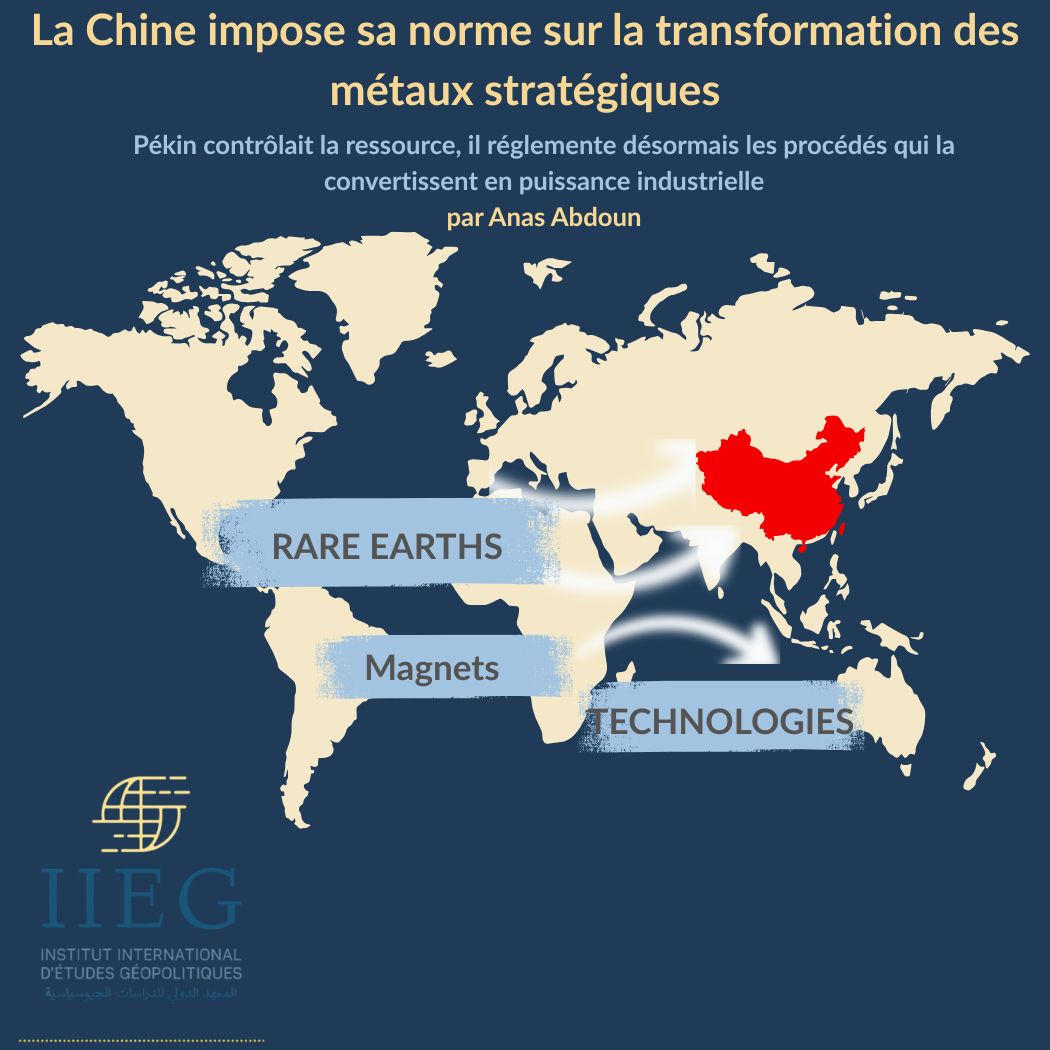
At the beginning of October, the Chinese Ministry of Commerce (Mofcom) extended its export licensing regime to rare earths, permanent magnets, “superhard” materials and associated technologies. A decisive new feature: the licensing obligation can apply even to goods manufactured outside China if they contain materials of Chinese origin or components produced with Chinese technology, a clear step towards the extraterritoriality of controls, until now an American trademark. Specialized firms detail a “50% rule”: beyond a certain threshold of Chinese rare earth content or dependence on Chinese processes, authorization from Beijing becomes necessary, including for exports carried out by non-Chinese players. State policy instrumentThis shift comes at a time when China already dominates the downstream sector: around 70% of global rare earth mining production and 90% of separation/refining capacity. In other words, Beijing no longer controls only matter; it regulates access to the process that transforms the resource into industrial power (NdFeB magnets, sputtering targets, strategic alloys). The markets have it understood: these controls are thought of as instruments of state policy, not simple commercial measures. The decision on export licenses conditions access to processing, including when the material or the factory is not in China. Chinese communication also assumes a staircase logic: after gallium, germanium and graphite in 2023, here are magnets, powders and technological bricks of hard industrial (batteries, magnetization, abrasives, semi-conductors). Western manufacturers, from ASML to large equipment manufacturers, say they have stocks and alternative sources in the short term, but recognize a structural risk if the tightening continues. From black gold to rare earthsAt the turn of the years 2000-2010, the United States and China were on strategic parity on a key point: both depended on hydrocarbon imports. The shale revolution has broken this symmetry. From 2015 and especially since 2019, the American energy equation is reversed: Washington becomes a net exporter over the year, gains a cost advantage and logistical autonomy (less dependence on maritime routes). Beijing remains a long-term net importer of oil and gas. On energy, the advantage therefore goes to the Americans. But the technological bifurcation shifts the center of gravity. In the economy of high-performance magnets, electric motors, wind turbines, precision sensors and defense/optics/power chains, rare earths are becoming the pivotal resource. And in this area, the structural advantage is Chinese. The asymmetry is not so much due to the ore as to the downstream: chemistry, metallurgy, processes and know-how. The October export licensing decision precisely locks this legal endorsement: it conditions access to processing, including when the material or the factory is not in China. Chinese extraterritoriality: a level of powerThe “extraterritorial” extension of Chinese control marks a level of power because it shifts the norm to where the advantage now lies: the downstream of critical materials. Until now the prerogative of Washington, extraterritoriality now applies to goods manufactured outside China as long as they incorporate Chinese materials, processes or intellectual property. Compliance no longer depends only on the exporting country, but also on the power of the process. However, this downstream feeds precisely the chains that will be the economy of the decade: semiconductors, AI, electrification, high-intensity defense, all materials-intensive. By licensing access to its chemistries, separations and alloys, Beijing does not decree an embargo: it controls the tempo, can defer or authorize according to its priorities, and obliges companies and States to live in the era of extraterritoriality of Chinese law. Concretely, it is a lever on the speed of equipment of Western factories, therefore on the rate of adoption of technologies which will create the competitive advantage in the future. The White House quickly reopened the political channel by maintaining a summit meeting with Xi Jinping, a sign that pure coercion is not enough. Management of Sino-American interdependenciesAs a backdrop, the tariff escalation announced by Donald Trump – up to 100% on certain Chinese flows – reminds us that Washington has formidable leverage: the depth of its domestic market. But faced with a China whose exporting power irrigates entire sections of global supply, the customs weapon has an immediate political cost: inflationary pressure in the United States and the increase in the cost of supply chains. Moreover, after brandishing the threat, the White House quickly reopened the political channel by maintaining a summit meeting with Xi Jinping, a sign that pure coercion is not enough, and that the equation also involves the management of interdependencies. Basically, everything comes back to the same reality: we are not in another commercial episode, but in a competition for hegemony. America anchors its advantage through energy, market and standard; China is establishing its own through materials, industrial approval and, now, the export of its rights. The decade that is opening will be less a rupture than a duel of tempos - which, from Washington or Beijing, will impose its pace at the heart of the technologies that will drive tomorrow's growth.

A quiet force at the heart of regional turbulence In a Middle East plagued by violent changes and increasingly acute rivalries, Egypt remains one of the rare states to have been able to preserve a line of conduct based on reason, moderation and the search for consensus. For decades, Cairo has established itself as a quiet force: a balancing power, heir to a long diplomatic tradition shaped by Pharaonic history, the wisdom of Arab-Muslim civilization and the spirit of national responsibility. A diplomacy of moderation and responsibility In a period where regional balances are under strain and where voices of confrontation attempt to stifle those of dialogue, Egypt reaffirms its central role in favor of peace, stability and the sovereignty of nations. Under the leadership of President Abdel Fattah al-Sissi, Egypt has maintained a clear and consistent position of principle: that of respect for international law, the rejection of violence in all its forms and the defense of human dignity. This posture, deeply rooted in the history and values of the Egyptian people, reflects the conviction that peace is not an option, but a shared responsibility. Cairo, nerve center of regional diplomacyDespite the considerable challenges and human tragedies unfolding on its borders, Egypt has chosen the path of reason and restraint. It tirelessly continues its diplomatic efforts, mobilizing its mediation channels to promote a comprehensive and lasting ceasefire, and create the conditions for an inclusive dialogue between all parties concerned. In recent months, Cairo has once again become a nerve center of regional diplomacy, welcoming heads of state, politicians and international representatives determined to find a way out of a crisis of unprecedented magnitude. Through its constant action, Egypt has demonstrated that the search for peace is a long-term commitment, based on trust, mutual respect and the vision of a common future. Today, while tensions persist and extremism seeks to sabotage any progress, Egypt remains faithful to its historic vocation: working for reconciliation, defending the legitimacy of dialogue and preserving regional stability. Its commitment to peace is not a matter of calculation, but of a duty towards the people and generations to come. History will remember that, in this critical phase, Egypt played its role with courage, wisdom and constancy. She was able to make the voice of moderation heard in a world in search of balance, which by definition remains very fragile. A strategic vision integrating development and security Far from being limited to a diplomatic posture, the quest for peace in Egypt is part of a global strategic vision. Cairo understands that political security cannot be dissociated from economic development, social justice and regional cooperation. This is why Egypt invests in cross-border projects – whether energy, water, trade or infrastructure – in order to consolidate an area of shared prosperity. In this logic, peace becomes a civilization project. It is nourished by education, interreligious dialogue, the fight against extremism and the promotion of a culture of coexistence. Presentation of the author The article by Khaled Hamadé, President of the International Institute of Geopolitical Studies, is a geopolitical analysis which highlights the crucial and moderating role of Egypt in a Middle East marked by strong tensions. The author highlights Egyptian diplomacy, under the leadership of President Abdel Fattah al-Sisi, as a constant and committed force in favor of dialogue, respect for international law and stability. The article presents Cairo as a nerve center of the negotiations, working tirelessly for de-escalation and the search for lasting peaceful solutions. This commitment to peace is carried by a particularly legitimate voice, that of Khaled Hamadé. As president of the International Institute of Geopolitical Studies, his expertise is recognized. But even more, his plea for peace is deeply rooted in his personal experience. Having himself suffered, along with the Lebanese people, the atrocities and suffering of the Lebanese war, he devoted his life to working on the path of reconciliation and dialogue. His career makes him a convinced man of peace, whose writings are not simple analyses, but powerful testimonies on the need to prefer diplomacy to confrontation.

A weakened Republic France is today going through one of the most serious crises of the Fifth Republic. Weakened institutions, social fractures, political divisions: so many signals which show that national cohesion is faltering. As Khaled Hamadé, President of the IIEG, points out: “We are witnessing a progressive disintegration of State authority which could lead to irreversible consequences for the stability of our Republic. » Reasons of State, designed to transcend partisan divisions, today seem to be stifled by electoral calculations and personal ambitions. Political fragmentation: chronic instability For a decade, the left-right divide has given way to a lasting tripolarization: A social and ecological left, A pro-European liberal center, A sovereignist and identity right. This configuration now prevents any stable majority. Since 2017, and especially after the legislative elections of 2024, France has experienced impossible governability: repeated dissolutions, ephemeral governments, motions of censure. As political scientist Pascal Perrineau observed, the year 2024 will remain that of “permanent instability”, with four governments in one year. A weakened and isolated state The crisis is also economic. Public debt reaches 113% of GDP, and the deficit amounts to 5.8% in 2024. These figures drastically reduce budgetary room for maneuver, compromising the State's ability to invest in the future. The crisis is also diplomatic. France, long a promoter of strategic autonomy, seems increasingly aligned with Washington. This orientation has contributed to isolating Paris, particularly in the face of Russia, and to weakening its traditional role as a balancing power in Europe. A society under tension The French are bearing the brunt of the rising cost of living and the housing crisis, with more than two million unsatisfied requests. The CEVIPOF barometer confirms citizen distrust: only 27% trust the Prime Minister and barely 16% the President of the Republic. At the same time, debates on immigration and communitarianism exacerbate the feeling of cultural and identity insecurity, accentuating social fractures. French society is exhausted and no longer believes in political promises. The specter of institutional collapse The concentration of power in the hands of the President, described as hyperpresidentialism, now weakens the system that it was supposed to protect. The dissolution of the National Assembly, presented as a solution, risks on the contrary accentuating instability. More and more voices are being raised to demand a in-depth reform of institutions, or even a Sixth Republic. For a national surge Faced with these dangers, answers exist. A temporary government of national unity to restore the primacy of the State. A reform of the voting method incorporating a dose of proportionalism to promote stable coalitions. A reaffirmed diplomatic independence, by redefining France's place within NATO and by dialoguing with all the powers. A social emergency plan, including housing and purchasing power. States General of the Republic, to give citizens the opportunity to rethink the institutional framework. These measures would aim to rebuild trust between those who govern and those who are governed, and to reaffirm the continuity of the State, a condition of any stable democracy. Conclusion: a “certain idea of France” to be reinvented France is not condemned. But it finds itself at a historical turning point. Two paths are available to it: reconnect with the republican spirit, or sink into a spiral of distrust and disorder. General de Gaulle spoke of “a certain idea of France”. This idea, which transcends particular interests, must once again become the driving force of our collective future. Rediscovering the meaning of public service, revaluing political function as a moral duty, and restoring the voice of the State are all conditions for lasting recovery. The Republic will not save itself by speeches, but by a lucid rebuilding of its social and institutional contract. More than ever, national resurgence appears to be a vital necessity to preserve democracy, sovereignty and the unity of the country.

In the history of modern Arab theater, the dramatic work of Naguib Mahfouz occupies a singular place. If his novels have ensured him worldwide recognition, his theater, more discreet, presents itself as a true aesthetic laboratory where he explores, through symbolism, the great spiritual, political and social crises of the Arab world. His plays He Makes Death and Makes Live (1974) and The Devil Preaches (1981) constitute two essential milestones: they translate, through highly symbolic figures, spaces and temporalities, the disenchantment born of the Arab defeat of 1967 as well as a critique of a sacred confiscated by ideology. Titles as keys to symbolismThe symbolism first emerges from the titles, which condense a strategy of inversion. He causes death and brings life hijacks a Quranic verse to overturn the sacred order of life and death, revealing a society where death is glorified to the detriment of life. The title then becomes a symbol of the ideology of martyrdom that Mahfouz denounces. Likewise, The Devil Preaches is based on an oxymoron: attributing to the Devil the function of preacher. This paradox symbolizes the displacement of truth, which no longer resides in the official discourse but in the marginal and forbidden voice. The inversion, as a symbolic process, reflects Mahfouz's desire to undermine religious evidence and to question the political use of the sacred. Symbolic time and scenic spacesThis use of symbolism also structures stage time and space. In these two pieces, time is never dated: it is suspended, cyclical, repetitive, a dramatic figure of spiritual impasse. The decor itself becomes a symbolic language. In He makes one die and makes one live, the water wheel represents the cycle of life, while the mastaba embodies frozen memory and the morbid glorification of the past. The Young Man, oscillating between these two poles, appears as the symbolic figure of consciousness in search of truth. In The Devil Preaches, the City of Brass materializes a closed, authoritarian universe, frozen in its laws, where only the margins – prison, exile, street – allow a possible truth to filter through. Spatial symbolism thus translates the conflict between life and death, light and darkness, freedom and oppression. Characters, speech and instructions: an allegory of the Arab worldThe characters relate to a symbolic typology more than a realistic psychology. The Giant embodies the religion of terror, a caricature of a power that speaks in the name of Allah to impose death. The Young Girl, luminous and silent, symbolizes on the contrary a poetic and Sufi faith, rooted in love and compassion. The Devil, paradoxically, becomes the emblem of a displaced truth: he embodies the marginal lucidity which dares to say what no one wants to hear. Even silence and gestures – covering one’s ears, laughing ironically, moving slowly – acquire a symbolic value, codifying power relations and spiritual choices. Mahfouz's theater thus becomes an allegorical fresco where each character, each object, each posture reflects a state of contemporary Arab consciousness. Dramatic speech as a critical instrumentDramatic speech, too, is not reduced to realistic dialogue but functions as a symbolic sign. The discourse of power, whether carried by the Giant or the Judges, is a fixed, stereotypical word, a symbol of ideological confinement. Conversely, the rare words of the Young Girl, the silence of the Sheikh or the irony of the Devil symbolize a truth that escapes control. The theater then becomes the place where the truth moves to the margins, where the symbolism of the weak voice or silence deconstructs the thunderous verb of authority. Didascalies and scenic contrasts The directions also participate in this symbolic architecture. The contrasts between light and darkness, the heavy silences, the codified gestures, all of this composes a choreography where the scene becomes a metaphor for the post-1967 Arab world: a closed, conflicting space, where the truth seeks to be told through indirect signs. The light surrounding the Young Girl symbolizes the transparency of the faith lived; the darkness enveloping the Giant translates the deadly dogma. The Devil's silent pauses become symbols of a suspended truth, which the spectator is invited to complete with his own consciousness. Critical and spiritual scope of symbolism in MahfouzUltimately, the symbolism in Mahfouz's theater goes beyond the simple aesthetic register to constitute a critical strategy. It is through symbol that he denounces the instrumentalization of religion, reveals the crisis of Arab consciousness and outlines a spiritual solution. Theater does not reproduce reality, it metaphorizes it: it invites the spectator to decipher the signs and reconstruct meaning. The faith that emerges is not institutional but poetic and interior: it is housed in light, silence, love and even in the paradoxical provocation of the Devil. Symbolism thus becomes a vector of spiritual resistance, a way of breathing new life into the sacred in the face of its ideological diversion. Through He makes one die and makes one live and The Devil Preaches, Mahfouz creates a theater where everything is a symbol: the title, the setting, the characters, the words, the silence, the light. This symbolic theater, far from being a simple formal experiment, reveals itself to be a weapon of unveiling and resilience. It opens a space where the sacred is regenerated by freeing itself from power, and where dramatic art regains its function as a spiritual and critical mirror, calling for a reconciliation of humans with their inner truth.

In contemporary history, each era has seen a resource established as a pillar of power. Coal and steel in the 19th century, oil and gas in the 20th, digital data in the 21st. These strategic resources condition the independence of nations, structure alliances and even have the power to trigger conflicts. Today, an ancestral resource, which we took for granted, finds an unexpected centrality. It's water. Described as blue goldby some, it is a factor of health and well-being as much as a variable of security, social stability and power. The planet is not lacking in volume, but it is good quality fresh water easily accessible to populations that is lacking. Already, a fifth of the world's population does not have access to drinking water, while demand everywhere is exploding with urban and agricultural growth. Droughts are intensifying, pollution is worsening, and demographic projections predict an explosion in the number of city dwellers before the world population begins a decline. Not all countries face the same challenge. Some, like Brazil, inherit a deceptive abundance. Others, like Morocco, are faced with structural scarcity which forces it to consider water as an issue of survival and sovereignty. In the new hit parade of strategic resources, the Kingdom finds itself at a crossroads. It must manage water scarcity and make it a lever of stability and influence, or be condemned to suffer it as a systemic vulnerability. Water capital in decline.In less than a century, Morocco has gone from a situation of water affluence to worrying scarcity. In the 1960s, each Moroccan could have an average of 2,500 m³ of fresh water per year. Today, this figure has collapsed to around 650 m³/inhabitant/year — this is well below the international scarcity threshold set at 1000 m³. This trend is structural and is aggravated by a climate that has become unpredictable – frequent droughts, irregular rains and shifts in seasons. Morocco's water resources are limited and very unevenly distributed. The country's average annual potential is estimated at 22 billion m³, including 18 billion of surface water and 4 billion of groundwater. But these figures mask a strong territorial disparity. More than 50% of resources are concentrated in the North and Center, leaving the South and East in permanent vulnerability. Agriculture largely dominates national consumption. Total annual consumption reaches approximately 16.3 billion m³, of which more than 80% is in fact intended for agricultural irrigation. This model is based on more than 2 million irrigated hectares, a growing part of which is oriented towards export. In other words, Morocco exports its water through its agricultural products. The country has 130 water tables (32 deep and 98 superficial) covering nearly 80,000 km². But this underground heritage is largely overexploited. Aquifers provide more than 90% of the rural drinking water supply and irrigate nearly 40% of agricultural areas. However, their piezometric level has been falling continuously for several years and some are no longer able to recover, even in years of heavy rain. Pressure, threats and paradoxes.In Morocco, water is a resource that is both rare and fragile. It irrigates the land, supplies cities and industries. But its current management method reveals profound contradictions which, far from bringing the country closer to water security, on the contrary aggravate its systemic vulnerability. Faced with the scarcity of surface water, withdrawals from groundwater are increasing. This emergency solution exhausts capital that has been built up over centuries. Several basins (Tensift, Souss-Massa, Oum Er-Rbia) are experiencing an alarming piezometric decline. In certain cases, even a succession of particularly rainy years would no longer be enough to replenish the reserves. Exhaustion becomes irreversible. To this quantitative scarcity is added a qualitative scarcity. Groundwater and rivers are contaminated by nitrates from fertilizers and livestock waste. In certain agricultural regions — Chaouia, Doukkala, Massa, Bou Areg — concentrations exceed 100 mg/l, which is well beyond the health standard of 50 mg/l. Added to this agricultural pollution are domestic and industrial discharges, which are insufficiently treated. The water resource becomes unfit for consumption and costly to clean up. The current climate in Morocco further accentuates the pressure. Periods of drought are more frequent and longer, rains increasingly rare and irregular. Forecasts predict a 10 to 20% reduction in renewable resources by 2050, even as demand continues to grow due to urbanization. To conclude, the paradox is institutional. Morocco has advanced laws (10-95, 36-15), basin agencies and specialized advice. But these systems suffer from chronic underfunding, lack of coordination and a lack of reliable data. As a result, the water strategy remains atomized, reactive and more focused on supply than demand. Building water sovereignty.Faced with the scale of the problem, Morocco is not inactive. Major projects are being launched, but their effectiveness will depend on the ability to quickly change the paradigm. It must move from a logic of capture to a logic of integrated and sustainable management. For this, the Kingdom relies heavily on technology. It has launched an ambitious seawater desalination program, with stations already operational in Agadir or Laâyoune and a megaproject planned in Casablanca. At the same time, the reuse of wastewater (ReUt / ReUse) for irrigation and green spaces is developing, as is the modernization of irrigation systems - thanks in particular to drip irrigation. These innovations reduce dependence on rain but remain costly and energy-intensive, which raises the question of their long-term sustainability. We must now reform the country's agricultural practices. With more than 80% of water consumed each year, agriculture is the heart of the problem... and also that of the solution. Experts recommend capping withdrawals, limiting crops that are too demanding - citrus fruits, watermelons, avocados - and promoting sectors that use less water and are better adapted to the semi-arid climate. We must also review the logic of exporting agricultural products – which is equivalent to exporting a rare resource. But water security is above all a question of governance. Recent reports from IRES and IMIS converge, it is necessary to set up a unified national water data system, enforce existing laws, strengthen basin agencies, and establish progressive pricing which will encourage sobriety. In other words, we must move from a model centered on supply – dams, drilling – to integrated management of demand. Finally, Morocco must adopt the Nexus approach. Water scarcity cannot be treated in isolation. It is inseparable from energy – the need for electricity for desalination –, from agriculture – irrigation and food security –, and from ecosystems – wetlands, forests, coastlines. The Nexus approach involves thinking about water in its systemic interactions. For Morocco, this approach is the only path towards true water sovereignty, which will condition its social stability and its geopolitical influence. From shortage to geohydric influence. Faced with a structural drought, accentuated by climate variability, agricultural harvesting and rapid urbanization, the Kingdom is at a decisive turning point. All recent reports confirm it, we must reconfigure the model, no longer around supply but around sustainable management of demand. But this scenario can – and must – also become an opportunity for water soft power. Morocco, like its success in the field of renewable energies, could ultimately make its experience a vector of regional influence - an exportable model and a hub of solutions and expertise. Not by exporting water, but by offering standards, technologies and resilience engineering. This will involve building a strong geohydric narrative, based on innovation and cooperation. In a world under permanent water stress, the most influential nations will not only be the most resilient, but also those that have succeeded in converting the threat into a strategic asset.
American Debt: Towards a “Heart Attack” or a Simple Crisis of Confidence? Analysis by the International Institute of Geopolitical Studies (IIEG) under the direction of Khaled Hamadé The global economy is going through a phase of great uncertainty. The growing debt of the United States, combined with geopolitical tensions and social fractures, poses a major risk to the stability of the international monetary system. It is in this context that Ray Dalio, founder of Bridgewater Associates – the world's largest investment fund – recently issued a worrying warning: A US debt “heart attack” could occur in the near future. The President of the International Institute of Geopolitical Studies (IIEG), Khaled Hamadé, and his team of experts believe that these comments must be taken with the greatest seriousness, given the importance of Dalio as an analyst and the global scope of the issues raised. But beyond the medical analogy, what is the reality of the situation? Ray Dalio: An authoritative voice in crisis analysisRay Dalio is no ordinary observer. Legendary investor and founder of Bridgewater Associates in 1975, he made his fund the most influential in the world with hundreds of billions of dollars under management. Author of several major works, including "Principles for Navigating Big Debt Crises", he is recognized for his ability to analyze economic and financial crises over the long term. His warnings are all the more heeded because they are based on a historical perspective, identifying the cycles of debt and recurring crises in the dominant economies. On July 24, 2025, in an interview with Fortune, Dalio said: "We spend 40% more than we take in, and it's a chronic problem. It's like plaque in the arteries that compresses purchasing power. "A debt that threatens to suffocate the system. For Dalio, the American situation resembles that of a patient whose excesses accumulated over decades end up causing a heart attack. The “heart attack” he speaks of corresponds to the explosion of public debt that has become unsustainable after years of chronic deficits and ultra-expansionary monetary policies.The figures speak for themselves: American debt today represents more than 120% of GDP, placing the United States among the most indebted countries in the developed world. Even more worrying, interest payments on this debt now represent more than 3% of GDP, even exceeding the defense budget. With almost a third of the debt maturing in less than a year, the US Treasury must constantly refinance itself on the markets, making it vulnerable to any rise in interest rates. Since 2008, US debt has continued to grow, reaching historic levels after the massive pandemic-related stimulus packages of 2020. This dynamic, according to IIEG experts, constitutes a major systemic risk that goes well beyond American borders, because the dollar remains at the heart of the global monetary system. The Real Risk: A Crisis of Confidence rather than Bankruptcy. It is crucial to understand that the danger for the United States is not bankruptcy in the traditional sense. As the issuer of its own global reserve currency, the US Treasury cannot technically default.As a last resort, the Federal Reserve can always create money to buy the debt. The real danger is a crisis of confidence. This scenario materializes when investors, domestic and foreign, begin to doubt the government's willingness or ability to control its fiscal trajectory. They then demand a higher risk premium to hold U.S. debt, which pushes up interest rates. This phenomenon can become self-fulfilling: the rise in rates increases the debt burden, which widens the deficit and reinforces investor distrust. The triggers for such a crisis could be persistent inflation, major political instability or a credit rating downgrade by rating agencies. Dalio estimates that there is more than a 50% chance that financial “trauma” will occur if nothing is done to correct the current trajectory. Social tensions comparable to the 1930s. Dalio also warns of the weakening of the American social and political fabric. Growing inequalities, ideological polarization and loss of trust in institutions create an unstable climate.According to him, the current situation is in certain aspects reminiscent of the 1930s and 1940s, marked by deep economic crises and rising international tensions. For Khaled Hamadé and the IIEG experts, this combination of excessive debt and social fragility makes the system particularly vulnerable. Financial crises are never isolated: they interact with social and geopolitical dynamics, amplifying their effects and potentially leading to upheavals well beyond the economic domain. Bitcoin and Gold: refuge from the fragility of the dollar. Faced with these threats, Ray Dalio recommends the diversification of investment portfolios. Gold, the ultimate safe haven asset, retains its role and its demand by the central banks of emerging countries remains strong. Dalio recommends holding 10 to 15% in a diversified portfolio. Concerning Bitcoin, Dalio recognizes its potential as “digital gold”.With its supply limited to 21 million units, Bitcoin stands out from fiat currencies subject to the inflationary policies of central banks. This rarity, added to its decentralization and its resistance to censorship, gives it a special status. However, IIEG experts urge caution regarding Bitcoin. Its extreme volatility and increasing correlation with technology assets during times of financial stress reduce its diversification benefits. Additionally, adoption by central banks is almost zero, due to regulatory uncertainties and custody challenges. Bitcoin should be considered a high-risk speculative asset rather than an anchor of stability comparable to gold. A Warning Signal for the International Community. Ray Dalio's analysis takes on particular importance because it highlights the risk of a global systemic crisis. As president of the IIEG, Khaled Hamadé emphasizes, with his team of experts, that the "heart attack" of American debt is not a simple theoretical hypothesis: it could have global repercussions on markets, international relations and the stability of states.Although the dollar maintains its dominant position with 58% of global foreign exchange reserves, its relative decline is an underlying trend. The diversification towards gold and, with caution, towards Bitcoin, must be understood as a warning about the evolution of global monetary balances. What we should remember is to replace analogy with analysis. Ray Dalio's comments, placed in the current geopolitical and economic context, constitute a major alarm signal. They reveal a structural fragility of the international monetary system, aggravated by political and budgetary choices which accentuate imbalances. The “heart attack” analogy, although powerful, must be overcome. The risk weighing on American debt is not that of a sudden payment default, but that of a slow erosion of confidence, which could lead to a liquidity crisis. The tools to manage debt exist, but political polarization in Washington casts doubt on the willingness to use them decisively. For the IIEG and its president Khaled Hamadé, these warnings must encourage decision-makers, investors and institutions to anticipate a possible systemic crisis.The dollar's decline will likely be slow and orderly, but it prompts strategic asset diversification. In this landscape, gold confirms its anchoring role, while Bitcoin, despite its disruptive potential, remains a volatile alternative to be handled with the greatest caution. Because one thing is certain: if the United States were to suffer this “heart attack” of debt, the repercussions would be felt throughout the planet. Analysis carried out by the IIEG economics commission under the direction of Khaled Hamadé References[1] International Monetary Fund (IMF) - data.imf.org [2] Committee for a Responsible Federal Budget (CRFB) - crfb.org [3] U.S. Congress Joint Economic Committee (JEC) - jec.senate.gov [4] Fortune (July 24, 2025) - "Ray Dalio issues his most dire warning to America yet" - fortune.com [5] NYDIG - nydig.com[6] World Gold Council - gold.org

Lebanon: on the edge of the geopolitical precipice, between external pressures and internal crises Lebanon has never been closer to a breaking point. Between external pressures, internal crises and regional ambitions, the country of Cedar finds itself at the center of a complex geopolitical game, where it is no longer a real actor, but a field on which other powers advance their pawns. The threat of a new civil war, potentially more devastating than that of 1975-1990, looms over the country. A geopolitical vise that is tightening Western capitals are demanding rapid disarmament of Hezbollah, without addressing the root cause of its influence: its strategic anchoring in the Iranian orbit. Israel, benefiting from implicit support, maintains constant military pressure, ready to strike its targets in southern Lebanon as well as in the Bekaa plain. Faced with this pressure, Tehran considers Lebanon as a central element of its regional system. For Iran, giving in on this front would mean weakening its position throughout the Middle East. In this regional chess game, Lebanon is seen as an expendable piece, not as a player in its own right. The lingering shadows of Damascus and AnkaraLebanon’s prolonged instability is reviving old appetites. Damascus has never renounced its influence over the country, forged by decades of tutelage and political interference. Ankara, more discreet but strategically active, seeks to increase its presence in the Eastern Mediterranean, exploiting every flaw in the Lebanese political architecture. Each internal crisis thus becomes an opportunity for regional powers to strengthen their influence, to the detriment of national stability. The structural weakness of the Lebanese state constitutes a breath of fresh air for these external ambitions. History as a warning The Lebanese conflict of 1975-1990 left deep scars in society and the economy. But a new conflict would not be a simple repetition: it would lead to even more radical fragmentation, weakening the last bases of national cohesion. History shows that it is not people who start wars, but those who hope to benefit from them. In the Lebanese case, they are numerous, and their means of action are formidable. A narrow path to avoid collapseIgnoring Iran in the Lebanese equation would be a major strategic error. The only realistic approach involves a discreet but concrete dialogue with Tehran, in order to negotiate a gradual and controlled disarmament of Hezbollah. This path is not synonymous with capitulation, but with diplomatic realism to prevent the country from becoming a proxy battlefield. At the same time, national unity must once again become a priority. President, Prime Minister and army must speak with one voice, not to satisfy the expectations of the great powers, but to preserve internal peace. Without internal cohesion, no external strategy will be able to protect Lebanon. Lebanon cannot afford pride A crossroads of civilizations for more than 6,000 years, Lebanon has survived thanks to its resilience and its capacity for reinvention. But today, the country no longer has the luxury of ideological posturing or internal quarrels. The challenge is not only to avoid war: it is to preserve the plural identity of the country and its historical role in the region, from Beirut to Tripoli, from Mount Lebanon to the Bekaa plain. Lucid realism as a survival plan The salvation of Lebanon requires lucid realism: Recognize current geopolitical truths. Dialogue with all stakeholders, including those who are disruptive. Protect internal unity and sovereignty at all costs. To refuse this realism is to risk transforming the country into a collateral victim of a conflict that it did not choose. Preserving Lebanon also means preserving a unique civilizational jewel in the world, a space where communities, cultures and intertwined histories coexist.
As soon as Russia attacked Ukraine on February 24, 2022, President Putin ordered his country's nuclear weapons to be put on alert. He subsequently indicated that Russia would use nuclear weapons if its vital interests were threatened. On August 1, 2025, President Trump ordered the deployment of 2 nuclear submarines near Russia. Recall that Russia and the United States are the largest holders of nuclear warheads: 5,977 for Russia and 5,224 for the United States. In addition, these two countries have aircraft and submarines that launch nuclear weapons. Nuclear weapons have only been used twice by the United States on August 6, 1945 in Hiroshima, and August 9 in Nagasaki. Hiroshima was massively destroyed, resulting in the deaths of 140,000 people, not counting the thousands of residents who were irradiated and subsequently died. As for Nagasaki, 6 km2 of the city was devastated, leading to the death of 74,000 people and thousands of residents being irradiated.During the Cold War between the United States and the USSR, nuclear weapons were never used, considered as weapons of deterrence. On the contrary, several Treaties have been signed by the two countries for the reduction of these weapons. In the meantime, several countries have acquired nuclear weapons: China, France, the United Kingdom, India, Pakistan. Israel, and North Korea. Iran also wanted to acquire nuclear weapons, but it was attacked on June 13, 2025 by Israel, and on June 21 by the United States. This allowed the total or partial destruction of its nuclear arsenal. In 1968 the Nuclear Non-Proliferation Treaty was signed, and came into force in 1970. But several countries did not adhere to this Treaty, including India, Pakistan, Israel, and North Korea.We can only be concerned about the current situation, following the statements of President Putin and President Trump. Experts have calculated that the stored nuclear power would destroy planet Earth several times over. We must hope for reason and avoid at all costs a third world war which would bring about the end of humanity. We are all concerned, even countries that do not possess nuclear weapons. After the end of the war in Ukraine, which I hope is very close, we should convene a Major International Conference within the UN, for the general disarmament of nuclear weapons, or in any case its drastic reduction. And the firm ban on any other country from acquiring nuclear weapons

A catalyst for a profound transformation of Morocco Recall that it was on December 11, 2024 that Morocco, Portugal and Spain were officially designated as host countries for the 2030 FIFA World Cup. This is for the first time that an African country is associated with two European countries to organize the World Cup. This decision by FIFA will contribute to the rapprochement of the two continents: Europe and Africa.Under the High Patronage of His Majesty King Mohammed VI, the Le Matin Group under the presidency of Mr Mohamed Haitami, dedicated its 8th edition of the “Morocco Today Forum” to this important event on the theme “Vision of a King-Morocco 2030: Consolidating the foundations of a great nation”. The Forum which took place in Rabat on July 11, 2025 welcomed nearly 1,000 participants, and was moderated by high-level speakers within the framework of three panels: Making humans the key factor for success, making the 2030 deadline an accelerator of sustainable and inclusive socio-economic development, making Morocco a “Digital Nation”. Several personalities spoke at the Forum including the Head of Government (by video), the Minister of Youth and Culture, the Minister of Economy and Finance, the Minister of Industry and Trade, the Minister Delegate in charge of the Digital Transition, the president of the CGEM, and the CEO of Attijariwafa Bank.In their final declaration sanctioning the work of this edition, the speakers addressed the transformations to be undertaken to make Morocco a civic and competent society, where humans are at the heart of the project. There is reason to think about citizen ownership of the 2030 project, which is not exclusively that of the State but of all Moroccans. Hence the need to raise awareness among all citizens, to appeal to their civic-mindedness and their sense of hospitality to welcome the millions of visitors who will flock to Morocco. 35 million tourists are expected in 2030 for the Football World Cup. In this regard, there is reason to welcome foreign visitors at the same level as that reserved for them by Spain and Portugal. Hence the need to improve reception in our Airports and urban and extra-urban mobility, as well as compliance with the highway code (pedestrian walkways).On the economic front, there is reason to transform the 2030 World Cup into a level of growth, and to make this meeting a structural lever for sustainable growth, and not a simple economic peak. The 2030 World Cup must contribute to a Moroccan economy that is efficient over the long term, inclusive and creates jobs. The Minister of Economy and Finance, Mrs. Nadia Fettah, announced the creation of 100,000 jobs annually, and an estimated impact of +1.7% GDP growth. Hence the need to provide a clear and readable trajectory to investors, by making the economic environment predictable, attractive, and accessible for all types of economic actors, from large companies to SMEs. Concerning the investments made by 2030, there is reason to think in terms of a system, that is to say transport, reception, digitalization, rather than in terms of isolated projects. The objective is to ensure the coherence and overall impact of investments, through an integrated and intersectoral approach. There is also a need to create a “trickle-down” ecosystem for the entire economic fabric, allowing all companies to benefit from the opportunities generated by the 2030 World Cup. Moroccan banks are asked to diversify financing products, adapted to the territories and targets. In the digital sector, the final declaration calls for encouraging the emergence of Moroccan start-ups in artificial intelligence and data linked to event management, security and user experience. It also calls for progressive digitalization, but also inclusive, multi-sectoral and territorial. The “Morocco Today Forum” 2025 aims to create bridges between decision-makers, researchers, entrepreneurs and citizens around the challenges inherent to the 2030 World Cup, which much more than a sporting event is called upon to play a role in accelerating development on a national scale. In conclusion, we can only congratulate the organizers of this Forum which was a great success. The organization by Morocco, Spain and Portugal of the 2030 World Cup is an exceptional opportunity for our country. But it poses many challenges to overcome, hence the need to start working hard now, because 2030 is tomorrow.

A country on the verge of thirst Morocco is currently experiencing an unprecedented water shortage. Long considered a model in terms of hydraulic policy, the Kingdom finds itself confronted with a prolonged drought, which is weakening its economy, its society and its environmental stability. From Casablanca to the Tadla countryside, the population lives to the rhythm of cuts, dry wells and compromised harvests. Since 2018, years of water stress have followed one another, culminating in 2024 with water availability falling to less than 500 m³ per inhabitant per year, the international water poverty threshold. Added to this is a drop in GDP to 3.2%, a fall of 38% in national livestock, and dams at less than 40% of their capacity. The royal response: a national strategy for water sovereigntyFaced with this emergency, the leadership of His Majesty King Mohammed VI was decisive. In his speech of July 29, 2024, the Sovereign set a clear course: making the water issue an absolute national priority. Among the key measures: Desalination: produce 1.7 billion m³ of water per year by 2030, with more than 17 stations, including the largest in Africa in Casablanca. Dams: 16 new large dams under construction, for an additional capacity of 4.4 billion m³. Inter-basin transfers: launch of the first water highways. Localized irrigation: equip 1 million hectares with drip irrigation by 2030. Morocco thus transforms its natural constraints into catalysts for modernization. Innovation at the heart of the responseThe massive use of cutting-edge technologies marks a strategic breakthrough. Desalination, long marginal, is becoming central. The Casablanca station, supported by Veolia, will supply more than 7 million people. Other projects involve China or the United Arab Emirates, with stations running on solar energy to reduce their carbon footprint. In rural areas, precision irrigation is becoming widespread. In Tadla, more than 67,000 hectares have already been converted, resulting in water savings of 60% and increased yields. The use of sensors, analysis software and solar pumps paves the way for climate-smart agriculture. Even the industry is adapting: the OCP group is building a desalination plant in Jorf Lasfar, connected to a 219 km pipeline, to secure its operations while relieving public resources. Water diplomacy focused on AfricaAware that the water crisis does not stop at borders, Morocco is deploying a true water diplomacy. It shares its know-how with several African countries, enters into technological partnerships (Hungary, Emirates), and positions its companies as key export players. This united approach makes Morocco a continental water management hub, capable of inspiring reproducible models in similar environments. Signs of hope…and a warning After six critical years, 2025 marks an improvement in precipitation. The dams are regaining volume (+45% over one year), crops are restarting, and the water tables are starting to stabilize. But as the Minister of Equipment and Water reminds us, these rains should not lead to relaxation. Climate change requires a structural adaptation: alternation of long droughts and intense rainy episodes, reduced reliability of seasons, increased risks of conflicts of use. Morocco, model of adaptation in AfricaWater has become the mirror of national sovereignty. By building its production (desalination), storage (dams) and distribution (transfers) capacities, Morocco affirms its climate resilience. But this success is only possible with the involvement of everyone: the State which invests, farmers who modernize, industrialists who optimize, and citizens who save. The Morocco of 2030 is taking shape today: more independent, more innovative, more united. In each station, each drop, each irrigated field, a new page of the water transition of the Kingdom is being written.

International law, a pillar of the world order since the United Nations Charter of 1945, is today going through a profound crisis. Contested for its ineffectiveness in preventing conflicts, powerless in the face of massive violations of human rights, and often exploited by powers, it seems frozen even though the challenges of the 21st century require its transformation. However, far from being condemned to obsolescence, international law is at a turning point: its renewal is both desirable and necessary to preserve peace, justice and the primacy of law in international relations. Several areas for development appear to be priorities in order to save its solemnity and credibility, a subject of debate and in-depth research by elites and experts in the field. Strengthening sanction mechanisms: towards more credible justiceOne of the major weaknesses of international law lies in its lack of effective coercive means. Although the International Criminal Court (ICC) has marked undeniable progress, its capacities are severely limited by the lack of cooperation from States and political obstacles, notably in the United Nations Security Council. This, via the right of veto of permanent members, frequently paralyzes the procedures for investigating and prosecuting international crimes.NGOs plead for the use of the veto to be prohibited in cases of mass crimes, so as not to compromise justice in the name of geopolitical interests. Furthermore, it is essential to provide the ICC, as well as regional jurisdictions such as the African Court of Human Rights and the European Court of Human Rights, with increased financial resources, qualified staff and more robust executive mechanisms. Universalization of fundamental standards: for justice without bordersThe legitimacy of international law is based on the universality of its norms. However, several major powers (United States, China, Russia, Israel) still refuse to ratify the Rome Statute, the founding text of the ICC. This situation gives rise to selective justice[1], where certain crimes are prosecuted while others remain unpunished, depending on the balance of power.A real reform of the international system therefore requires the accession of these States to the main legal instruments, in particular the Geneva Conventions on humanitarian law. Amnesty International therefore calls for universal ratification of the Rome Statute[2], an essential condition for guaranteeing fair and global justice. Protecting the independence of international jurisdictions: against political interferenceInternational judicial institutions can only fulfill their role if their independence is guaranteed. Today, political pressures exerted on the courses, whether through conditional funding, partisan appointments or diplomatic interference, threaten their impartiality. This situation undermines citizen confidence and weakens the moral authority of these jurisdictions.Strengthening procedural guarantees, creating independent funding mechanisms and increasing transparency in appointment processes are essential. Some researchers, such as those from IRIS[3], also suggest the establishment of an independent body responsible for monitoring the political pressures exerted on international courts.This would make it possible to preserve the autonomy of judges, like the good practices listed in specialized academic journals such as “Questions nationaux” from Documentation Française, “Journal of International Criminal Justice” (JICJ) from Oxford University Press, the “European Journal of International Law” (EJIL) and many others. Fully integrating civil society and NGOs: an indispensable actorFaced with the limits of institutional mechanisms, civil society and NGOs have gradually emerged as central actors in international law. Their contribution to documenting crimes, mobilizing public opinion and putting pressure on institutions has become essential. In addition, technological progress today allows them to collect evidence via tools such as open source video surveillance, geolocation or collaborative databases[4].International non-governmental organizations indeed illustrate this ability to fill the void left by institutions. By integrating these actors into legal processes, in particular by recognizing their role in investigative procedures or by their consultation in the development of standards, international law could gain in efficiency, legitimacy and proximity to victims.Reinventing international law for the futureInternational law finds itself at a crossroads. If it does not adapt to the realities of the contemporary world, it risks sinking into ineffectiveness, or even irrelevance. However, solutions exist. By strengthening sanction mechanisms, universalizing fundamental norms, protecting the independence of institutions and fully integrating civil society, the international community can build an international law that is fairer, stronger and closer to the people.Such a renewal is imperative to guarantee that it is not the law of the strongest, but rather the force of law, which governs international relations in the 21st century.Sources:1 “Https://Www.Icrc.Org/En/Document/International-Humanitarian-Law-and-Global-Challenges-2024,” n.d.2 “Https://Www.Amnesty.Org/En/Documents/Ior40/6264/2024/En/,” n.d.

As the conflict between Israel and Iran reached a new threshold in June 2025, the international community can no longer be satisfied with calls for “restraint”. The time has come to demand one simple but fundamental thing: the rigorous application of international law. Otherwise, the Middle East - and beyond - risks sinking into a spiral of lasting instability. China and Russia: between calculation and ambivalence China, self-proclaimed mediator of a new regional order, pleads for stability. But its position remains unclear. Preserving its energy interests or its bilateral relations cannot justify silence in the face of the violation of international humanitarian law or preventive aggression. If it wants to be seen as an actor for peace, Beijing must clearly commit to a resolution based on legality. Russia, for its part, is juggling between strategic solidarity with Tehran and concern to preserve its hold on Syria. This ambivalence weakens his credibility as a mediator. Supporting state sovereignty while tolerating extraterritorial strikes goes against the very principles it claims in other theaters of war. Israel faces its strategic contradictionsThe Israeli offensive against Iranian infrastructure, presented as a national security measure, constitutes a serious attack on international standards if it is not justified by a clearly established, imminent threat. It has weakened ongoing diplomatic efforts, accentuated regional divisions, and alienated powers that, until now, supported Israel on the world stage. By freeing itself from multilateral frameworks, Israel strengthens the arguments of its adversaries and compromises its own long-term security. International law, far from being an obstacle, could be its best ally in breaking the current impasse. High-risk regional consequences!Tensions have already extended beyond the two direct protagonists. Armed groups have intensified their actions in various hotspots in the region, worsening the humanitarian situation and threatening trade routes. This dynamic escapes any centralized control, and can only be contained by a collective response, based on international legality. Demand more than diplomacy: justice Faced with this situation, three requirements must guide the global response: - Respect for international humanitarian law, including the protection of civilians and the prohibition of indiscriminate reprisals. - A return to multilateral dispute resolution mechanisms, particularly under the aegis of the United Nations. - Regional mediation accompanied by legal guarantees, rather than one-off and ambiguous security agreements. The law as the only defense. This conflict is not inevitable. But it cannot be contained by realpolitik alone. The only credible way to avoid a regional conflagration and lasting fragmentation of the Middle East is to place international law at the center of diplomatic responses. Silence, ambiguity or indulgence with regard to current violations will tomorrow be collective renunciations.

International law occupies a central place in the regulation of relations between states, the preservation of human rights, and the attempt to limit the destructive effects of armed conflicts. However, recent events in the Near and Middle East regions are putting its legitimacy, effectiveness and concrete application to the test. The fundamental role of international law today Despite its flaws, international law continues to represent an indispensable framework, notably through three main functions: limiting violence, regulating the use of force, and holding perpetrators of international crimes accountable. a) Limit armed violence International humanitarian law (IHL), based on the Geneva Conventions of 1949[1] and their additional protocols, sets clear rules in times of war[2]: The protection of civilians is an absolute principle; Indiscriminate attacks are prohibited; Prisoners of war must be treated humanely; Humanitarian access must be guaranteed to organizations like the Red Cross. However, in war zones like Gaza or Syria, these principles are often flouted. The use of explosive weapons in densely populated urban environments, strikes on hospitals or prolonged sieges that deprive civilians of access to vital needs are clear violations of IHL. b) Regulate the legality of the use of force International law, notably the United Nations Charter, strictly limits the use of force. According to Article 51[3], only self-defense or an explicit authorization from the Security Council can justify armed intervention; and how many conflicts, crimes are committed in the name of self-defense! However, unilateral interventions, such as that carried out by the United States in Iraq in 2003 without a UN mandate, have violated this principle, illustrating the difficulties in making the great powers respect these rules. c) Holding perpetrators of serious crimes accountable international criminal law makes it possible to judge war crimes, crimes against humanity and genocide. The International Criminal Court (ICC) was created for this purpose by the Rome Statute in 1998. It represents a major step forward in the fight against impunity. However, his authority is often contested. Countries like the United States, Israel, Russia and Syria refuse to recognize its competence[4]. Moreover, the ICC is sometimes accused of acting selectively, pursuing mainly African officials while other cases (such as crimes in Palestine or Afghanistan) stagnate or are slowed down. Ultimately, international law is far from perfect. It is often weakened by the hypocrisy of the great powers, the slowness of judicial mechanisms and the asymmetry in the application of the rules. But despite its flaws, it remains today the only common framework allowing the erection of legal, moral and political barriers against barbarism, violence and arbitrariness. Renouncing this right means agreeing to plunge back into a world where force takes precedence over law, and where justice becomes an illusion. Conversely, believing in it, reforming it and defending it means working for a more humane, more equitable and more stable world order. The structural limits of international law: between idealism and impotence International law suffers from an original defect: the absence of a real coercive mechanism. Unlike internal legal systems, it does not have a centralized executive force to impose its decisions. Its implementation is essentially based on the voluntary consent of States. This means that compliance with international standards depends largely on the political will of governments, which can vary depending on the strategic interests of the moment. This dependence makes international norms particularly vulnerable to power struggles and diplomatic hypocrisy. An emblematic example of this weakness is the United Nations Security Council, the main body responsible for guaranteeing international peace and security. Theoretically, it has binding means to impose its decisions (sanctions, peacekeeping operations, authorization of the use of force). But in practice it is often hamstrung by the veto power of the five permanent members — the United States, Russia, China, France and the United Kingdom. This blocking power, inherited from the Second World War, allows just one of these powers to defeat any resolution contrary to its interests. This institutional dysfunction regularly prevents crucial actions, particularly in cases of massive violations of humanitarian law or military aggression. Furthermore, international criminal law, embodied by the International Criminal Court (ICC), also suffers from a lack of coercive power. The ICC has neither police force nor its own means to arrest the suspects it indicts. It depends entirely on the cooperation of States. However, this cooperation is often non-existent, or even openly hostile. Many states, including major powers such as the United States, China, Russia and Israel, do not recognize the jurisdiction of the Court or actively oppose its functioning. This significantly reduces its reach, especially in the most politically sensitive cases[5]. Another essential limit lies in the instrumentalization of universal legal principles. International law is sometimes accused of being applied selectively, according to geopolitical logic. This reality fuels the discourse of “double standards”, particularly in the countries of the South. When an African leader is prosecuted for war crimes, but those responsible for similar violations in other regions escape prosecution, the legitimacy of the system crumbles. International law, supposed to embody the sovereign equality of States and universal justice, then becomes perceived as a tool of interference or domination. What if international law collapsed? Assumptions and dangers of a world without rules Faced with these limits and the increasing fragility of the international system, certain researchers and analysts are asking a radical question: what would happen if international law completely collapsed? If treaties lost their force, if international jurisdictions were no longer recognized, if common standards disappeared, what alternatives would remain for organizing international life? Several scenarios are emerging, but none seems capable of ensuring a stable, just and peaceful order. The first hypothesis would be a return to absolute sovereignty, in which each State would act freely according to its national interests alone, without feeling bound by external commitments. This model recalls the anarchy of the pre-20th century Westphalian system. It would mean the end of all multilateral regulation, and would open the way to permanent conflicts, unstable alliances, and increased competition for resources. A second alternative would be that of the law of the strongest. In a world where law is disappearing, military, economic or technological force becomes the only means of regulation. This would strengthen great powers at the expense of weaker states, and undermine the protection of civilian populations, minorities and refugees. This dystopian model would bring the international system closer to a Hobbesian chaos, where violence is omnipresent and security depends solely on power. A third possible scenario would be the emergence of compartmentalized regional systems, such as the European Union, the African Union, or the BRICS. Each bloc would develop its own normative framework, without global coordination. Although this may provide some local stability, this fragmentation would undermine the coherence of international law and reinforce legal inequalities depending on the region of the world in which one is located. The universality of rights and international solidarity would become inaccessible. Finally, a final hypothesis, still marginal but worrying, would be the installation of private or technological governance, dominated by large transnational companies and digital platforms. In a globalized world, these actors sometimes have more influence than the States themselves. They could impose economic, security or social standards beyond any democratic control. Such a model would widen inequalities and roll back fundamental rights. [1] “Amnesty International. 2024. International Humanitarian Law. Https://Www.Amnesty.Org/Fr/What-We-Do/International-Law/”. [2] “International Committee of the Red Cross (ICRC). 2024. The Geneva Conventions of 1949. Https://Www.Icrc.Org/Fr/Document/Les-Conventions-de-Geneve-de-1949.,”. [3] “Charter of the United Nations, Chapter VII: Action in Cases of Threats to the Peace, Breach of the Peace and Acts of Aggression - Article 51,”. [4] “Https://Www.Icc-Cpi.Int/about/How-the-Court-Works,”. [5] “Institute of International and Strategic Relations (IRIS). 2024. Studies on International Law and Contemporary Crises. Https://Www.Iris-France.Org/.,” n.d. [6] “United Nations. 2024. Maintaining International Peace and Security. Https://Www.Un.Org/Fr/Our-Work/Maintain-International-Peace-and-Security.,” n.d.

With his latest work recently published by Dalloz, “Should we abandon power to the scientists? The temptation of epistocracy”, Professor Alexandre Viala questions the foundations of contemporary democracy in the light of an ancient concept which dates back to Plato, but which is today relaunched by the geopolitical challenges attributable to the worrying rise of populism: that of epistocracy, that is to say government by the most competent or the most educated. In a context where representative democracy is going through a crisis of legitimacy, where social networks are shaking up the hierarchy of knowledge, and where technical decisions require increasingly sophisticated knowledge, Alexandre Viala asks a disturbing question: should the competence of decision-makers take precedence over electoral legitimacy? While refusing an authoritarian technocracy, he explores the tensions between rationality and popular will, and offers a stimulating reflection on the connection between knowledge and power. Professor of constitutional law and philosophy of law at the University of Montpellier, Alexandre Viala is a committed intellectual figure. Author of the reference manual “Philosophy of Law” (Éditions Ellipses), he directed for many years CERCOP (Centre for Comparative Constitutional and Political Studies and Research), a research center recognized for its rigor and its openness to major contemporary debates. For more than twenty years, he has also directed the Montpellier University Diploma in Philosophy of Law. His commitment is not limited to the university. Active member of the Scientific Council of the International Institute of Geopolitical Studies, based in Montpellier, Alexandre Viala makes a valuable contribution, at the crossroads of law, philosophy and geopolitics. The Institute, which brings together experts, academics and diplomats, aims to be a place for strategic reflection on major global issues, with particular attention paid to changes in law in international relations. Throughout his career, Alexandre Viala embodies a rare intellectual requirement: that of a legal thinker capable of bringing democratic ideals and the realities of knowledge into tension. His book is a call to think of democracy not only as a regime of freedom, but also as a permanent challenge to collective intelligence.

A presidential election took place in Gabon on April 12, 2025 and was won by Brice Clotaire Oligui Nguema, previously President of the Transition since March 30, 2023, the date of the coup which saw the departure of Ali Bongo Ondimba from power.Brice Clotaire Oligui Nguema, who was one of the 8 candidates for the presidential chair at the Seaside Palace in Gabon, largely won this presidential election with more than 94% of the votes cast. This was not a surprise because popular support was underway and the Constitution modified following a Referendum immediately excluded the candidates who could block it. In the aftermath of this victory confirmed and proclaimed by the Constitutional Court, there were no internal tensions as was the case in 2009, 2016 and 2023; just after the publication of the results. The only candidate who could respond to Oligui Nguema during this presidential election was Alain Claude Bilie By Nze, who unfortunately did not succeed in attracting the trust of a larger number of voters. Coming in second place with just over 3% of the vote, he still managed to position himself as the new leader of the opposition. What are the expectations expected by voters and what will change, particularly for foreign investors?Investors, for their part, expect more rigor in business law legislation, flexible application of the Mining and Oil Codes, in particular, but also more assurance and support in terms of finances to carry out major projects which are slow to come to fruition. In the aftermath of the presidential election, eyes are turned towards the formation of a new government which should take into account the combined efforts of the different alliances which favored the victory of Oligui Nguema who was not running. not under the banner of any political party, but as an independent. The new President of the Republic Brice Clotaire Oligui Nguema had obtained the support of almost all political forces, whether from the old PDG system, from the ex-opposition which participated in the transition, such as the tenors Alexandre Barro Chambrier or Paulette Missambo, or from formerly very critical voices of civil society such as the environmental defender Marc Ona Essangui or the lawyer Anges-Kevin Nzigou.After the phase protocol of the inauguration ceremony of the elected president which is scheduled for May 3, 2025, there will certainly be the formation of a government of national unity, quite broad, to reward the actors of this victory because Oligui Nguema needed broad support, in particular that of the Gabonese Democratic Party (PDG) whose break with the old system he nevertheless advocated but which ultimately supported him and got him elected. Will the next government be made up of senior officers from the Committee for the Transition and Restoration of Institutions (CTRI)?The question remains because to be a candidate in the presidential election of April 12, 2025, Brigadier General Brice Clotaire Oligui Nguema had to do without his military uniform to present himself as a civilian candidate. Will Oligui Nguema have a completely free hand to lead the country without his former brothers in arms? The question remains. Transactions between the parties, the associations, have certainly begun. Oligui Nguema's plebiscite is based on resolving the immediate needs of a little more than two (2) million Gabonese people by initially reducing inequalities. There is no significant middle class in Gabon. And this is a segment of the population that should be constituted. It is undeniable that Oligui Nguema risks being weighed down at some point by the former ruling party which mobilized for his victory. This is also a sign that several current ministers will leave their posts as soon as the new government is formed, the date of which is not yet known. An economic revolution which involves better management of Gabonese subsoil resources. To carry out mining projects, the development of the iron deposits of Belinga, Baniaka and Milingui, investments with high added value are essential. Infrastructure and national energy potential have not yet found solutions. The primary challenge will, in fact, be the construction of roads, bridges, deep-water ports and two-track railways. But also power plants to provide sufficient electricity for the proper functioning of factories. This requires large financial contributions that Gabon and foreign investors will have to release. With the end of the transition period and the return to constitutional order, foreign capital should abound to support the economic and social development of the country. Today, there is more assurance because Gabon is approaching the long term with an environment which is gaining confidence and which will reassure foreign investors. The projects awaiting the government are colossal. There is also the country's public debt. To find adequate solutions, the elected president should surround himself with experts and the best specialists in key areas of the economy. The question that remains is whether the President of the Republic Brice Oligui Nguema, who trained under the Bongo regime, will have full powers to lead the country at the level of the National Assembly and the Senate. We would probably have to wait around a few months of governance to appreciate the value and direction of the reforms initiated. A new president under the weight of numerous projects The bet for another way of leading the country enters a new era. In addition to the political aspect, eyes are now turned towards the economic development of the country which has fallen far behind in relation to the wealth at its disposal. A desired economic expansion which will involve a better distribution of income within the population. The election of Brice Clotaire Oligui Nguema is considered a revival in Gabon. But major projects await the next government. Who are the personalities who will make up the next government?There are many of them knocking on his door. Let's start with Hermann Immongault, the Minister of the Interior, whose department organized the vote across the country. There is also the current Prime Minister Raymond Ndong Sima; the Vice Prime Minister Alexandre Barro Chambrier; But also Jean-Pierre Oyiba, the general campaign coordinator of Brice Clotaire Oligui Nguema. Some personalities from civil society appointed by Oligui Nguema to the Senate, the National Assembly, and the Economic, Social and Environmental Council (CESE), could undoubtedly be part of the next government. Certain candidates who, during the presidential election, openly supported the program of the elected president, could see themselves rewarded. This is the case of Alain Simplice Boungoueres, leader of the Gabonese Citizens' Movement (MCG). the latter proposed, among other things, the creation of a Sovereign National Pardon Fund (FSPN), endowed with 40 billion CFA francs, intended to allow the return of Gabonese political exiles, victims of injustice, by offering them land and financial compensation. The day after his victory, elected President Brice Clotaire Oligui Nguema invited his collaborators to continue the efforts deployed during the past 19 months. For him, "the presidential election has passed and the work must continue." The Gabonese population is estimated at just over 2 million inhabitants. Resources are abundant but the Gabonese economy has always been dominated by the export of wood, manganese, oil and soon by iron and then many other precious metals. Despite this intrinsic economic potential, Gabon, with an area of 268,000 km2 and more than 80% covered by dense forest, is struggling to achieve sustainable and inclusive growth. Even though it is recognized that Gabon has the highest gross domestic product (GDP) per capita in Africa, the distribution of wealth within the population still remains unequal and in 2022, according to the World Bank, one in three Gabonese people still lived below the poverty line.

Exclusive interview with Mr. Khaled Hamadé, President of the International Institute of Geopolitical Studies (IIEG) Produced by Antoine Lawson, director of the Infoplus Gabon agency The framework agreement signed on June 11 June 2025 in London between the United States and China marks a decisive turning point in Sino-American relations. Beyond mutual trade concessions, this agreement opens a new era of strategic management of the rivalry between the two great powers. Decryption with Mr. Khaled Hamadé, president of the IIEG, a recently founded think tank already influential in diplomatic circles. Antoine Lawson: Mr. Hamadé, this agreement comes after months of commercial, technological and military tensions. Does it really mark a major geopolitical turning point? Khaled Hamadé: Absolutely. We are witnessing the emergence of a new geopolitical doctrine that I call regulated competition. Unlike the Cold War when the world was divided into two antagonistic blocs, the current era sees the superpowers alternating confrontation and cooperation according to their vital interests. The London agreement is emblematic of this new logic: Washington and Beijing are competing for global hegemony, but are forced to negotiate to preserve the stability of their interconnected economies. Strategic realism is required. Antoine Lawson: Rare earths seem to be at the heart of the agreement. Why are these resources so strategic today? Khaled Hamadé: Rare earths have become the equivalent of oil in the 21st century. They are essential to the manufacturing of advanced technologies: smartphones, wind turbines, electric vehicles, sophisticated weapons. However, China provides 92% of global refining of these critical metals. This industrial domination gives it major geopolitical leverage. The signed agreement highlights an embarrassing American dependence: despite its military power, Washington remains technologically vulnerable, because it depends on a strategic rival for access to these resources. Antoine Lawson: Can we say that this agreement contributes to the establishment of a multipolar world? Khaled Hamadé: Paradoxically, yes. By recognizing their interdependence, the United States and China are sending a strong signal to regional powers: they too can benefit from Sino-American competition. The BRICS, in particular, are watching closely. India is accelerating its mining investments in Africa, Russia is banking on strengthened energy diplomacy, Brazil is more interested in the geopolitical valorization of its natural resources. We are witnessing the formation of regional strategic coalitions, capable of countering the exclusive influence of Washington and Beijing. Antoine Lawson: What role can Africa hope to play in this new global arena? Khaled Hamadé: Africa has immense geostrategic potential: it contains 50% of the world's cobalt reserves, 85% of manganese, and a significant portion of rare earths not yet exploited. But this potential is not synonymous with power. We need strong political will and a pan-African vision. The Sino-American agreement opens a window of opportunity: Western powers are seeking to diversify their supplies, which gives Africa unprecedented negotiating power. Provided, of course, that we overcome the logic of rent, national rivalries and focus on regional integration. Antoine Lawson: This raises the question of the economic sovereignty of African states. What do you think? Khaled Hamadé: Sovereignty in the 21st century is no longer measured solely by political or military independence. It is defined by the ability to control its strategic resources, to transform them locally, to create value. African countries must move up the value chains: build refining units, train engineers, create transnational consortia. Replacing a Chinese dependency with an American dependence would be a mistake. True sovereignty consists of playing on the rivalry between powers to obtain maximum advantages. Antoine Lawson: How do you see these issues evolving in the coming years? Khaled Hamadé: We are entering the age of strategic resources. It is no longer the only military power that shapes the balance of power, but also control of access to critical metals, water and energy. Three scenarios are possible: The balance of economic terror, where interdependencies become Fragmentation into watertight economic blocks, synonymous with protectionist withdrawal. Regulated multipolarity, where several centers of power cooperate according to rules In all cases, the States which control critical resources will be at the heart of international arbitrations. The London agreement is only the first act of a restructuring that could last decades.

"The Moroccan Sahara: Land of Light and Future" – A Journey to the Heart of the Desert In a book overflowing with passion and faith, the Franco-Swiss writer Jean-Marie Heydt takes us on a journey through pages bathed in light, carried by hope, and perfumed by the expanse of sands in a horizon that knows neither break nor end. The title alone is a poem: “The Moroccan Sahara: Land of light and future”. From the first lines, the author does not just transmit information. He sows words like grapes in a golden dish. He heads towards the Moroccan south, not as a simple traveler passing through, but as a lover who came late, to apologize to the desert on behalf of those who misunderstood him. He places his hand on his pulse and hears the ancient stories echoing in the silence of the dunes. He contemplates the azure sky and reads there the poems of dreams and the promise of life.He says to the Western reader: stop for a moment. Listen.Don’t reduce the desert to a simple point of contention in a geography textbook. This is not disputed land. It is a land of light, of memory, of human beings who love, create and perform miracles with little. Poems are born from its sand. Songs spring from the hearts of its inhabitants. From its embrace came the tribes that united north and south, desert and ocean. A Wonderful Dive into Saharan Culture Jean-Marie Heydt moves forward as one opens a sacred book. He marvels at the blue eyes, the warmth of Dakhla, the murmur of the oases of Smara. He speaks of Saharan clothing as a poet speaks of his beloved, and of Hassani poetry as one speaks of the prophets. In every tent he sees a novel. In every marriage, an epic worthy of the Arabian Nights. He speaks of camels, not as mere beasts of burden, but as symbols of historical patience. It evokes men and women as if they were the silent pillars of this noble and vast nation.But the magic of the past does not distract him from the clarity of the present. Here he describes the roads crossing the desert as arteries in a living body, ports under construction, airports being inaugurated, investments sowing hope in sands long mistreated by media and political discourse. He sees in the Moroccan Sahara not only a brilliant past, but a future taking shape, in silence, with perseverance, and under a clairvoyant royal vision. A Call for Reason and Understanding The author does not avoid the political dimensions, but he approaches them with the nobility of a thinker, not the noise of an orator. He calls for peace, understanding, respect for sovereignty with deep humanity. He believes that the autonomy proposed by Morocco is not only a political solution, but a promise of a dignified life for the sons of the desert, within a nation that recognizes all its diversity. He invites Europe to see the truth with the eyes of reason, and not through the prism of interests. Listen not to what is being said, but to what is really happening on the ground.This book is not a report. It is a sincere mirror. A source of love. An illumination of consciousness. Jean-Marie Heydt wrote it not to defend one side against another, but to defend the truth. To say that the Moroccan Sahara is not an unsolved story, but a dawn that is beginning to shine. On each page of this work, we hear the quivering of a palm tree in silent prayer, we breathe the scent of hot tea on the embers of hospitality, we see the shadows of dawn slipping between the tents of Laâyoune, looking for a child who traces his future with a wooden stick on the sand. “The Moroccan Sahara: Land of light and future” is a message of love. A document of light. A promise that tomorrow is already beginning.

On May 1, 2025, Ukraine and the United States signed a landmark agreement in the field of natural resources, aimed at establishing a joint investment fund for the reconstruction of Ukraine, while providing American companies with privileged access to Ukrainian mineral resources. This agreement, although hailed by some as a strategic step forward, raises questions about its economic repercussions, particularly for the European Union. An agreement with strategic contours The agreement stipulates the creation of a joint investment fund, with equitable sharing of revenues from future mining projects, such as lithium, titanium, uranium and rare earths. Ukraine retains full ownership of its natural resources and infrastructure, but the profits generated will be reinvested in the reconstruction of the country for the first ten years. After 2035, dividends can be distributed. However, this agreement does not provide any security guarantees from the United States for Ukraine, and the question of NATO membership will be addressed separately, as part of a future peace agreement with Russia. Reactions and implications for the European UnionThe European Union, already engaged in a strategic partnership with Ukraine since 2021, finds itself faced with a complex situation. On the one hand, the agreement offers American companies privileged access to Ukrainian mineral resources, thus strengthening the influence of the United States in the region. On the other hand, Europe fears that this agreement will marginalize its own initiatives and reduce its role in the reconstruction and economic development of Ukraine. European authorities have expressed concerns about the management of Ukraine's natural resources and stressed the need for close cooperation between the EU and Ukraine to ensure sustainable and equitable exploitation of these resources. The European Commissioner for Industrial Strategy, Stéphane Séjourné, has proposed an alternative agreement, highlighting a “win-win” approach that prioritizes mutual interests and sustainability. Economic consequences for Europe The agreement between the United States and Ukraine could have several repercussions on the European economy:1. Limited access to resources:European companies could find themselves excluded from mining projects in Ukraine, reducing their access to strategic resources essential for the energy transition and the technology industry. 2. Increased competition:The increased presence of American companies in Ukraine could intensify competition for European markets, particularly in the energy and technology sectors. 3. Geopolitical uncertainty:The lack of security guarantees from the United States could increase instability in the region, negatively affecting European investments and energy security. 4. Financial pressure:The European Union could be called upon to assume a greater share of Ukraine's reconstruction costs, while the United States appears to favor an approach more focused on direct economic returns. Future outlook Faced with these challenges, the European Union will have to adopt a proactive strategy to preserve its economic and geopolitical interests: Strengthen cooperation with Ukraine: Continue and deepen existing partnerships, with an emphasis on sustainability, transparency and inclusiveness in the exploitation of natural resources. Diversify sources of supply: Explore new supply routes for strategic resources, in order to reduce dependence on single and potentially unstable sources. Promote innovation and competitiveness: Invest in research and development to strengthen Europe's position in key sectors of the global economy. Maintain transatlantic unity: Dialogue with the United States to ensure effective policy coordination and avoid divergences that could harm common interests. Ultimately Although the agreement between the United States and Ukraine opens new prospects for the reconstruction of Ukraine and access to its natural resources, it also presents considerable challenges for the European Union. A balanced approach, based on cooperation, innovation and solidarity, will be essential to navigate this new geopolitical and economic landscape.

Since 2019, Lebanon has been going through a multidimensional crisis profoundly affecting its democratic institutions. The municipal elections, initially scheduled for 2022, have been postponed several times due to major factors such as the COVID-19 pandemic, the economic collapse, as well as the deterioration of security in the south of the country, marked by recurring clashes between Hezbollah and Israel.This postponement has raised serious concerns about the continuity of the democratic process and the legitimacy of local authorities, especially since municipal councils ensure the management of essential public services. Many councils have also resigned or ceased to function since the last elections in 2016, due to lack of financial resources or personnel.Lebanese President Joseph Aoun nevertheless reaffirmed his commitment to the return to stable democratic life, a commitment shared by the government. This commitment was materialized in the preparations and holding of the 2025 municipal elections. 1. Issues in the 2025 municipal elections a. Local governance and public servicesLebanese municipalities play a key role in providing services such as waste management, infrastructure maintenance and social services. Their dysfunction accentuates regional inequalities, particularly in rural areas, and weakens national cohesion. b. Preparation for the 2026 legislative elections Municipal elections often serve as a life-size test for political parties, with a view to legislative elections. They allow them to evaluate their local presence, test alliances and adjust their strategies. Their postponement disrupted this preparatory process. c. Youth mobilization Increased participation of young people, particularly through candidacies, reflects a desire for political renewal. This dynamic could significantly influence future elections, in particular the legislative elections of 2026.The final results will allow an initial analysis of the young profiles who won this election. 2. The role of regional forces a. The influence of HezbollahHezbollah, supported by Iran, remains a major political and military player, especially within the Shiite community. However, it was weakened by the deadly conflict of September/October 2024, marked by the assassination of its leading figures, including Hassan Nasrallah and his successor Hashem Safieddine.This military and political setback, amplified by the loss of key regional allies such as the Syrian regime of Bashar El-Assad, has led to growing international pressure for its disarmament. Despite this, the municipal elections represent a crucial opportunity for Hezbollah to demonstrate its resilience and maintain its link with its popular base. b. Security fragmentation The absence of strong state governance has favored the emergence of local militias, including Hezbollah, often supported by foreign powers. This fragmentation considerably complicates the political stabilization of Lebanon. c. New geopolitical order in the Middle EastLebanon is directly impacted by regional geopolitical transformations: readjustments of alliances, diversification of partnerships, rise of new technological centers.These changes offer a window of opportunity to parties opposed to Iranian influence, who seek to break with the status quo and propose a sovereign and modern political alternative. 3. Prospects for the 2026 legislative elections The 2026 legislative elections will be a decisive moment to reshape the Lebanese political landscape. New forces could emerge, alliances reformed. But the success of this election will depend on the ability to guarantee a free, secure and fair electoral environment, in a context still marked by economic and security instability. ConclusionLebanon is at a turning point. The 2025 municipal elections constitute a crucial test of the government's ability to reconcile security stability and democratic demands.Their results will provide a valuable reading of the state of public opinion and will serve as a strategic basis for the parties with a view to the 2026 legislative elections.In this tense context, the persistent presence of Hezbollah, calls for its disarmament, and international geopolitical pressures further complicate the situation.Finally, the The role of the Lebanese army and security forces remains central: they not only ensure the holding of the vote, but also the defense of a democratic process in the service of citizens. References: Here Beirut L’Orient-Le Jour The World Libnanews – Lebanese Citizen Media

A historic reform for the evolution of family law Under the leadership of His Majesty King Mohammed VI, Morocco continues its modernization dynamic by launching a major reform of the Family Code. It aims to correct identified gaps and is part of a dynamic where gender equality has become a global priority. By guaranteeing more equitable protection in matters of marriage, divorce, filiation and inheritance, this reform contributes to the elimination of persistent disparities in the application of family law and ensures a harmonious transition towards a more inclusive and equitable legal system. Alignment with Morocco’s international commitments Through this reform, the Kingdom reaffirms its commitment to international conventions relating to human rights and demonstrates to the world to what extent it has become a large, modern and essential State in the constellation of Nations. This process attests to Morocco's desire to place human rights at the heart of legislative reforms, and to make social justice a fundamental pillar of its development. A balance between tradition and modernityContrary to some apprehensions, this reform should not be seen as an opposition between tradition and modernity, but rather as an opportunity to strengthen the rule of law, ensure social justice, protect the rights of women and children, and align Moroccan law with societal developments and international commitments. An inclusive reform adapted to the realities of Morocco Based on a participatory approach, this reform is the result of a broad national dialogue involving public institutions, NGOs, legal experts and social actors. By placing human rights and equality at the center of the reforms, this initiative marks a thoughtful transition towards a more inclusive legal system, where traditions and international commitments do not oppose but complement each other, thus strengthening the cohesion and stability of Moroccan society.

Electric mobility is emerging today as an essential response to the ecological, economic and social challenges of our time. In Africa, and particularly in Morocco, under the enlightened vision of His Majesty King Mohammed VI, this transition is underway, driven by strategic reforms and an innovative ecosystem. Faced with rising expectations in terms of sustainability and efficiency, light electric mobility, particularly two-wheelers and three-wheelers, embodies a major technological and social transformation. Morocco: a model of leadership in electric mobility Thanks to a clear strategic vision, Morocco has the assets to become an African and global hub for electric mobility. State-of-the-art energy infrastructure Projects like Noor Ouarzazate provide clean, competitive energy, essential to supporting a sustainable electric mobility ecosystem. Structural reforms and enabling environment The reform of the ANRE and the modernization of energy policies provide a favorable framework for the integration of new technologies. Smart cities and urban connectivityInitiatives like Casablanca Smart City make it possible to test innovative solutions integrating electric mobility into a global approach to sustainability and urban management. Advanced technologies and fintech innovation The integration of fintech solutions and smart monitoring technologies, combined with robust security measures, paves the way for lightweight mobility that is not only greener but also more connected. The advantages of electric mobility for the end user Cost reduction and accessibility Electric two-wheelers and three-wheelers, thanks to their low initial cost and reduced maintenance, are becoming accessible to a large population, including the middle and working classes. Improved quality of life These vehicles, particularly suited to urban and semi-urban environments, make everyday travel easier while reducing noise and air pollution. Enhanced security and connectivity Embedded monitoring and tracking systems allow users to benefit from better security, while fintech innovations make flexible payment solutions possible (leasing, micro-financing). Positive social and environmental impactsBy promoting less polluting modes of transport, electric mobility contributes to the creation of more resilient and inclusive urban communities, while reducing the carbon footprint. A collaborative platform to accelerate the transition To guarantee an effective and inclusive transition, the International Institute of Geopolitical Studies proposes the establishment of a collaborative platform from the first quarter of 2025. Key objectives: Strategic dialogues: organize round tables bringing together startups, investors and public decision-makers. Innovative partnerships: facilitating public-private collaborations to support mobility pilot projects. Awareness raising: involve all stakeholders to align local and international objectives. A call to investors: a unique opportunity International investors are invited to exploit the potential of the Moroccan market, characterized by its economic stability and its strategic position as a gateway to Africa. Why invest? A growing market: increasing demand for lightweight electric mobility solutions. A favorable regulatory framework: reforms and incentives facilitating investments. Innovation potential: Morocco can serve as a laboratory to develop solutions adapted to developing countries. A global model for 2025 and beyond Light electric mobility represents a transformational lever, integrating advanced technologies to meet the growing needs of users while being part of a vision of sustainability. By encouraging synergies between technological innovation, modern infrastructure, and collaborative initiatives, Morocco is on track to becoming a global model for electric mobility. In other clearer words, it is a vision for resilient and connected communities. Morocco has the opportunity to demonstrate how electric mobility can combine innovation, accessibility, and sustainability.By focusing on local needs while integrating global solutions, this transformation will benefit not only end users, but also the entire economic and social ecosystem. Through this initiative, the International Institute for Geopolitical Studies intends to play a catalytic role in drawing up an ambitious and inclusive roadmap, propelling Africa, Morocco and Europe into a new era of sustainable mobility

The Syrian epicenter The Middle East is undergoing profound transformations, marked by persistent tensions and major geopolitical reconfigurations. Current dynamics, influenced by regional and international actors, pose significant challenges to the stability of the region. This analysis aims to explore current issues, including the impact on the energy sector, the implications of Turkish and Israeli policies, as well as the role of global powers. It also offers future perspectives for lasting peace. Syria: epicenter of geopolitical reconfigurations Syria has once again become the heart of geopolitical reconfiguration in the Middle East, influencing regional and international balances. The fall of Bashar al-Assad's regime led to a redistribution of the cards, affecting relations between regional and global powers. This situation also has repercussions on minorities, notably the Kurds, who seek to define their political future in this unstable context. Lebanon and energy and diplomatic issuesLebanon occupies a strategic position in the Eastern Mediterranean, a region rich in gas and oil resources. The discovery of these resources has fueled desire and exacerbated tensions between neighboring countries. In this context, the construction of the second largest US embassy in the world in Beirut raises questions about US intentions in the region. This reinforced diplomatic presence could indicate a desire to secure energy interests and influence local political dynamics. Turkish and Israeli politics: regional ambitions Turkey and Israel are playing key roles in redefining the geopolitical landscape of the Middle East. Turkey, under the leadership of President Recep Tayyip Erdoğan, pursues an assertive foreign policy, seeking to expand its influence in Syria and Iraq, while involving itself in energy issues in the Eastern Mediterranean. At the same time, Israel, with a dominant political right, continues to adopt a proactive posture to secure its borders and strategic interests, particularly in the face of perceived threats from Hezbollah and Palestinian factions. The Kurdish question: between aspirations and divisionsThe Kurds, distributed mainly between Syria, Iraq, Turkey and Iran, aspire to political and territorial recognition. However, internal divisions and divergent interests among the different Kurdish factions make it difficult to achieve a unified vision. In Syria and Iraq, the Kurds have established autonomous zones, but their future remains uncertain in the face of pressure from central governments and regional powers. Role of world powers: United States, Russia, China, Iran and Saudi Arabia The United States, Russia, China, Iran and Saudi Arabia exert a major influence on the dynamics of the Middle East. The United States, although having reduced its direct military presence, maintains significant diplomatic and economic influence, particularly in Lebanon. Russia and China are strengthening their strategic and economic alliances in the region, supporting incumbent regimes and investing in infrastructure projects. Iran, for its part, continues to play a key role, notably through its support for Hezbollah and other allied groups, while seeking to balance its military influence with an increased economic presence.Saudi Arabia, for its part, is asserting itself as a central actor in regional diplomacy, using its relations with various powers to shape geopolitical dynamics. Accepted actions of Morocco and European democracies: stabilization and development Morocco, under the leadership of His Majesty King Mohammed VI, is asserting itself as a key player in the stabilization of the Sahel and the Middle East. Its proactive diplomacy, combined with economic development and security cooperation initiatives, makes it a strategic partner for countries in the region. European democracies, for their part, are called upon to play a more active role in supporting inclusive peace processes and strengthening local institutions to promote stability. Towards a new international governance: rethinking the world order Faced with the limits of the UN system and the rise of a new unilateralism, it is imperative to rethink global governance to establish a more equitable and effective international order. Reform of the UN Security Council: Expansion of permanent members and revision of the right of veto to avoid decision-making blockages. Promotion of inclusive diplomacy: Creation of regional dialogue forums and cultural and educational initiatives to strengthen cooperation. Conflict resolution mechanisms: Neutral mediation and support for transitional justice processes. Regional economic cooperation: Common economic zones and infrastructure investments. Commitment of world powers: Respect for the sovereignty of nations and support for local initiatives. By implementing these concrete actions, the international community and regional actors can work together to build a more peaceful and stable Middle East, based on cooperation, mutual respect and justice. To conclude We must be told that the road to peace is possible and essential! It requires collective commitment and concerted actions to build a stable and prosperous future for the Middle East.
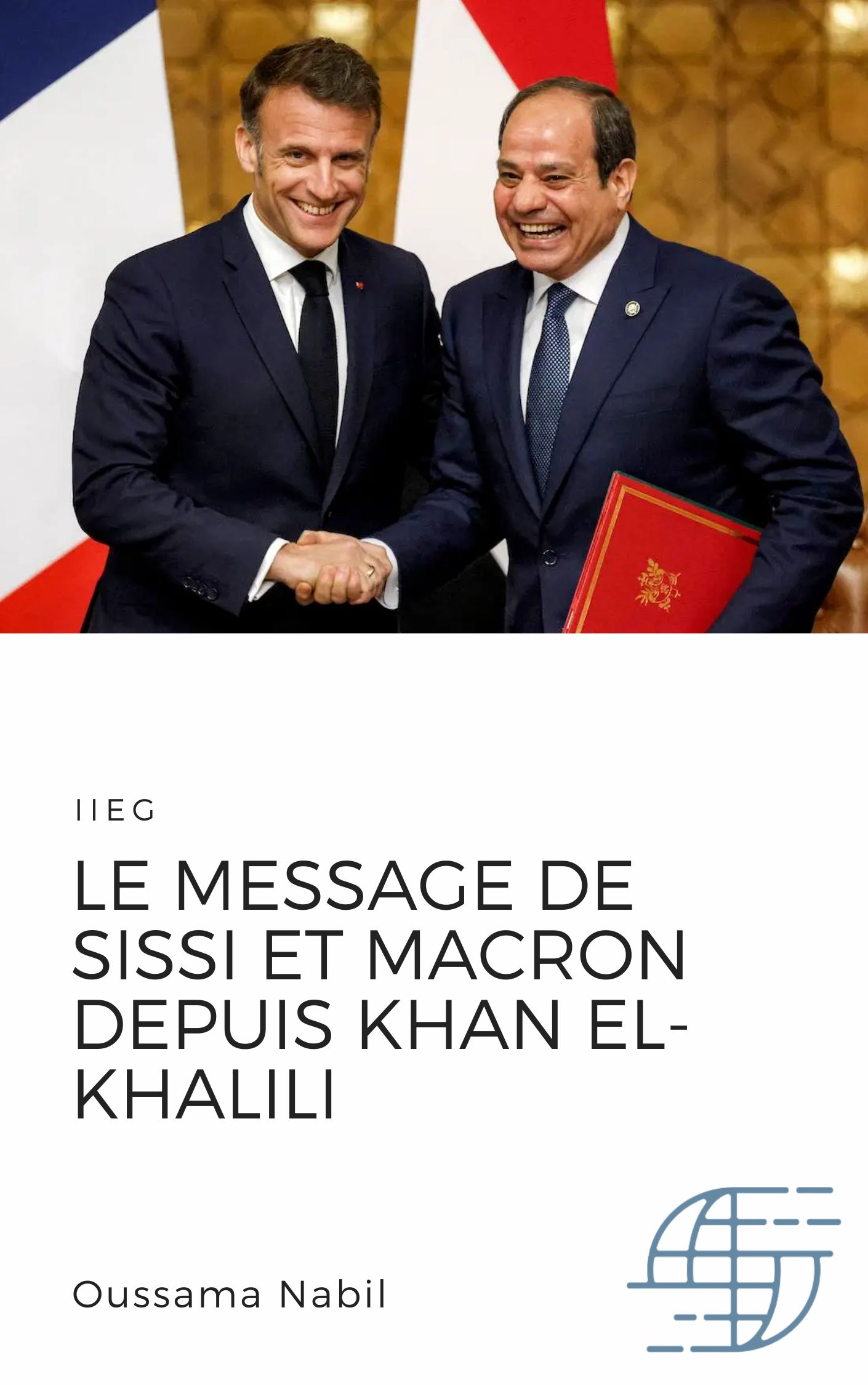
In the lively streets of Khan El-Khalili, in the heart of historic Cairo, Egyptian President Abdel Fattah Al-Sissi and his French counterpart Emmanuel Macron made a symbolic visit that goes beyond the tourist framework. Behind this stroll through one of the most emblematic districts of the Egyptian capital lies a strong message, political, cultural and diplomatic at the same time. Khan El-Khalili: a highly symbolic choice The choice of Khan El-Khalili is not insignificant. This century-old souk, a living vestige of medieval Cairo, embodies the cultural richness of Egypt, its historical openness to the world and its anchoring in a plural identity. By treading its cobblestones, the two heads of state sent a first declaration: that of the historical continuity and the civilizational depth of Egypt. A strong diplomatic message Beyond the picturesque images broadcast by the media, this visit constitutes a clear message: Egypt remains a stable player in the Middle East, open to dialogue and international cooperation. For France, this presence on the ground is also a way of strengthening ties with a strategic partner, while promoting intercultural dialogue. The diplomacy of symbols in the service of dialogueThe stroll of Macron and Sissi in this Mecca of Cairo heritage is part of a diplomacy of symbols. Where official discourses can sometimes seem fixed, culture offers a universal language. Through this immersion in popular Egyptian daily life, the two leaders showed their desire to build bridges, beyond cultural and religious differences. A sequence with strong media reach This sequence, widely relayed on social networks and news channels, is not only aimed at chancelleries. It also targets public opinion, both in Egypt and in France. By highlighting conviviality, security and cultural richness, it helps to improve Egypt's image internationally while underlining Paris' interest in dialogue with the Arab world. A thoughtful diplomatic act More than a simple tourist detour, the visit to Khan El-Khalili by Abdel Fattah Al-Sissi and Emmanuel Macron appears to be a thoughtful diplomatic act. In a world riddled with identity tensions and geopolitical tensions, this shared moment at the heart of one of the jewels of urban Islamic heritage delivers a strong message: that of a partnership based on respect, culture and common history.