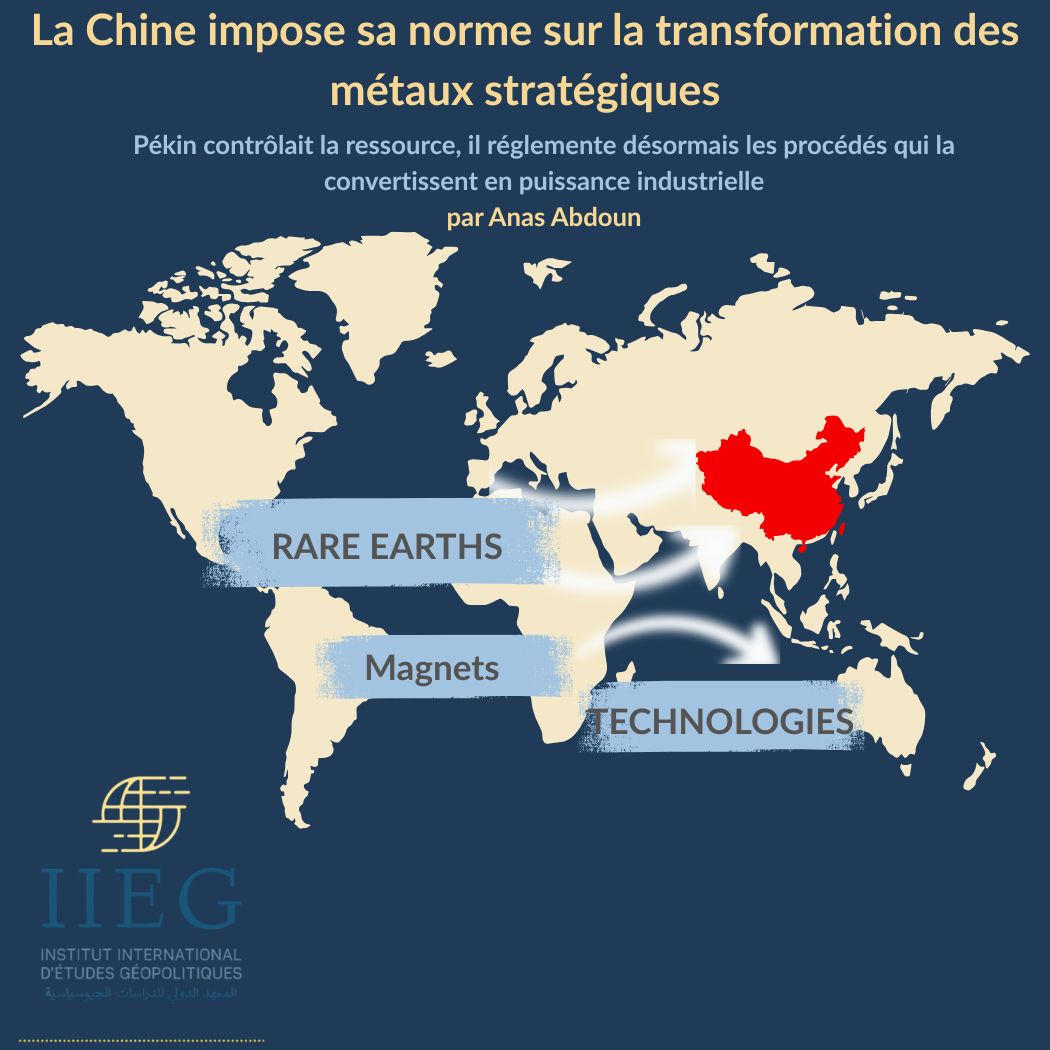
At the beginning of October, the Chinese Ministry of Commerce (Mofcom) extended its export licensing regime to rare earths, permanent magnets, “superhard” materials and associated technologies. A decisive new feature: the licensing obligation can apply even to goods manufactured outside China if they contain materials of Chinese origin or components produced with Chinese technology, a clear step towards the extraterritoriality of controls, until now an American trademark. Specialized firms detail a “50% rule”: beyond a certain threshold of Chinese rare earth content or dependence on Chinese processes, authorization from Beijing becomes necessary, including for exports carried out by non-Chinese players.
State policy instrument
This shift comes at a time when China already dominates the downstream sector: around 70% of global rare earth mining production and 90% of separation/refining capacity. In other words, Beijing no longer controls only matter; it regulates access to the process that transforms the resource into industrial power (NdFeB magnets, sputtering targets, strategic alloys). The markets have it
understood: these controls are thought of as instruments of state policy, not simple commercial measures.
The decision on export licenses conditions access to processing, including when the material or the factory is not in China.
Chinese communication also assumes a staircase logic: after gallium, germanium and graphite in 2023, here are magnets, powders and technological bricks of hard industrial (batteries, magnetization, abrasives, semi-conductors). Western manufacturers, from ASML to large equipment manufacturers, say they have stocks and alternative sources in the short term, but recognize a structural risk if the tightening continues.
From black gold to rare earths
At the turn of the years 2000-2010, the United States and China were on strategic parity on a key point: both depended on hydrocarbon imports. The shale revolution has broken this symmetry. From 2015 and especially since 2019, the American energy equation is reversed: Washington becomes a net exporter over the year, gains a cost advantage and logistical autonomy (less dependence on maritime routes). Beijing remains a long-term net importer of oil and gas. On energy, the advantage therefore goes to the Americans.
But the technological bifurcation shifts the center of gravity. In the economy of high-performance magnets, electric motors, wind turbines, precision sensors and defense/optics/power chains, rare earths are becoming the pivotal resource. And in this area, the structural advantage is Chinese. The asymmetry is not so much due to the ore as to the downstream: chemistry, metallurgy, processes and know-how. The October export licensing decision precisely locks this legal endorsement: it conditions access to processing, including when the material or the factory is not in China.
Chinese extraterritoriality: a level of power
The “extraterritorial” extension of Chinese control marks a level of power because it shifts the norm to where the advantage now lies: the downstream of critical materials. Until now the prerogative of Washington, extraterritoriality now applies to goods manufactured outside China as long as they incorporate Chinese materials, processes or intellectual property. Compliance no longer depends only on the exporting country, but also on the power of the process. However, this downstream feeds precisely the chains that will be the economy of the decade: semiconductors, AI, electrification, high-intensity defense, all materials-intensive. By licensing access to its chemistries, separations and alloys, Beijing does not decree an embargo: it controls the tempo, can defer or authorize according to its priorities, and obliges companies and States to live in the era of extraterritoriality of Chinese law.
Concretely, it is a lever on the speed of equipment of Western factories, therefore on the rate of adoption of technologies which will create the competitive advantage in the future.
The White House quickly reopened the political channel by maintaining a summit meeting with Xi Jinping, a sign that pure coercion is not enough.
Management of Sino-American interdependencies
As a backdrop, the tariff escalation announced by Donald Trump – up to 100% on certain Chinese flows – reminds us that Washington has formidable leverage: the depth of its domestic market. But faced with a China whose exporting power irrigates entire sections of global supply, the customs weapon has an immediate political cost: inflationary pressure in the United States and the increase in the cost of supply chains. Moreover, after brandishing the threat, the White House quickly reopened the political channel by maintaining a summit meeting with Xi Jinping, a sign that pure coercion is not enough, and that the equation also involves the management of interdependencies.
Basically, everything comes back to the same reality: we are not in another commercial episode, but in a competition for hegemony. America anchors its advantage through energy, market and standard; China is establishing its own through materials, industrial approval and, now, the export of its rights. The decade that is opening will be less a rupture than a duel of tempos - which, from Washington or Beijing, will impose its pace at the heart of the technologies that will drive tomorrow's growth.