
Loading...
Strategic analysis, in-depth research and expert perspectives on contemporary global issues.
The International Institute for Geopolitical Studies (IIEG) is an analysis and action platform dedicated to global geopolitical transformations, with a particular focus on the Mediterranean, Africa, the Caucasus and Central Asia.

The multidimensional dispute between Iran and the Washington-Tel Aviv axis, transmuted into a kinetic confrontation since February 2026, does not constitute a simple regional crisis, but a catalyst for fragmentation of the world system. The intensity of this crisis corroborates the theses of strategic stagnation, where Israel's preventive posture and the American doctrine of containment aim, through forced decoupling, to neutralize Eurasian influence in the Middle East. The geoeconomic repercussions are structured around four pillars: energy security, global logistics, industrial resilience and macrofinancial balances. Energy Crisis and Flow DisruptionThe partial asphyxiation of the Strait of Hormuz – a strategic lock through which 30% of the world's oil and 17% of the world's gas transit – has generated major exogenous volatility, propelling prices beyond 50% of their pre-conflict value. The profitability differential: The selective blockage (reduction to 5 million barrels/day) highlights a critical asymmetry: while extraction costs in the Middle East remain marginal ($3-10), American shale hydrocarbons require a much higher profitability threshold ($40-60), accentuating global energy inflation. Alternatives and reorientation: If the increase in flow rates via the Abqaiq-Yanbu pipeline (targeting 7 million b/d according to Saudi Aramco) and the Habshan-Fujairah pipeline offers a palliative, the shutdown of the northern routes (Kurdistan, BTC) limits the compensation. In the medium term, we are witnessing a pivot towards the West: the development of Mediterranean infrastructure secured by American-Israeli influence foreshadows a diversion of resources to the detriment of Asian economies (China, India, Japan). Reconfiguration of Logistics and TradeInsecurity in chokepoints (Bab el-Mandeb, Suez) requires a redefinition of maritime geography. The diversion via the Cape of Good Hope, while it guarantees the continuity of flows for the Atlantic powers, induces a structural increase in costs (20-30%) and an extension of delivery times. The decline of East-West routes: The model of horizontal flows, pillar of liberal globalization, is obsolete. The architecture of the “New Silk Roads” is compromised, apart from its Russian and Central Asian continental segments, themselves burdened by diplomatic ostracism towards Moscow. The emergence of the North-South model: We are observing a transition towards a regionalized model based on nearshoring and friendshoring. This shift favors a reindustrialization of the West and propels Africa and Latin America as new productive lungs, articulated around the energy-water-material nexus. Disruptions and Industrial SovereigntyThe conflict reveals the dependence of processing industries on Middle Eastern inputs (chemistry, metals, helium). The food peril: The tension over fertilizers is symptomatic. Despite the capabilities of leaders like OCP in Morocco, dependence on regional inputs (ammonia) creates a risk of supply disruption. The security strategies of India and the USA illustrate a return to strategic protectionism. Defense economy: The arms sector is emerging as the main beneficiary of this instability, with an acceleration in global military budgets (exceeding $1,781 billion by 2024). War of commodities: China's use of its levers on sensitive technologies (rare earths, PCBs) in response to Western pressure confirms the transition from a market economy to an shortage management economy. Macroeconomic Imbalances and Systemic RiskThe conflict serves as a vector for a struggle for monetary supremacy. Anchoring the dollar to “strategic nexus” trade is a direct response to the desire for dedollarization of the BRICS. Recessionary spiral: Imported inflation forces central banks to tighten monetary policy. The rise in interest rates and the widening of bond spreads (notably between the Bund and the OAT) revive the specter of a fragmentation of the euro zone. Atrophy of growth: The correlation between the rise in oil prices and the fall in GDP (0.5 points of growth lost for 10% increase in price) suggests a lasting global recession, an increase in structural unemployment and an unsustainable deterioration in debt service for the most exposed States. The current confrontation seals the end of the illusion of infinite and deregulated growth. The world is falling into an era of systemic fragmentation where the Middle East remains the pivot of the balance of power between East and West. The viability of the international financial system, still indexed to the petrodollar, is now being tested by a geopolitical reality where supply radically takes precedence over demand. References Clausewitz, C. von: Of War – For the analysis of the continuity of politics through financial means. Mackinder, H.: The Geographic Pivot of History – Relevance of the Middle East/Eurasia zone. Friendshoring Theory (J. Yellen): Analysis of new resilient zones of influence. Reports from the IEA and the World Bank (2025-2026): Data on transport capacities and growth forecasts. Energy-Water-Food Nexus Concept: Sustainable global security analysis framework.

The American-Israeli crisis against Iran from February-March 2026 revealed the vulnerability of the major global energy and logistics balances. The tensions around the Strait of Hormuz have been interpreted by the markets as a risk of blockage (traffic disruptions, additional insurance costs, re-routing, etc.), resilience no longer depends only on power, but also on the capacity to diversify its routes, its partners and its support bases. In this new configuration, Morocco appears as an increasingly credible space of stability, interconnection and strategic projection. A regional crisis with systemic effectsThe American-Israeli war against Iran from February-March 2026 constitutes much more than a military episode confined to the Middle East. It acted as a brutal revealer of the fragilities of the regional security and energy architecture, while accelerating the erosion of a strategic model long associated with Pax Americana. The de facto closure of the Strait of Hormuz has caused a global economic shock. The barrel of Brent exceeded 114 dollars [1], maritime freight costs rose sharply and global financial markets suffered a sharp decline. Among the most notable indicators, the South Korean KOSPI stock index lost up to 12%, while the Japanese Nikkei fell by around 2% and the Dow Jones lost almost 400 points [2]. At the same time, rising tensions have caused gas prices to soar in Europe, which have increased by 50% since March 2 [4]. The economic consequences have also affected other sectors, notably tourism in the Gulf countries, where projections suggest a potential loss of 56 billion dollars and up to 38 million fewer visitors for the year 2026 [5]. Finally, the direct costs of the conflict illustrate the extent of the economic pressures generated by the war. According to some estimates, the Israeli economy would bear a cost of approximately $2.9 billion per week linked to military operations and economic disruption [6]. The shock of 2026 or the end of certainties The sequence of Israel-Iran escalation (with American involvement) has gone beyond the regional framework to establish itself as a real geopolitical shock with systemic effects. It highlighted the limits of a system based both on the centrality of a single energy corridor – the Strait of Hormuz – and on a security architecture largely backed by the United States. This reading is debated: some see that the $2,000 billion in investments promised to the United States may appear less as the price of lasting protection than as the cost of a strategic dependence that has become more uncertain [3]. This shock is not simply cyclical. It reveals a structural transformation. It requires us to rethink the very concept of economic security. For economies whose prosperity relies on the fluid circulation of hydrocarbons and the stability of trade routes, the diversification of logistical and strategic anchorages now becomes an imperative. Morocco, a pole of stability in an uncertain environmentIn this changing landscape, Morocco stands out through a set of attributes that reinforce its credibility as a space of continuity and strategic projection. Its geopolitical value is not only due to its geographical position. It is based on a model combining institutional stability, efficient infrastructure, multidimensional diplomacy and transnational human capital. Consolidated political stability The dynastic continuity and the long-term strategic vision carried by the Monarchy give Morocco continuity in public policies in the region. This stability constitutes a determining factor for long-cycle strategic investments. World-class logistics infrastructureThis port architecture is expected to be strengthened with the rise in power of the port of Nador West Med, located in the bay of Betoya, approximately 30 km west of the city of Nador. Designed as a new generation deep-water port, it is destined to become one of the main logistics and energy hubs in the Western Mediterranean. Its container component provides for an initial capacity of around 3 million TEUs, expandable to 5 million TEUs over time. Taken together, Tanger Med, Nador West Med and Dakhla Atlantique gradually shape a true strategic Moroccan port arc, connecting the Mediterranean, the Strait of Gibraltar and the Atlantic. This increases the value of Morocco as a workaround and continuity solution in the event of stress on the Hormuz–Red Sea–Suez corridors. A multidimensional diplomacy Morocco also stands out for its ability to dialogue with several power centers. It has been a major non-NATO ally of the United States since 2004, a privileged partner of the European Union and a growing player in African integration through the Atlantic Initiative. At the same time, it maintains close relations with China and Russia [9]. Transnational human capitalFinancial transfers from Moroccans living abroad reached $12.9 billion in 2024, or more than 8% of the national GDP [10]. Beyond their economic dimension, these flows demonstrate the depth of the links between the diaspora and the national economy. Three scenarios for the next 6 to 18 months In such an uncertain environment, the scenario method makes it possible to structure the analysis. The first scenario is that of a contained conflict. In this hypothesis, military tensions remain mainly limited to the confrontation between Iran and Israel, without major extension to other regional actors. Disruptions in the Strait of Hormuz remain intermittent, causing regular tensions on energy markets and maritime insurance costs. Oil flows are not permanently interrupted but remain exposed to high security risks. In this context, energy prices remain high and volatile, oscillating around 100 to 120 dollars per barrel, without lastingly crossing critical thresholds for the global economy. The second scenario is that of regional escalation.In this more critical configuration, the conflict is gradually widening by more directly involving certain Gulf actors and their strategic infrastructures. Attacks on energy installations, ports or maritime routes are increasing, leading to a prolonged or partial blockage of the Strait of Hormuz, through which nearly a third of global maritime oil trade passes. Such a situation would cause a major energy shock and could propel oil prices well beyond $130 or $150 per barrel, generating high global energy inflation, financial market tensions and a real risk of a global economic slowdown. The third scenario is that of precarious stabilization.In this hypothesis, international mediation – potentially supported by several powers or international organizations – manages to establish a fragile ceasefire between the parties. Maritime traffic in the Strait of Hormuz is gradually resuming, allowing for relative relaxation in energy markets. Oil prices could then stabilize in a range between $90 and $110 per barrel. However, this stabilization remains structurally fragile: distrust between regional actors persists and states and companies are continuing their strategies of diversifying trade and logistics routes in order to reduce their exposure to future geopolitical shocks. What strategic implications?Faced with these uncertainties, several directions appear possible. Mapping of strategic orientations Horizon 0 – 3 months: security and operational continuity In the immediate phase, the priority is to reduce exposure to logistical and energy disruptions caused by regional instability. Economic and institutional actors must focus on securing trade flows and diversifying operational bases. Several actions can be considered: Building security logistics capacities at Tanger Med, making it possible to secure trade flows to Europe and Africa and to anticipate possible disruptions in supply chains. Strategic audit of logistics and energy chains, to identify critical dependencies linked to the Gulf and Red Sea shipping routes. Partial relocation of strategic functions (logistics management, finance, regional supervision) to stable hubs like Casablanca Finance City. Reinforcement of strategic stocks for sensitive sectors (energy, raw materials, industrial components). Horizon 3 – 6 months: diversification and operational deployment Once operational continuity is ensured, the challenge consists of transforming crisis management into a structural diversification strategy. Initiatives may include: Development of industrial and logistical partnerships around Moroccan infrastructures (Tangier Med, Nador West Med and industrial platforms). Targeted investments in Moroccan economic zones, particularly in the industrial, agri-food and pharmaceutical sectors, in order to strengthen regional production capacities. Establishment of pilot projects in the energy transition, particularly in the green hydrogen sector, an area in which Morocco aims to mobilize 1 million hectares and $35 billion in investments [11]. Structuring alternative logistics corridors linking the Atlantic, Europe and Africa. Horizon 6 – 18 months: strategic integration and African projection In the longer term, the objective becomes the consolidation of a lasting strategic partnership and the gradual integration of initiatives into a broader regional economic architecture. Several axes can be developed: Creation of joint investment vehicles intended to finance infrastructure and industrialization projects in Africa. Strengthening Atlantic economic corridors, linking Morocco to emerging African markets and transatlantic trade routes. Development of regional industrial ecosystems around strategic sectors: energy, logistics, automotive industry, agro-industry and green technologies. Institutionalization of a long-term economic and strategic dialogue between public and private partners in order to anticipate future geopolitical transformations. This gradual approach makes it possible to move from a logic of risk management to a logic of strategic projection, transforming geopolitical uncertainties into opportunities for economic restructuring. Resilience as a new strategic grammarThe crisis of 2026 constitutes an inflection point. She reminds us that security architectures based on too concentrated dependencies inevitably become fragile. In this context, resilience is no longer limited to the ability to resist crises. It is now based on the ability to organize relays of stability, to multiply anchor points and to diversify economic routes. Through its institutional stability, the quality of its infrastructure, the flexibility of its diplomacy and the depth of its human and economic networks, Morocco appears to be one of the most credible spaces to support this transition. In a world where the major maritime routes – from the Strait of Hormuz to the Red Sea, from the Suez Canal to the Strait of Gibraltar – are once again becoming spaces of strategic tension, the capacity to organize alternative logistical continuities becomes a determining factor of economic stability. Through the complementarity of its port infrastructures, from Tanger Med to Nador West Med and up to the future port of Dakhla Atlantique, Morocco is gradually positioning itself as one of the pivots of this new geography of flows. At the crossroads of the Mediterranean, the Atlantic and African dynamics, it tends to embody a true arch of strategic resilience, capable of articulating new trade routes in an increasingly fragmented international system. As Ibn Khaldoun wrote, history does not repeat itself but it teaches. The lesson of this crisis is perhaps the following: in a more fragmented world, strategic autonomy depends less on raw power than on the ability to build lasting continuities. References[1] Reuters. (2026). Oil prices surge above $110 as Middle East tensions threaten Strait of Hormuz shipping.https://www.reuters.com/markets/commodities/ [2] Financial Times. (2026). Global markets slide as Middle East conflict rattles investors.https://www.ft.com [4] The World. (2026, March 5). War in the Middle East: the mechanics of a new economic shock are in place. https://www.lemonde.fr/economie/article/2026/03/05/guerre-en-iran-la-mecanique-d-un-nouveau-choc-economique-est-en-place_6669595_3234.html [5] BFM TV. (2026, March 4). Up to 38 million fewer visitors and $56 billion in lost revenue in 2026. https://www.bfmtv.com/economie/international/until-38-millions-of-visitors-in-minus-and-56-billion-de-dollars-de-miss eu-to-win-in-2026-the-conflict-in-the-middle-east-threatens-the-lucrative-tourism-sector-in-the-gulf_AV-202603040534.html [6] Arab News. (2026, March 4). Damage to Israeli economy from Iran war could top $2.9 billion a week. https://www.arabnews.com/node/2635242 [7] Tangier Med. Port and Logistics Center. https://www.tangermed.ma/fr/pole-portuaire-et-logistique/ Gulf: the Iran–United States war puts an end to fifty years of Pax Americana
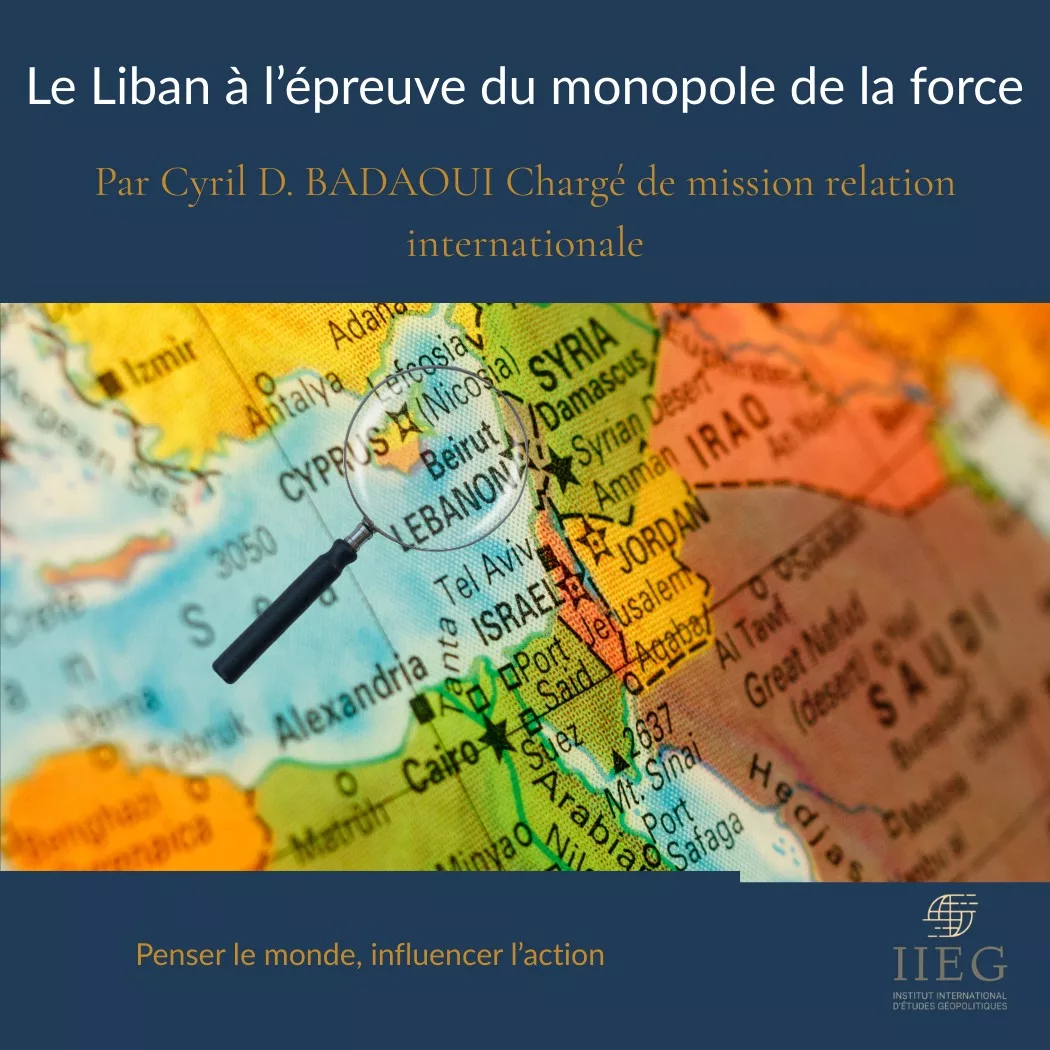
The decision of the Lebanese Council of Ministers of March 2, 2026 (Annex 1) prohibiting any security or military activity of a non-state armed actor and instructing the legitimate Lebanese armed forces to take possession of its weapons constitutes a pivotal moment for the Lebanese state. In a regional context marked by tensions involving Iran, the United States and several conflicts in the Middle East, this decision reaffirms the state monopoly on legitimate violence and national sovereignty. The article analyzes the relevant constitutional foundations, international law and international humanitarian law, assesses the geopolitical implications and highlights the strategic importance of Lebanon's active neutrality and relations with the Gulf States. IntroductionLebanon is going through a critical phase of institutional restructuring. The prolonged coexistence of non-state armed actors weakens the authority of the Council of Ministers and undermines the ability of the state to exercise its monopoly on legitimate violence. The decision of March 2, 2026 aims to prohibit any autonomous military activity of these actors and to entrust the Lebanese army and the internal security forces with the resumption of their weapons, in compliance with national law and international obligations. This decision comes in an unstable regional context, characterized by the growing influence of Iran and the proliferation of armed actors, which expose Lebanon to the risk of proxy conflicts. This study examines the institutional and legal implications of this decision, emphasizing the importance of restoring state monopoly and guaranteeing strategic neutrality. I. Monopoly of legitimate violence: doctrinal and constitutional foundations1. Doctrinal Foundations Max Weber defines the modern state as “the human community which successfully claims a monopoly on legitimate physical violence in a given territory” ¹. This conceptualization remains central in political science and public law for understanding the legitimacy of the State in the face of militias. Hans Kelsen emphasizes that the unity of coercive power is an essential element for maintaining the internal legal order². The absence of exclusive control over the armed force creates risks of anomie and fragmentation of authority. 2. Lebanese constitutional foundations The Preamble of the Lebanese Constitution enshrines national sovereignty. The Council of Ministers holds executive power and determines defense policy. The monopoly of armed force is exercised by the Lebanese armed forces, in accordance with the national defense law. Any parallel armed structure weakens decision-making cohesion and compromises the unity of the State. II. Public international law and international obligations 1. State ResponsibilityAccording to the Montevideo Convention and the jurisprudence of the International Court of Justice (Nicaragua case, 1986), a State is responsible for acts committed from its territory by non-State entities if it exercises effective control or if these acts violate international law⁴. 2. Security Council Resolutions Lebanon is bound by United Nations Security Council resolutions 1559 (2004) and 1701 (2006), which: Call for the disarmament of militias; Urge the government to fully exercise its authority throughout the territory; Underline the need to prevent any use of Lebanese territory for regional conflicts. 3. International humanitarian law (IHL)IHL applies whenever there is an armed conflict, including when it involves non-state actors. According to Additional Protocol II to the 1977 Geneva Conventions and the jurisprudence of the International Committee of the Red Cross (ICRC): Non-state armed groups must comply with IHL and cannot carry out military operations in the territory of a sovereign state without legitimate authorization. The State must protect the civilian population and ensure proportionality and distinction in all military action. The decision of March 3, 2026 is part of this legal framework: it seeks to restore the primacy of the State over armed force and to prevent potential violations of IHL. III. Regional context: Iranian tensions and conflicts in the Middle EastRivalries involving Iran and its regional allies exacerbate the risks of conflict projection onto Lebanese territory. Strategic analyzes highlight that the coexistence of autonomous armed actors increases the risk of escalation. Indeed, the allies of the Islamic Republic of Iran in Lebanon joined it in the war between Israel and the United States, after the assassination of the Iranian Supreme Leader, Ayatollah Ali Khamenei. On the night of Sunday March 1 to Monday March 2, Lebanese Hezbollah claimed its first salvos of drones and missiles towards Israel since the ceasefire agreement concluded between Lebanon and the Jewish state in November 2024, which offered a golden alibi to Israel to bomb Lebanon during the night from Sunday to Monday, causing around thirty deaths and hundreds of injured⁷. Strategic neutrality therefore appears to be a measure of national protection and stability. IV. Strategic neutrality and national interestActive neutrality, inspired by the Swiss and Austrian models, consists of not taking sides in regional conflicts while maintaining balanced diplomatic and economic relations. For Lebanon, this implies: The dissociation of regional conflict axes; The consolidation of reliable state institutions; Maintaining credibility with strategic partners, notably the Gulf States. V. Relations with the Gulf States: strategic and economic dimension The support of the Gulf States for Lebanon is based on: Direct financial aid and investments; Integration of the diaspora into economic flows; Diplomatic support in instances The restoration of state monopoly and sovereignty is a positive signal for these partners and a factor of economic and political confidence. VI. Implementation and institutional challengesThe success of this decision will depend on: Internal political cohesion; The operational capacity of the Lebanese Armed Forces; The clear legal framework, respecting constitutional law, public international law and IHL; Measured international support. Gradual implementation helps reduce the risks of internal and external escalation and strengthens the legitimacy of the State. ConclusionThe decision of March 3, 2026 represents a major institutional turning point. The restoration of the monopoly on legitimate violence constitutes a precondition for the sovereignty, strategic neutrality and economic and diplomatic stability of Lebanon. This decision is also essential to ensure respect for public international law and IHL, while consolidating Lebanon's credibility with its regional and international allies. Notes and references: Weber, The Scientist and the Politician, 1919. Kelsen, Pure Theory of Law, 1934. Rotberg, When States Fail: Causes and Consequences, Princeton University Press, 2004. ICJ, Military and Paramilitary Activities in and against Nicaragua (Nicaragua v. United States), 1986, ICJ Rep. 14. International Committee of the Red Cross (ICRC), Commentary to the Geneva Conventions, 2016. Byman, Deadly Connections: States That Sponsor Terrorism, Cambridge University Press, 2005. https://lemonde.fr/international/article/2026/03/02/en-tirant-des- missiles-sur-israel-le-hezbollah-precipite-de-nouveau-le-liban-dans-la- war_6669238_3210.html Fauchille, Neutrality and international law, Recueil des Cours de l’Académie de Droit International, 1938. Collier, The Bottom Billion, Oxford University Press, 2007. Appendix 1: The Lebanese Government Prohibits All Security or Military Activities of Hezbollah and Instructs the Army to Take Possession of Its Weapons The Council of Ministers, In application of the Constitution, the National Document of Understanding and the Ministerial Declaration of the Government, Following its rejection and condemnation of the rocket launching operation claimed yesterday by Hezbollah, an operation which goes against the principle according to which the decision of war and peace rests exclusively with the Lebanese State, and the desire of Lebanon not to be drawn into the ongoing regional war, and which constitutes a violation of the decisions of the Council of Ministers as well as a contempt for the will of the majority of the Lebanese, thus undermining the credibility of the State Lebanese, After deliberation, The Council decided:First: The Lebanese State declares its absolute rejection, without any ambiguity or possibility of misinterpretation, of any military or security act emanating from Lebanese territory outside the framework of its legitimate institutions, and affirms that the decision of war and peace rests exclusively with the State. This implies the immediate ban on all of Hezbollah's security and military activities, these being illegal, and obliges it to hand over its weapons to the Lebanese State and to confine its action to the political domain, within the framework of constitutional and legal provisions, so as to consecrate the exclusivity of the carrying of weapons for the benefit of the State and to strengthen its full and complete sovereignty over its entire territory. The Government calls on all military and security apparatuses to take immediate measures to implement the above, to prevent any military operation or any launch of rockets or drones from Lebanese territory, and to apprehend offenders in accordance with applicable laws and regulations. Second: Request the Army Command to immediately and firmly implement the plan it presented at the Council of Ministers session held on 16-2-2026, regarding the cantonment of weapons north of the Litani River, using all necessary means to ensure its execution. Third: In line with its constant commitment to prevent Lebanon from being drawn into any conflict in a context of heightened regional tensions, the Council calls on the Guarantor States of the Declaration of Cessation of Hostilities to obtain a clear and definitive commitment from the Israeli side to cease all attacks throughout Lebanese territory. The Council reaffirms Lebanon's total and definitive adherence to all the provisions of the Declaration, thus preserving peace and stability. The Council declares its full availability to resume negotiations on this subject, with civilian participation and under international auspices. Fourth: Asking the Ministry of Foreign Affairs and Emigrants to intensify diplomatic contacts with the international community as well as with brotherly and friendly countries in order to put an end to Israeli aggression and ensure the implementation of relevant international resolutions. Fifth: Request the Ministry of Social Affairs to ensure accommodation for displaced people and provide them with food and other essential supplies, in coordination with the relevant ministries, the High Relief Committee, the Development and Reconstruction Council, the Southern Council, and the Disaster Risk and Crisis Management Unit at the Presidency of the Council of Ministers.
Discover our areas of expertise and strategic research axes.
A high-level conference gathering experts to discuss the future of regional stability.
Rabat, MoroccoExploring the impact of the Tangier Med port on Atlantic trade routes.
Tanger, MoroccoStrategic analysis of artificial intelligence challenges for African governance.
Casablanca, MoroccoInternationally renowned researchers and analysts serving strategic reflection.

Khaled Hamadé
Founder & President of IIEG

Jacques Touchon
President of the Scientific Council

Wafae Aziz
Secretary General

Nouzha Bouchareb
Expert — Urban Planning & Sustainable Development

Cheick Sako
Vice President for Africa — Former Minister of State, Minister of Justice

Yann Fortunato
Expert — Forest Management & Governance

Sanjeev Rao
Vice-President India

Hamza Belgourari
Vice-President Brazil

Lionel Le Gloanec
Director of the Nexus Pole

Amine Benchekri
Associate Expert

Cyril Badaoui
Legal Advisor — International Law & Development Policies

Rita Maria Chaptini
Mission Officer to the General Secretariat — International Business Legal Counsel

Antoine Lawson
Special Advisor for Strategic Intelligence
Create a free account to access monthly geopolitical analyses in 3 languages, and download them as PDF for offline reading.