Vice-President Europe, International Institute of Geopolitical Studies (IIEG) CEO, Racines de France
“The world must understand that each felled tree is a source of water that dries up, rain that will no longer fall, a future that dries up. We no longer have the luxury of ignorance or that of waiting. The time for action is here and now. »
The 30th Conference of the Parties (COP30) in Belém, in the heart of the Amazon, has just concluded. Although progress has been noted, the prevailing feeling is that of an emergency not yet fully integrated by the international community. As a forest expert and direct witness to the dynamics at work, I wish to share a conviction forged by years of work in the field: the solution to many of our crises – climatic, water, food and even geopolitical – lies in the shade of trees. But for this, we must carry out a radical conceptual and economic revolution.
COP30: between glimmers of hope and lack of ambition
COP30 put forests at the center of debates, a late but essential recognition of their role. The launch of the “Tropical Forests Forever Facility” (TFFF) by Brazil, aiming to mobilize $125 billion to pay for forest protection, is an initiative that we must welcome and amplify [1]. It is a first step towards an economy where preservation becomes more profitable than destruction. The commitment to allocate 20% of these funds to indigenous communities, ancestral guardians of 80% of global biodiversity, is also a crucial step forward [2].
However, this progress cannot mask a dark reality. The UNFCCC summary report is clear: current commitments are leading us towards catastrophic warming of nearly 3°C [3]. Deforestation continues its mad course, with 8.1 million hectares lost in 2024, an alarming figure which takes us away from the objective of zero deforestation in 2030 [4]. The paradox is tragic: global subsidies to forest-destroying industries are 200 times greater than the funding allocated to their protection [4]. We can no longer wait for the COPs to act. Now is no longer the time for declarations of intent, but for immediate action, on all fronts.
The forgotten principle: it is the tree that gives water
At the heart of our collective blindness is the forgetting of a fundamental truth, a principle that nature teaches us and that science confirms:
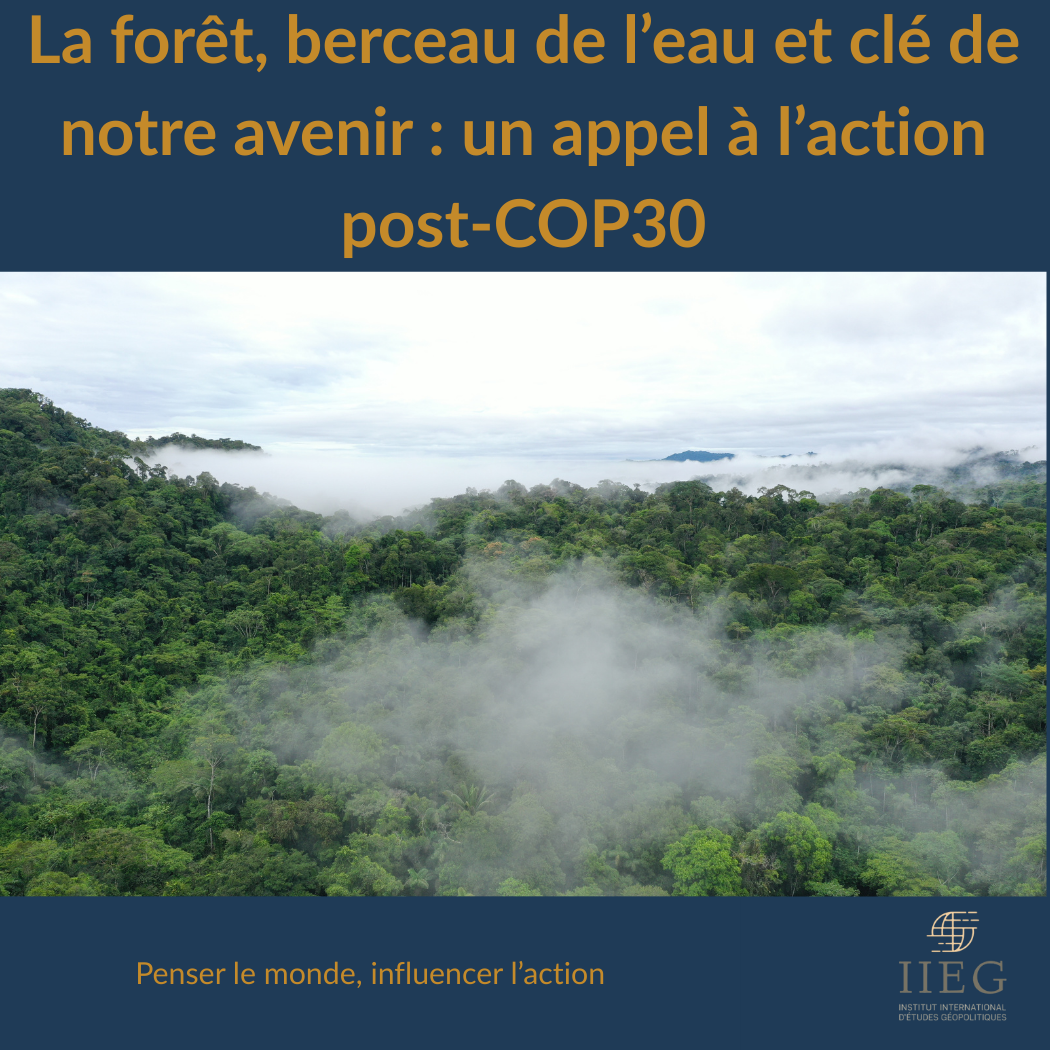
it is the tree that gives water, and not the other way around. We have been conditioned to see rain as a source that feeds the forest. The reality is more complex and more beautiful: the forest itself creates rain. Through the mechanism of evapotranspiration, a mature forest recycles colossal quantities of water into the atmosphere, creating moisture flows that generate precipitation hundreds or even thousands of kilometers away [5]. A tropical forest can recycle up to 70% of the water it receives, acting as a gigantic pump and climate regulator [6].
Cutting down a tree is therefore much more than losing wood or a carbon sink. This is breaking an essential link in the water cycle. Deforestation is not only a cause of climate change, it is a self-reinforcing consequence by drying out land and threatening the availability of the most vital resource: fresh water.
From theory to action: the Arches Castriotes demonstrator
Faced with this observation, the International Institute of Geopolitical Studies (IIEG), via its Sustainable Development division, and the mission-driven company Racines de France, which I manage, are committed to transforming theory into practice. Our conviction is that awareness must be embodied in concrete, viable and replicable models. This is the spirit of our founding principle: “a living tree must have more value than a cut tree”.
It is this vision that gave birth to the
“Les Arches Castriotes” project, near Montpellier. On a former five-hectare vineyard site, we planted more than 2,000 trees of 36 different species to create an agroforestry ecosystem unique in the world [7]. It is not a simple plantation, it is an open-air laboratory, a scientific demonstrator which proves that it is possible to regenerate soil, restore biodiversity and the local water cycle, and massively capture carbon, while creating a local and sustainable economy.
This demonstrator, a living example of real solutions, is beginning to interest governments that are increasingly aware of the issues. This model, followed by the international scientific community, is not a utopia. It is a tangible solution, a know-how that we wish to share and transfer, particularly in Africa and Morocco, where the challenges of water and food security are particularly acute. It demonstrates that agroforestry is not a step backwards, but an agriculture of the future, resilient and efficient.
“De-risking”: an imperative for the business world
Today I am sending a direct message to the business world, all sectors combined. Inaction in the face of deforestation is no longer an option. It represents a systemic risk for your supply chains, your reputation and your sustainability. This risk is estimated at $2.7 trillion for global supply chains [8].
It is time to move from the concept of “social responsibility” to that of
“strategic de-risking”. It’s about integrating nature as an essential asset and deforestation as an intolerable liability in your balance sheets. With my teams, we are working on concrete proposals to support companies in this transition: complete traceability of raw materials, investment in regeneration projects like ours, and adoption of “zero deforestation” policies which are more than just slogans.
Only 3% of global companies today have robust and enforced policies against deforestation [8]. It is a collective failure. We need everyone to turn the tide. The solutions exist, they are profitable and meaningful. It takes the courage to implement them.
Peace from the roots: a general mobilization
COP30 must be an electric shock. But the future will not only be played out in negotiation rooms. It plays out on the ground, in our territories, in our consumption and investment choices. The actions of Racines de France show it every day: it is possible to create value by regenerating living things.
Let us make no mistake: the fight for the forest and for water is a fight for stability and peace. The wars of tomorrow will be water wars if we do not change course. By restoring ecosystems, we restore the conditions for shared prosperity and a fairer world.
The time has come for general and positive mobilization. Join us. Plant, fund, demand change. Let's make the regeneration of nature the greatest project of our century. It is through the roots that we will build peace.
References
[1] RTBF. (2025).
Making the protection of forests financially more attractive than their destruction: Brazilian President Lula's plan to combat deforestation.
https://www.rtbf.be/article/rendre-la-protection-des-forets-financierement-more-interesting-que-leur-destruction-le-plan-du-president-bresilien-lula-face-a-la-deforestation-11632844
[2] IIEG. (2025).
COP30 in Belém: Forests, Climate Finance and New Commitments for a Just Transition.
https://institugeo.org/articles/cop30-un-tournant-decisif-pour-laction-et-la-gouvernance-climatiques/
[3] Greenpeace. (2025).
COP30: progress on phasing out fossil fuels and protecting forests, but we need to go further.
https://www.greenpeace.org/africa/fr/communiques-de-presse/59551/cop30-des-avancees-sur-la-sortie-des-energies-fossiles-et-la-protection-des-forets-mais-il-faut-aller-plus-loin/
[4] Les Echos. (2025).
Reduction in deforestation in Brazil: the tree that hides the forest before COP30.
https://www.lesechos.fr/monde/ameriques/recul-de-la-deforestation-au-bresil-larbre-qui-cache-la-foret-avant-la-cop30-2196877
[5] NFB.
The power of trees: evapotranspiration.
https://www.onf.fr/vivre-la-foret/%2B/2888::le-pouvoir-des-arbres-levapotranspiration.html
[6] EFI.
What role do forests play in the water cycle?.
https://efi.int/forestquestions/q7_fr
[7] Roots of France.
The Castriote Arches.
https://www.racinesdefrance.com/project/les-arches-castriotes/
[8] Forbes. (2025).
Deforestation: A $2.7 Trillion Corporate Supply Chain Risk.
https://www.forbes.com/sites/feliciajackson/2025/05/08/deforestation-a-27-trillion-risk-hiding-in-corporate-supply-chains/