
When long history sheds light on contemporary crises
Khaled Hamadé
IIEG Expert
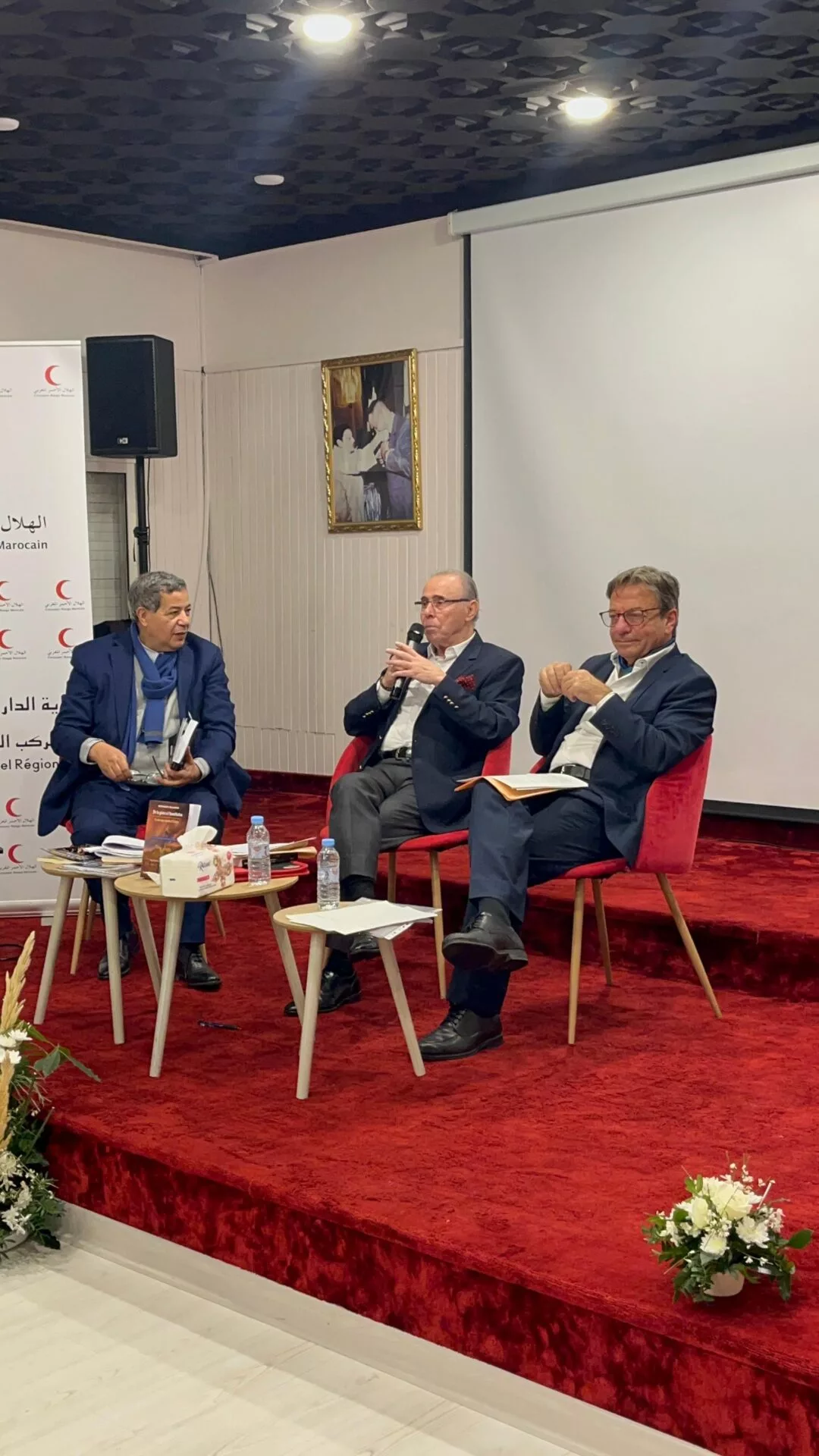
On January 27 in Casablanca, a high-level intellectual meeting brought together researchers, experts, academics and informed citizens around the same objective: better understand contemporary crises in the light of long history.
This meeting was held on the occasion of the presentation of the work From Glory to Humiliation, by the historian Mohammed Belahmer, dedicated to the root causes of the fall of the Kingdom of Granada in 1492.
Central moment of the event, the intervention of Khaled Hamadé, President of the International Institute of Geopolitical Studies (IIEG), left a lasting impression on people through the depth of its analysis and the strength of its geopolitical perspectives.
1492: a historic rupture founding the modern geopolitical order
Returning to the fall of Granada, the last Muslim stronghold in al-Andalus, Khaled Hamadé recalled that 1492 is not only a symbolic date, but a major tipping point in the structuring of the modern geopolitical order.
Far from a purely memorial or emotional reading, his analysis highlighted the emergence, from this period, of a sustainable model of power, still at work in contemporary international relations.
This model is based on an old matrix — comparable to a real geopolitical “source code” — articulated around three fundamental pillars:
-
territorial conquest,
-
its legitimization by historical, religious or ideological stories,
-
strategic control of trade routes, economic flows and maritime spaces.
According to the President of the IIEG, this triptych, more than five centuries old, never really disappeared; it has been transformed, adapted and modernized.
A reading grid to decipher contemporary crises
This geopolitical approach has made it possible to shed light, with rigor and education, on the dynamics at work in several current theaters: in Europe, Asia, the Middle East, but also in global economic rivalries.
The analysis highlighted a worrying phenomenon: the assumed return of power relations, often to the detriment of international law and multilateral mechanisms supposed to guarantee global stability.
In this context, legal norms tend to be circumvented or exploited, while international institutions appear increasingly weakened in the face of the logic of state power.
Mohammed Belahmer’s book: a lucid reading of history
The presentation of the book From Glory to Humiliation was another highlight of the meeting.
Through rigorous and documented historical work, Mohammed Belahmer was able to expose the true causes of the fall of Granada, highlighting the internal responsibilities, political divisions and governance flaws that weakened the Nasrid State.
This reading, praised by the public, breaks with fatalistic or exclusively externalized narratives of history and invites a more demanding reflection on the role of elites and political choices in the great historical collapses.
A high-level debate and strong public mobilization
The discussions with the public, who came in large numbers, confirmed the growing interest in this type of cross-analysis between history, geopolitics and international news.
The debate was brilliantly moderated by Abid Kabadi, vice-president of IMRI, recognized jurist and geopolitical analyst, whose mastery of the issues contributed greatly to the quality and fluidity of the discussions.
Thinking about the world to better understand the present
Beyond the success of this meeting, the event recalled an essential conviction:
👉 understand the world beyond simplistic speeches,
👉 connect the past to the issues of the present,
👉 give geopolitical thought back its place in citizen debate.
The success of this meeting illustrates the importance of these spaces for dialogue and transmission, made possible thanks to the commitment of the organizing teams, in particular Madame Najat Lebbar, to the joint intellectual contribution of the IMRI and the IIEG, as well as to the generous welcome of Madame Chraibi within the Red Crescent space.
In a world marked by instability, polarization and the questioning of common rules, long history remains an essential tool for deciphering the present.
This meeting in Casablanca offered a clear and convincing demonstration, confirming the essential role of spaces for reflection and think tanks in shedding light on contemporary geopolitical issues.
 the presentation of the work From Glory to Humiliation[/caption]