
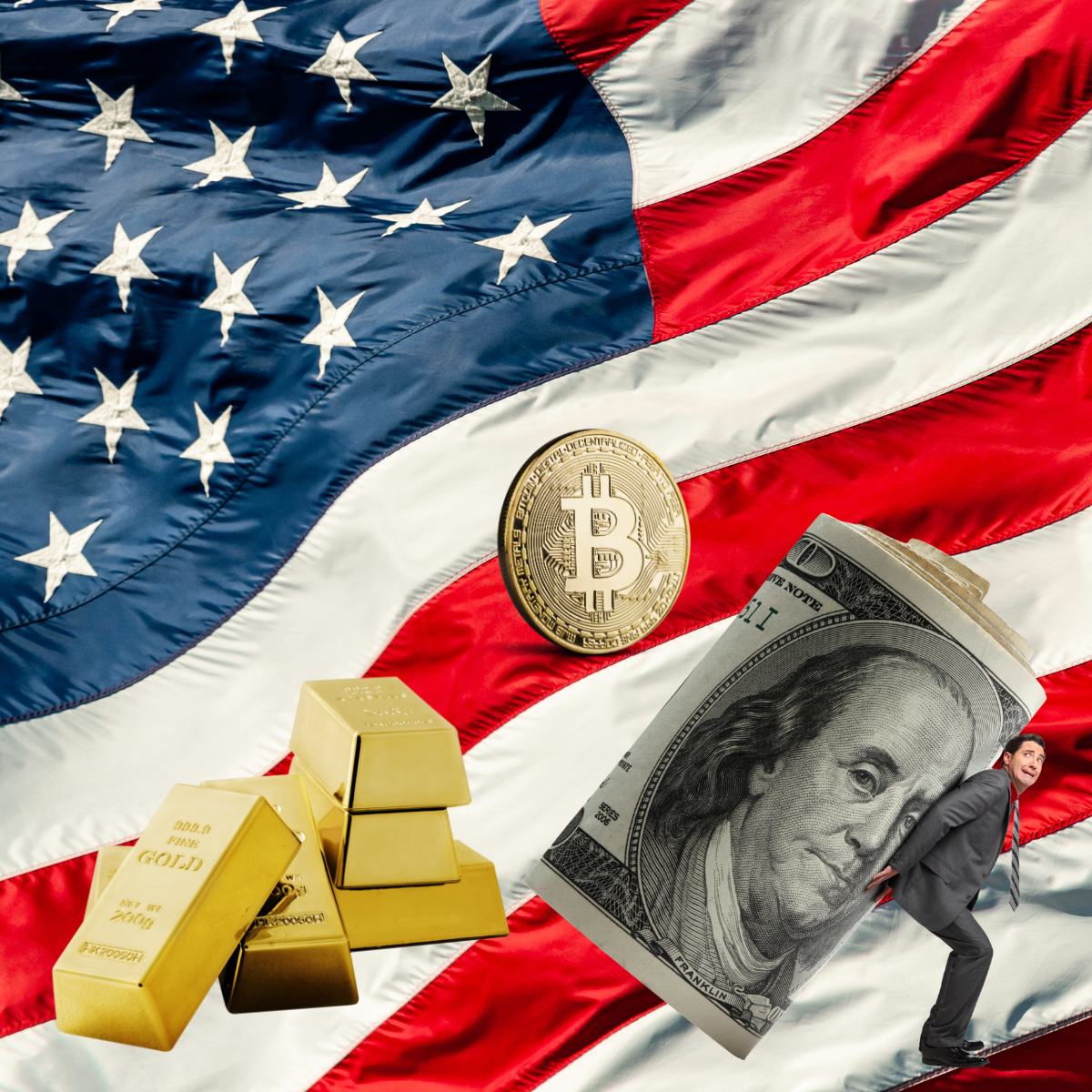
The American Debt: Towards a \"Heart Attack\" or a Simple Crisis of Confidence?
Khaled Hamadé
IIEG Expert
Towards a “Heart Attack” or a Simple Crisis of Confidence?
Analysis by the International Institute of Geopolitical Studies (IIEG) under the direction of Khaled Hamadé
The global economy is going through a phase of great uncertainty. The growing debt of the United States, combined with geopolitical tensions and social fractures, poses a major risk to the stability of the international monetary system.
It is in this context that Ray Dalio, founder of Bridgewater Associates – the world's largest investment fund – recently issued a worrying warning: A US debt “heart attack” could occur in the near future.
The President of the International Institute of Geopolitical Studies (IIEG), Khaled Hamadé, and his team of experts believe that these comments must be taken with the greatest seriousness, given the importance of Dalio as an analyst and the global scope of the issues raised.
But beyond the medical analogy, what is the reality of the situation?
Ray Dalio: An authoritative voice in crisis analysis
Ray Dalio is no ordinary observer. Legendary investor and founder of Bridgewater Associates in 1975, he made his fund the most influential in the world with hundreds of billions of dollars under management. Author of several major works, including "Principles for Navigating Big Debt Crises", he is recognized for his ability to analyze economic and financial crises over the long term. His warnings are all the more heeded because they are based on a historical perspective, identifying the cycles of debt and recurring crises in the dominant economies.
On July 24, 2025, in an interview with Fortune, Dalio said: "We spend 40% more than we take in, and it's a chronic problem.
It's like plaque in the arteries that compresses purchasing power.
"A debt that threatens to suffocate the system.
For Dalio, the American situation resembles that of a patient whose excesses accumulated over decades end up causing a heart attack. The “heart attack” he speaks of corresponds to the explosion of public debt that has become unsustainable after years of chronic deficits and ultra-expansionary monetary policies.
The figures speak for themselves: American debt today represents more than 120% of GDP, placing the United States among the most indebted countries in the developed world. Even more worrying, interest payments on this debt now represent more than 3% of GDP, even exceeding the defense budget. With almost a third of the debt maturing in less than a year, the US Treasury must constantly refinance itself on the markets, making it vulnerable to any rise in interest rates.
Since 2008, US debt has continued to grow, reaching historic levels after the massive pandemic-related stimulus packages of 2020.
This dynamic, according to IIEG experts, constitutes a major systemic risk that goes well beyond American borders, because the dollar remains at the heart of the global monetary system.
The Real Risk: A Crisis of Confidence rather than Bankruptcy.
It is crucial to understand that the danger for the United States is not bankruptcy in the traditional sense. As the issuer of its own global reserve currency, the US Treasury cannot technically default.
As a last resort, the Federal Reserve can always create money to buy the debt. The real danger is a crisis of confidence. This scenario materializes when investors, domestic and foreign, begin to doubt the government's willingness or ability to control its fiscal trajectory. They then demand a higher risk premium to hold U.S. debt, which pushes up interest rates. This phenomenon can become self-fulfilling: the rise in rates increases the debt burden, which widens the deficit and reinforces investor distrust.
The triggers for such a crisis could be persistent inflation, major political instability or a credit rating downgrade by rating agencies. Dalio estimates that there is more than a 50% chance that financial “trauma” will occur if nothing is done to correct the current trajectory.
Social tensions comparable to the 1930s.
Dalio also warns of the weakening of the American social and political fabric. Growing inequalities, ideological polarization and loss of trust in institutions create an unstable climate.
According to him, the current situation is in certain aspects reminiscent of the 1930s and 1940s, marked by deep economic crises and rising international tensions.
For Khaled Hamadé and the IIEG experts, this combination of excessive debt and social fragility makes the system particularly vulnerable.
Financial crises are never isolated: they interact with social and geopolitical dynamics, amplifying their effects and potentially leading to upheavals well beyond the economic domain.
Bitcoin and Gold: refuge from the fragility of the dollar.
Faced with these threats, Ray Dalio recommends the diversification of investment portfolios. Gold, the ultimate safe haven asset, retains its role and its demand by the central banks of emerging countries remains strong.
Dalio recommends holding 10 to 15% in a diversified portfolio.
Concerning Bitcoin, Dalio recognizes its potential as “digital gold”.
With its supply limited to 21 million units, Bitcoin stands out from fiat currencies subject to the inflationary policies of central banks. This rarity, added to its decentralization and its resistance to censorship, gives it a special status. However, IIEG experts urge caution regarding Bitcoin. Its extreme volatility and increasing correlation with technology assets during times of financial stress reduce its diversification benefits.
Additionally, adoption by central banks is almost zero, due to regulatory uncertainties and custody challenges. Bitcoin should be considered a high-risk speculative asset rather than an anchor of stability comparable to gold.
A Warning Signal for the International Community.
Ray Dalio's analysis takes on particular importance because it highlights the risk of a global systemic crisis.
As president of the IIEG, Khaled Hamadé emphasizes, with his team of experts, that the "heart attack" of American debt is not a simple theoretical hypothesis: it could have global repercussions on markets, international relations and the stability of states.
Although the dollar maintains its dominant position with 58% of global foreign exchange reserves, its relative decline is an underlying trend.
The diversification towards gold and, with caution, towards Bitcoin, must be understood as a warning about the evolution of global monetary balances.
What we should remember is to replace analogy with analysis.
Ray Dalio's comments, placed in the current geopolitical and economic context, constitute a major alarm signal.
They reveal a structural fragility of the international monetary system, aggravated by political and budgetary choices which accentuate imbalances. The “heart attack” analogy, although powerful, must be overcome.
The risk weighing on American debt is not that of a sudden payment default, but that of a slow erosion of confidence, which could lead to a liquidity crisis.
The tools to manage debt exist, but political polarization in Washington casts doubt on the willingness to use them decisively.
For the IIEG and its president Khaled Hamadé, these warnings must encourage decision-makers, investors and institutions to anticipate a possible systemic crisis.
The dollar's decline will likely be slow and orderly, but it prompts strategic asset diversification. In this landscape, gold confirms its anchoring role, while Bitcoin, despite its disruptive potential, remains a volatile alternative to be handled with the greatest caution. Because one thing is certain: if the United States were to suffer this “heart attack” of debt, the repercussions would be felt throughout the planet.
Analysis carried out by the IIEG economics commission under the direction of Khaled Hamadé References[1] International Monetary Fund (IMF) - data.imf.org [2] Committee for a Responsible Federal Budget (CRFB) - crfb.org [3] U.S. Congress Joint Economic Committee (JEC) - jec.senate.gov [4] Fortune (July 24, 2025) - "Ray Dalio issues his most dire warning to America yet" - fortune.com [5] NYDIG - nydig.com[6] World Gold Council - gold.org